 Experience

Last verified · Next check due
On this page
- January country by country
- Kenya: half the Mara fee, a quieter reserve
- Tanzania: the herds settle at Ndutu before calving
- Botswana: green rates from 10 January, zebra on the pans
- South Africa: Kruger at R692, high season to 15 January
- Namibia: rain at Etosha, green rates in the desert
- Zambia and Zimbabwe: peak rains, most bush camps shut
- Uganda and Rwanda: gorillas in a drier spell
- January park fees
- When holiday rates end, camp by camp
- Which camps are closed in January
- Package prices in January
- Worked examples: what the January dates do to the bill (our sums)
- Malaria and rain in January
- Common mistakes about a January safari
- Frequently asked questions
- Sources
Short answer: Go to Tanzania’s southern Serengeti and Ndutu, where the herds gather and the first calves are born ahead of February’s peak, to Uganda or Rwanda for gorillas in a drier spell, or to Botswana’s Kalahari pans for zebra. Holiday rates end between 1 and 15 January; Botswana’s green rates start on 10–11 January. Kruger costs R692 a day in January 2027. South Luangwa’s bush camps and most Mana Pools camps are closed.
Key facts
- In January the herds are usually on the southern plains, around Ndutu and the Serengeti’s Naabi, Kusini and Moru plains, and the first calves are born; calving peaks in February (a camp operator’s migration guide; Great Migration month by month). There are no river crossings from January to May. Where to stay: Serengeti calving season.
- January sits between the short and the long rains in East Africa, but it is not dry: the Masai Mara averages 95 mm in January and Amboseli 45 mm (Climates to Travel, an aggregator), and the southern Serengeti plains get thunderstorms (a camp operator’s migration guide). Rwanda is in its short dry season, and Uganda’s drier months run about December–February (one operator’s guide).
- Holiday rates end between 1 and 15 January at the camps we checked: Governors’ Camp on 1 January, Kicheche Mara North on 3 January, Singita Kwitonda and Vumbura Plains on 6 January, Natural Selection on 10 January, Great Plains on 11 January and SANParks’ high season after 15 January (2024–2026 rate cards and tariffs). The Ndutu calving camps keep their peak rate: Lemala Ndutu charges US$825 until 31 March 2027.
- Southern Africa is in green season: Botswana’s green rates start on 10–11 January, and South Luangwa’s bush camps and most Mana Pools camps are closed (Time + Tide; one operator’s Mana Pools guide; green-season safari).
- Kruger’s fee is R692 (R602 until 31 October 2026), so January 2027 costs R692 per international adult a day (SANParks 2026/27, PDF).
- Uganda’s chimpanzee prices rise on 1 January 2027: Kibale goes from US$250 to US$300 and the gorilla habituation experience from US$1,500 to US$1,800; the gorilla permit stays US$800 (UWA letter TDO 93/04, PDF).
January country by country
January suits the southern Serengeti and Ndutu, the gorilla parks and Botswana’s Kalahari pans; Kenya’s Mara is quieter and cheaper than in December; Zambia’s and Zimbabwe’s remote bush camps are mostly closed. The whole year is on best time for a safari, the month before on safari in December and the dry-season peak on safari in July; this table covers January only.
| Country | Weather in January | Wildlife in January | Rates after the holidays (example) | Main park fee in January, per adult |
|---|---|---|---|---|
| Kenya (Masai Mara, Amboseli) | Between the short and the long rains: Mara 95 mm, Amboseli 45 mm | Resident game; the Loita herd moves into Ol Kinyei “usually by January” | Governors’ US$623 from 1 January; Kicheche Mara North US$730 from 3 January (2026 cards) | Mara reserve US$100 a day on the last published schedule; Amboseli US$90 per 24 h |
| Tanzania (Serengeti, Ndutu) | Wet season; thunderstorms on the southern plains | Herds on the southern plains; first calves | No fall: Lemala Ndutu US$825 to 31 March; Ubuntu US$1,080 to 28 February | Serengeti US$141.60 a night inside; Ndutu (NCA) US$70.80 entry + US$59 a night |
| South Africa (Kruger) | Wet season, October–March | Summer; “hot and green” | SANParks high season to 15 January, low from 16 January (2024/25 tariff); Sabi Sabi’s +15% ends for arrivals after 5 January | R692 a day (from 1 November 2026) |
| Botswana (Okavango, Chobe, pans) | Rains, November–March | Zebra at Nxai Pan; Delta water low | Green from 10 January (Natural Selection) and 11 January (Great Plains, Machaba) | Chobe, Moremi P270 a day (last published, 2022); P380 and P500 reported since |
| Namibia (Etosha, Sossusvlei) | Tsumeb, near Etosha: 120 mm in January | Etosha’s poorest months for game: animals disperse | NWR low season (November–June); Wolwedans green from 11 January | N$280 per foreign adult, no seasons |
| Zambia (South Luangwa) | Peak rains, January–March | Boat trips from a few Mfuwe-area lodges | Most bush camps closed; Chinzombo US$1,330 green rate (2027 card) | South Luangwa US$25 a day |
| Zimbabwe (Hwange, Mana Pools, Victoria Falls) | Rains, November–March | Hwange game disperses; the Falls’ curtain is building | Camp Hwange US$550 (January–March 2026); most Mana Pools camps closed | Hwange US$24 a day visitor, US$12 staying inside; Mana Pools US$24 |
| Uganda (Bwindi) | Drier months, about December–February | Gorilla trekking, rated “Excellent” in January | No fall: Buhoma Lodge US$535 (top rate) | Gorilla permit US$800 (US$600 only April, May, November) |
| Rwanda (Volcanoes) | Short dry season | Gorilla trekking | Park-run lodges high to 28 February; Singita Kwitonda US$2,720 from 6 January | Permit US$1,500; US$1,050 with an Akagera or Nyungwe stay |
Typical year, not a forecast; camp rates per person sharing per night, 2024–2026 cards, read 8–10 October 2026 (most 2027 cards were not yet published). Rain: Climates to Travel (Masai Mara, Amboseli; Namibia, Tsumeb), an aggregator. Herds: a camp operator’s migration guide. Fees: Narok County FY2025/26, the last published; TANAPA, last published tariff, 2023/24; NCAA; KWS LN 160/2025; SANParks 2026/27; DWNP via Tourism Update (1 April 2022); Government Notice 115 of 2026; DNPW 2025 schedule; ZimParks Tariff 2026; UWA; RDB. Each rate card is linked in the sections below.
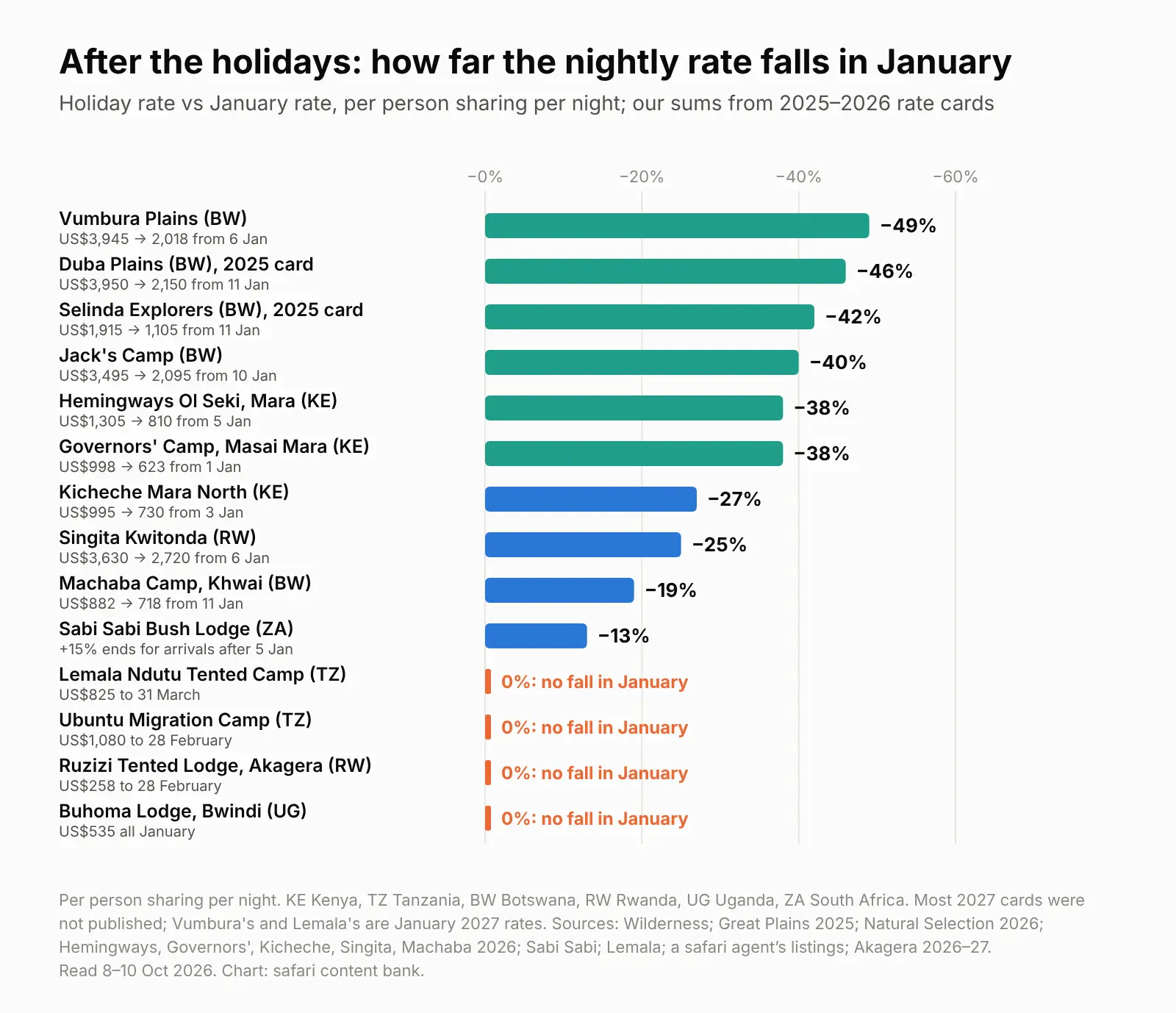 Our sums from each camp’s published rate card or agent listing (2025–2026; Vumbura’s and Lemala’s January 2027 rates), read 8–10 October 2026. Chart: safari content bank.
Kenya: half the Mara fee, a quieter reserve
Kenya in January means resident Mara game without the migrating herds, camp rates back below their holiday level, and, on the last published schedule, the Mara reserve fee at US$100 instead of US$200.
- The Mara fee halves on 1 January on the last published schedule: US$100 per non-resident adult per day from 1 January to 30 June, against US$200 from 1 July to 31 December (Narok County FY2025/26). That schedule expired on 30 June 2026, and no schedule covering January 2027 had been published by 9 October 2026. Check the January 2027 fee before you book. Detail: Masai Mara park fees.
- Wildlife: the Masai Mara has resident game in January–March, not the migrating herds (a camp operator’s Mara vs Serengeti guide). The smaller, separate Loita herd moves into Ol Kinyei Conservancy “usually by January” and calves there in February–March (Masai Mara). Destination experts on the TripAdvisor Kenya forum call January–February “uncrowded on sightings” (traveller forum).
- Camp rates after the holidays: Governors’ Camp charges US$998 per person a night from 21 to 31 December and US$623 from January to March, and its exclusive vehicle falls from US$512 to US$385 a day (Governors’ 2026, PDF). Kicheche Mara North charges US$995 to 2 January and US$730 from 3 January to 28 February (Kicheche 2026, PDF), and Hemingways Ol Seki US$1,305 to 4 January and US$810 from 5 January (Hemingways 2026, PDF). These are the 2026 cards; the 2027 sheets were not published when we checked.
- In the fee, a conservancy night costs more than a reserve day from January to June: US$130 per adult per night in a Mara conservancy against US$100 a day in the reserve (Mara reserve vs conservancies).
- Rain: the Mara averages 95 mm in January, against 115 mm in December (Climates to Travel, an aggregator). Amboseli averages 45 mm, with highs of 30 °C and lows of 15 °C, and Ol Tukai Lodge charges US$290 in January–March (Amboseli). KWS parks charge US$90 per non-resident adult per 24 hours, US$45 for a child under 18, 5 and under free, with no seasons (KWS Legal Notice 160 of 2025).
- Entry: the eTA costs US$30, and since 5 October 2026 (U.S. Embassy Nairobi) arrivals have needed a government health policy, up to US$44 (eCitizen) (Kenya visitor insurance).
Full costs: Kenya safari cost, Masai Mara safari cost; the country hub: Kenya.
Tanzania: the herds settle at Ndutu before calving
Tanzania is the migration country in January: the herds are on the southern plains, the first calves are born, and calving builds to its peak in February. The calving camps do not drop their rates after New Year.
- Where the herds are: on the southern plains, around Ndutu in the Ngorongoro Conservation Area and on the Serengeti’s Naabi, Kusini and Moru plains, with the first calves and thunderstorms (a camp operator’s migration guide). Calving runs from late January to mid-March and peaks in February, compressed into two to three weeks; one safari operator’s guide says most calves are born “in a short window around February” (Great Migration month by month). No source dates the peak for a given year.
- Ndutu is in the Ngorongoro Conservation Area, not the Serengeti, so NCAA fees apply there: US$70.80 entry per 24 hours and US$59 concession per person per night at Ndutu lodges, with no low season (NCAA, read 9 October 2026). Inside the Serengeti a January night costs US$141.60 per adult: entry US$82.60 plus concession US$59 (last published tariff, 2023/24), unchanged until 14 March. Detail: Serengeti park fees, Ngorongoro and Ndutu fees.
- No post-holiday fall at the calving camps: Lemala Ndutu Tented Camp charges US$825 per person a night from 20 December 2026 to 31 March 2027, guide and vehicle extra (Lemala rates); Ndutu Safari Lodge US$451 from 15 December to 31 March and Ubuntu Migration Camp US$1,080 from 20 December to 28 February (a safari agent’s listing). Lake Masek Tented Camp charges its peak US$545 from January to March. The migration camps we checked charge the same in January–February as in July–October (Great Migration safari cost).
- Elsewhere in the Serengeti the year turns on 6 January: Singita’s 2026 sheet runs from 6 January 2026 to 5 January 2027, and its low season from 6 January to 15 May (Faru Faru, Sabora, Explore US$2,210 in 2026); its Mara River Tented Camp in the far north is closed from 15 January to 31 May (Singita Serengeti 2026, PDF). The 2027 sheet was not in our sources. Serengeti Wilderness Camp, east of Seronera, is listed at US$400 in January–February (an agent’s listing; Serengeti).
- Getting there: Coastal Aviation’s link from Tarime to the Serengeti runs from 16 December to 31 March (Mara to Serengeti). A self-drive operator’s guide says to allow about 30 minutes at the Ngorongoro gate and 30 at the Serengeti gate in December–January. andBeyond Ngorongoro Crater Lodge is closed for a rebuild, with reopening expected in January 2027 (Ngorongoro).
- Beach extension: Zanzibar averages 85 mm in January, a month our Tanzania safari and Zanzibar page rates good but hot.
- Entry: a tourist visa costs US$50 (US citizens US$100), and mainland Tanzania’s government travel insurance costs US$44 per adult as of October 2026, for foreign visitors except EAC and SADC residents (Tanzania visitor insurance).
Full costs: Tanzania safari cost, Great Migration safari cost; hubs: Tanzania, Serengeti, Ngorongoro.
Botswana: green rates from 10 January, zebra on the pans
Botswana in January is green season: the rain falls, the Okavango’s water is low, the zebra are on the Kalahari pans, and camp rates fall to their lowest of the year from 10–11 January.
- Green rates start after the holidays: Natural Selection’s High season runs 20 December–9 January and its Green season 10 January–31 March; Jack’s Camp goes from US$3,495 to US$2,095 per person a night and Camp Kalahari charges US$795 (NS 2026, PDF). Great Plains charges Peak to 10 January and Green from 11 January (Duba Plains US$3,950 → US$2,150, Selinda Explorers US$1,915 → US$1,105, 2025 card, PDF). Machaba Camp moves from Shoulder US$882 to its “Secret” US$718 on 11 January (Machaba 2026), and Wilderness’s Vumbura Plains from US$3,945 (20 December–5 January) to US$2,018 for January–March 2027 (Wilderness, Vumbura Plains).
- Single travellers: Natural Selection waives its single supplement from 10 January to 31 March (single supplements and child rates).
- Zebra on the pans: zebra are at Nxai Pan from December to February and on the Makgadikgadi from December or January to February or March (Makgadikgadi). Natural Selection’s San Camp in the Makgadikgadi is closed until 31 March (open 1 April–15 October, NS 2026, PDF).
- The Delta is low: rain on the Angolan highlands that feeds the flood is heaviest about January, but the water in the Delta is low, and seasonal camps run no boats in January and February (Africa Geographic; two camp operators’ seasonal guides). The flood reaches the Delta later in the year: Okavango flood calendar.
- Chobe: Chobe Safari Lodge in Kasane charges US$500 from January to March 2026 against US$550 from April, park fees included, and the Chobe Princess houseboat R10,896 per person a night from 1 December 2026 to 28 February 2027 against R13,432 from March to November (Chobe).
- Park rules bind every camp in Moremi Game Reserve. Mombo is on Chief’s Island, inside the reserve, where Botswana Tourism says night driving is prohibited (Moremi).
- Park fees: no official current tariff. The last published DWNP schedule (1 April 2022) charges P270 per non-resident adult a day in Chobe and Moremi and P190 in Nxai Pan, the Makgadikgadi and the Central Kalahari; in February 2026 the government news agency called the existing fee P380, and a P500 rise was announced, then reported postponed (Botswana park fees). Fly-in camp rates usually include park fees.
- Malaria: TravelHealthPro rates northern Botswana, including the Okavango, high from October to May (TravelHealthPro, Botswana).
Full costs: Botswana safari cost, Okavango Delta safari cost; hubs: Botswana, Okavango Delta, Chobe.
South Africa: Kruger at R692, high season to 15 January
Kruger in January is wet, hot and green; the fee is R692 per international adult in January 2027, and SANParks’ high season runs to mid-January.
- The fee: Kruger’s daily conservation fee for an international adult is R692 (R602 until 31 October 2026); children aged 2–11 pay R345 (R300 until 31 October 2026) (SANParks 2025/26, PDF; 2026/27, PDF). In January 2027 the R692 rate applies: the 2026/27 schedule runs to 31 October 2027. Detail: Kruger park fees.
- Season: October to March is Kruger’s wet season, “hot and green”; April to September is the dry season and the easiest time to see animals (SANParks climate).
- Rest-camp seasons: SANParks’ high season ran from 13 December to 15 January in its 2024/25 tariff, and the low season from 16 January to 19 March, when a Skukuza campsite cost R368 a night against R480 in high season (SANParks Tariffs 2024/25, PDF). SANParks had not published its 2026/27 accommodation tariff when we checked on 1 November 2026, so confirm the price when you book. Those are the latest tariff dates we hold.
- Private reserves: Sabi Sabi charges one rate, R29,600 per person a night at Bush Lodge, plus 15% for arrivals from 20 December to 5 January (Sabi Sabi). In the Eastern Cape, January is high season: Kwandwe charges R26,180 from 1 October 2026 to 30 April 2027 (Kwandwe 2026–27, PDF).
- Long days: entrance gates open 05:30–18:30 from November to February, and camp gates open at 04:30 from November to January (SANParks gates).
- Malaria: SANParks puts Kruger’s highest risk in November–April and calls it “generally low, even in summer” (SANParks malaria). Reserves outside the malaria area: malaria-free safaris in South Africa.
Full costs: South Africa safari cost, Kruger safari cost; hubs: South Africa, Kruger.
Namibia: rain at Etosha, green rates in the desert
Namibia in January is low season and the start of the main rains at Etosha: game disperses, park fees stay the same, and several desert lodges switch to green rates on 10–11 January.
- Rain and game: Tsumeb, near Etosha, averages 120 mm in January and 80–140 mm a month from January to March, with highs up to 31 °C; January to March are Etosha’s poorest months for game, as animals spread out to temporary pans (Etosha; Climates to Travel, Namibia, an aggregator). Okaukuejo’s gates close at 19:40 in January (an independent guide site).
- Rates: NWR’s low season runs November–June: Okaukuejo N$1,900 bed and breakfast and Sossus Dune Lodge N$4,030 dinner, bed and breakfast, per person (a booking agent’s listing, read 17 October 2026). Natural Selection’s Kwessi Dunes goes to its green rate, N$10,845, on 10 January (2026 card), and Wolwedans’ green season starts on 11 January: from 11 January 2027 Desert Lodge and Dune Camp cost N$14,900 per person sharing, plus a N$1,680 levy per adult (Wolwedans 2027, PDF; Sossusvlei safari cost).
- Closures and limits: Wolwedans Desert Lodge was closed in green season, 11 January–31 March 2026; Natural Selection’s Hoanib Elephant Camp and Nkasa Linyanti close in green season (green-season safari). No balloon flights run at Sossusvlei from 15 January to 15 February (a Namibia travel-booking site’s ballooning page), and Nkasa Rupara and Khaudum roads can be impassable from November to April (a safari booking site).
- Fees: N$280 per foreign adult at Etosha, Sossusvlei and the other Tier 1 parks, with no seasons (Government Notice 115 of 2026; Namibia park fees).
- Malaria: northern Namibia, including Etosha and the Zambezi region, has its malaria season in the rains, November–April (a safari booking site).
Full costs: Namibia safari cost; hubs: Namibia, Etosha, Sossusvlei.
Zambia and Zimbabwe: peak rains, most bush camps shut
Zambia and Zimbabwe are the weakest January choices for a classic bush-camp safari: South Luangwa’s bush camps and most Mana Pools camps are closed, and Hwange’s game disperses in the rains. The camps that stay open charge their lowest rates.
- South Luangwa: the rains peak from January to March; most lodges and bush camps are closed and walking is impractical, while a few Mfuwe-area lodges run boat trips on the swollen river (South Luangwa). Time + Tide’s bush camps open only from 20 May to 15 November, Robin Pope Safaris opens Nsefu Camp in February and March, and Flatdogs Camp closes from 16 January to 14 March. Chinzombo stays open at its green rate, US$1,330, from January to June on Time + Tide’s 2027 card (Time + Tide). Mfuwe Lodge charges US$565 in its green season (1 January–31 May) on The Bushcamp Company’s 2026 sheet, which its 2027 sheet replaces on 1 January 2027 (Bushcamp Company 2026, PDF).
- Elsewhere in Zambia: Lower Zambezi’s Chiawa and Old Mondoro close from mid-November to April, and Kafue’s Busanga Plains camps open only from June to the end of October. Fees: South Luangwa US$25 per international adult a day (DNPW 2025 schedule, the last published). Nationalities that need a visa pay US$50 for a single entry since 1 January 2026; UK, US, Canadian, Australian and EU passport holders need none (Zambia safari cost).
- Zimbabwe: most Mana Pools camps close from December to March, when the black-cotton soil becomes impassable (one operator’s Mana Pools guide). Hwange’s camps stay open at their lowest rates: Camp Hwange US$550 a night in January–March 2026 against US$1,080 in July–October, and Bomani Tented Lodge US$445 (an agent’s listings), but game disperses in the rains and one safari operator advises avoiding January to March (Hwange). Hwange’s conservation fee is US$24 a day for a day visitor and US$12 staying inside the park; Mana Pools is US$24 (ZimParks Tariff 2026; Zimbabwe safari cost).
- Victoria Falls in January: January is the last of the low-water months (September–January): the flow is rising and the curtain building, and the flood runs from February to May (Victoria Falls). The Rainforest entrance costs US$58 per international adult (ZimParks Tariff 2026). Zimbabwe has charged 15.5% VAT on tourism services for foreign visitors since 1 January 2026 (Tourism Update, 6 October 2026, a single press source).
- Malaria: one UK safari operator says malaria is present across Zambia and all year in the valleys; a Zimbabwe travel site names Victoria Falls, Kariba and the Zambezi Valley, with the highest risk from November to May. We have read no official source for either country (Zambia safari questions, Zimbabwe safari questions).
Uganda and Rwanda: gorillas in a drier spell
January is one of the better gorilla months in both countries: a safari booking site rates Bwindi “Excellent” in January, and Rwanda is in its short dry season. It is not a cheap month in Uganda, and Uganda’s other primate permits rise on 1 January 2027.
- Trekking conditions: the drier months in Bwindi are about June–September and December–February (one operator’s guide), and Bwindi averages 7 to 20 °C (UWA). Treks go ahead in rain, with no refund for weather in Bwindi (a safari booking site), and Rwanda’s official kit list is built around mud, stinging nettles and rain: solid boots with gaiters, long clothing, gloves and a light rain jacket (Visit Rwanda). More on the day itself: gorilla trekking day.
- Uganda’s permit is US$800 in January, and stays US$800 from 1 January 2027; the US$600 low-season permit applies only in April, May and November and cannot be rescheduled (UWA letter TDO 93/04, PDF). Buhoma Lodge charges its top US$535 per person a night in January (a safari agent’s listing).
- New Uganda prices from 1 January 2027: Kibale chimpanzee tracking rises from US$250 to US$300, Kyambura Gorge from US$100 (plus US$40 park entry) to US$200, and the 4-hour gorilla habituation experience from US$1,500 to US$1,800 (UWA; Uganda safari cost, chimpanzee trekking permits).
- Rwanda: January–February is the short dry season (Volcanoes). The gorilla permit is US$1,500, or US$1,050 (30% off, our sum) from November to May with two nights in Akagera or Nyungwe (RDB). Two nights’ Akagera entry costs an international adult US$150, so the discounted permit plus the Akagera entry comes to US$1,200 (our sum).
- Lodges: Rwanda’s park-run lodges stay in high season from 15 December to 28 February; Ruzizi Tented Lodge in Akagera charges US$258 (Ruzizi 2026–2027, PDF). Singita Kwitonda falls from US$3,630 to US$2,720 per adult a night on 6 January (Singita 2026, PDF; Volcanoes).
- Malaria: the WHO lists malaria risk all year in the whole of Rwanda; we have read no official malaria source for Uganda (Rwanda safari questions, Uganda safari questions).
Full costs: Uganda safari cost, Rwanda safari cost, gorilla permit prices, Uganda or Rwanda for gorillas.
January park fees
One government fee falls on 1 January on its last published schedule, the Masai Mara’s, and Uganda’s chimp and habituation prices rise on 1 January 2027. Kruger’s January 2027 fee is R692; Tanzania’s parks, KWS parks, Namibia and the gorilla permits charge their normal rate.
| Park or permit | Fee per adult in January | Changes around January | Status and source |
|---|---|---|---|
| Maasai Mara National Reserve (Kenya), per day | US$100 (1 January–30 June) | US$200 to 31 December | Narok County FY2025/26, the last published; expired 30 June 2026, no schedule for January 2027 published by 9 October 2026 |
| Amboseli, Lake Nakuru (KWS), per 24 h | US$90; child under 18, 5 and under free, US$45 | No seasons | KWS Legal Notice 160 of 2025 |
| Serengeti (Tanzania), a night inside the park | US$141.60 (entry US$82.60 + concession US$59) | Unchanged until 14 March | Last published tariff, 2023/24 |
| Ndutu and the Ngorongoro Conservation Area | US$70.80 entry per 24 h + US$59 a night at Ndutu lodges | No seasons | NCAA tariffs page, undated, read 9 October 2026 |
| Tarangire, Lake Manyara, Arusha (Tanzania), per day | US$59 | Low fee (US$53.10) only 15 March–15 May | Last published tariff, 2023/24 |
| Kruger National Park (South Africa), per day | R692 | R692 (R602 until 31 October 2026) | SANParks 2025/26 and 2026/27 schedules |
| Chobe, Moremi (Botswana), per day | P270 (last published, 2022) | P380 called existing by BOPA; P500 reported postponed | DWNP via Tourism Update; no official current tariff |
| Nxai Pan, Makgadikgadi, Central Kalahari (Botswana), per day | P190 (last published, 2022) | As above | DWNP via Tourism Update; no official current tariff |
| Etosha, Sossusvlei (Namibia) | N$280 | No seasons | Government Notice 115 of 2026 |
| South Luangwa (Zambia), per day | US$25 | No seasons | DNPW 2025 schedule, the last published |
| Hwange; Mana Pools (Zimbabwe), per day | Hwange US$24 day visitor, US$12 staying inside; Mana Pools US$24 | No seasons | ZimParks Tariff 2026 |
| Uganda gorilla permit | US$800 | Unchanged from 1 January 2027; US$600 only in April, May and November | UWA letter TDO 93/04, 26 February 2026 |
| Kibale chimpanzee tracking (Uganda) | US$300 from 1 January 2027 | US$250 until 31 December 2026 | UWA letter TDO 93/04 |
| Rwanda gorilla permit | US$1,500; US$1,050 with an Akagera or Nyungwe stay (our sum) | Discount runs November–May | RDB, checked 9 October 2026 |
Fees copied from our Kenya, Tanzania, Botswana, Namibia, South Africa, Zambia, Zimbabwe, Uganda and Rwanda cost pages, read 17 October 2026. The whole year’s fee seasons are on green-season safari and Great Migration month by month.
The official fee lines, with the date each took effect and the authority’s own source:
| Fee | Amount | In force from | Source |
|---|---|---|---|
| Maasai Mara National Reserve, non-resident adult, per day (12-hour ticket, 06:00–18:00), 1 Jan–30 Jun | USD 100 | Since 1 Jan 2024; Narok County FY2025/26 schedule, the last published | Narok County fee schedule FY2025/26 |
| Amboseli and Lake Nakuru National Parks (KWS), non-resident adult, per 24 hours | USD 90 (child under 18, 5 and under free, USD 45) | Legal Notice 160 of 2025, gazetted 22 Sep 2025, which states no start date; in force 1 Oct 2025 per the KWS press release of 29 Sep 2025 | KWS Fees Regulations 2025 (LN 160/2025) |
| Serengeti and Nyerere National Parks, non-East African adult, entry per day, 16 May–14 Mar | USD 70 + 18% VAT = USD 82.60 | 1 Jul 2023 (2023/24 tariff, last published) | TANAPA Tariffs 2023/24 |
| Serengeti and Nyerere, concession fee per person per night inside the park | Jul–Sep USD 60 + VAT = USD 70.80; Oct–Jun USD 50 + VAT = USD 59 | 1 Jul 2023 (2023/24 tariff, last published) | TANAPA Tariffs 2023/24 |
| Tarangire, Lake Manyara and Arusha National Parks, non-East African adult, entry per day | Peak USD 50 + VAT = USD 59; low USD 45 + VAT = USD 53.10 | 1 Jul 2023 (2023/24 tariff, last published) | TANAPA Tariffs 2023/24 |
| Ngorongoro Conservation Area, non-East African adult, entry per 24 h (single entry) | USD 70.80 (NCAA's page does not say whether VAT is included) | Undated official page, read 9 Oct 2026 | NCAA |
| Ngorongoro concession fee, rim and Ndutu lodges, per person per night | USD 59 (NCAA's page does not say whether VAT is included) | Undated official page, read 9 Oct 2026 | NCAA |
| Chobe National Park and Moremi Game Reserve (DWNP), non-resident adult, per person per day | BWP 270 (SADC residents BWP 205; Botswana citizens and residents BWP 30) | Last published DWNP schedule, 1 April 2022 (via Tourism Update). In Feb 2026 the government news agency BOPA called the existing non-resident fee P380; a P500 rise was announced, then reported postponed. No official current tariff: confirm with DWNP or your operator | Tourism Update, 23 Feb 2022 (DWNP fee schedule) |
| Other DWNP parks and reserves (Central Kalahari Game Reserve, Khutse, Nxai Pan, Makgadikgadi Pans), non-resident adult, per person per day | BWP 190 (SADC residents BWP 145; Botswana citizens and residents BWP 20) | Last published DWNP schedule, 1 April 2022 (via Tourism Update). In Feb 2026 the government news agency BOPA called the existing non-resident fee P380; a P500 rise was announced, then reported postponed. No official current tariff: confirm with DWNP or your operator | Tourism Update, 23 Feb 2022 (DWNP fee schedule) |
| Tier 1 parks (Etosha, Namib-Naukluft including Sossusvlei, Skeleton Coast, Ai-Ais/Fish River Canyon, Waterberg Plateau, Cape Cross, Dorob, Tsau //Khaeb), foreign adult 16+, per person | NAD 280 (NAD 140 park entrance + NAD 140 conservation fee) | 1 Apr 2026 (Government Notice 115 of 2026; the notice prices fees per person with no period; MEFT's 2021 schedule made fees valid for 24 hours from entry); was NAD 150 under the 2021 schedule | Government Gazette 8877 (Government Notice 115 of 2026), hosted by the Legal Assistance Centre |
| Kruger National Park daily conservation fee, international adult (12+), per day | ZAR 602 | 1 Nov 2025 to 31 Oct 2026 (SANParks 2025/26 schedule) | SANParks daily conservation fees 2025/26 |
| Kruger National Park daily conservation fee, international adult (12+), per day | ZAR 692 | 1 Nov 2026 to 31 Oct 2027 (SANParks 2026/27 schedule, already published) | SANParks daily conservation fees 2026/27 |
| South Luangwa and Lower Zambezi National Parks (DNPW Category A), international adult, entry per day (06:00–18:00) | USD 25 (SADC and resident USD 20; Zambian citizen ZMW 55.60); child 5–13 half price, under 5 free | DNPW 2025 schedule ("official 2025 rates"), the last published; page last modified 8 May 2025, still shown 9 Oct 2026 | DNPW 2025 fee schedule, as shown on a Zambia travel portal |
| Hwange National Park, Main Camp (row as labelled in the ZimParks 2026 tariff), international adult, conservation fee per day | USD 24 day visitor; USD 12 if staying overnight in the park (SADC USD 18 / 10; local USD 5 / 3) | ZimParks Tariff 2026 (tariff year 2026, published February 2026); the conservation-fee table does not say whether VAT is included; Robins, Sinamatella and Kazuma Pan are not listed separately in our sources | ZimParks De-Gazetted Tariff 2026 |
| Mana Pools National Park, Sapi and Chewore, international adult, conservation fee per day | USD 24, day visitor or staying overnight (SADC USD 18; local USD 8) | ZimParks Tariff 2026 (tariff year 2026, published February 2026); the conservation-fee table does not say whether VAT is included | ZimParks De-Gazetted Tariff 2026 |
| Victoria Falls Rainforest (Zimbabwe), main gate, international adult, per entry | USD 58 (SADC USD 35; local USD 7) | ZimParks Tariff 2026 (tariff year 2026, published February 2026); the fee table does not say whether VAT is included | ZimParks De-Gazetted Tariff 2026 |
| Uganda: gorilla tracking permit, Bwindi Impenetrable and Mgahinga Gorilla NPs, foreign non-resident, per person per trek (guide and that day's park entry included) | USD 800 (foreign resident USD 700; rest of Africa USD 500; East African citizens UGX 300,000) | Since 1 Jul 2024 (UWA tariff 2024–26); confirmed unchanged from 1 Jan 2027 by UWA letter TDO 93/04 of 26 Feb 2026 | UWA letter TDO 93/04, 26 Feb 2026 |
| Uganda: chimpanzee tracking, Kibale NP, foreign non-resident (park entry included) | USD 250; USD 200 in April, May and November; USD 300 from 1 Jan 2027 | Tariff July 2024–June 2026; low-season rate from 26 Feb 2026; new rate 1 Jan 2027 | UWA letter TDO 93/04, 26 Feb 2026, and UWA tariff 2024–26 |
| Rwanda: mountain gorilla tracking permit, Volcanoes NP, international visitor, per person per day | USD 1,500 | Current RDB price, checked 9 Oct 2026 | Visit Rwanda (Rwanda Development Board) |
| Akagera National Park, international adult, park entry per person | USD 100 for one night or day; USD 150 for two nights; USD 200 for three (child 6–12: USD 50 / 75 / 100; under 6 free) | 2025 price list, the latest we found (checked 8 Oct 2026) | African Parks, Akagera NP price list 2024 |
| Rwanda: gorilla permit low-season discount, November–May, with two nights in Akagera or Nyungwe (paid hotel receipt and one paid activity) or one night in each | 30% off (USD 1,050, our sum); one discounted permit per person per 3-day/2-night stay | November–May; conditions checked 9 Oct 2026 | RDB booking portal, low-season discount |
When holiday rates end, camp by camp
Most camps that charge a holiday rate end it between 1 and 11 January, and Botswana’s camps then drop to their lowest rate of the year; the Ndutu calving camps and Rwanda’s park lodges keep their high rate into February or March. Check the night your stay starts: one night either side of a switch can change the price by a third or more.
| Camp or group (country) | Holiday rate | January rate | Switch date | Rate card |
|---|---|---|---|---|
| Governors’ Camp, Masai Mara (Kenya) | US$998 (21–31 December) | US$623 | 1 January | Governors’ 2026 (PDF) |
| Kicheche Mara North (Kenya) | US$995 (20 December–2 January) | US$730 | 3 January | Kicheche 2026 (PDF) |
| Hemingways Ol Seki, Naboisho (Kenya) | US$1,305 (18 December–4 January) | US$810 | 5 January | Hemingways 2026 (PDF) |
| Lemala Ndutu Tented Camp (Tanzania) | US$825 | US$825, no fall | To 31 March 2027 | Lemala |
| Ndutu Safari Lodge (Tanzania) | US$451 | US$451, no fall | To 31 March | A safari agent’s listing |
| Ubuntu Migration Camp (Tanzania) | US$1,080 | US$1,080, no fall | To 28 February | A safari agent’s listing |
| Singita Kwitonda, Volcanoes (Rwanda) | US$3,630 (from 15 December) | US$2,720 | 6 January | Singita 2026 (PDF) |
| Ruzizi Tented Lodge, Akagera (Rwanda) | US$258 | US$258, no fall | To 28 February | Ruzizi 2026–2027 (PDF) |
| Vumbura Plains, Wilderness (Botswana) | US$3,945 (20 December–5 January) | US$2,018 (January–March 2027) | 6 January | Wilderness |
| Jack’s Camp, Natural Selection (Botswana) | US$3,495 (High, 20 December–9 January) | US$2,095 (Green) | 10 January | NS 2026 (PDF) |
| Duba Plains, Great Plains (Botswana) | US$3,950 (Peak, 20 December–10 January) | US$2,150 (Green) | 11 January | Great Plains 2025 (PDF) |
| Machaba Camp, Khwai (Botswana) | US$882 (Shoulder, no holiday rate) | US$718 (Secret) | 11 January | Machaba 2026 |
| SANParks rest camps, Kruger (South Africa) | High season, 13 December–15 January | Low season | 16 January | SANParks Tariffs 2024/25 (PDF) |
| Sabi Sabi Bush Lodge (South Africa) | R29,600 + 15% (arrivals 20 December–5 January) | R29,600 | Arrivals from 6 January | Sabi Sabi |
| Buhoma Lodge, Bwindi (Uganda) | US$535 | US$535, no fall | All January and February | A safari agent’s listing |
Per person sharing per night unless marked. What a rate includes differs: Kenyan rates exclude park and conservancy fees; Botswana’s fly-in rates include park fees; Lemala’s exclude guide and vehicle. Read 8–10 October 2026. Most camps had not published 2027 cards: the January rates for Governors’, Kicheche, Hemingways, Singita, Natural Selection and Machaba are from their 2026 cards, Great Plains’ from its 2025 card and SANParks’ dates from its 2024/25 tariff.
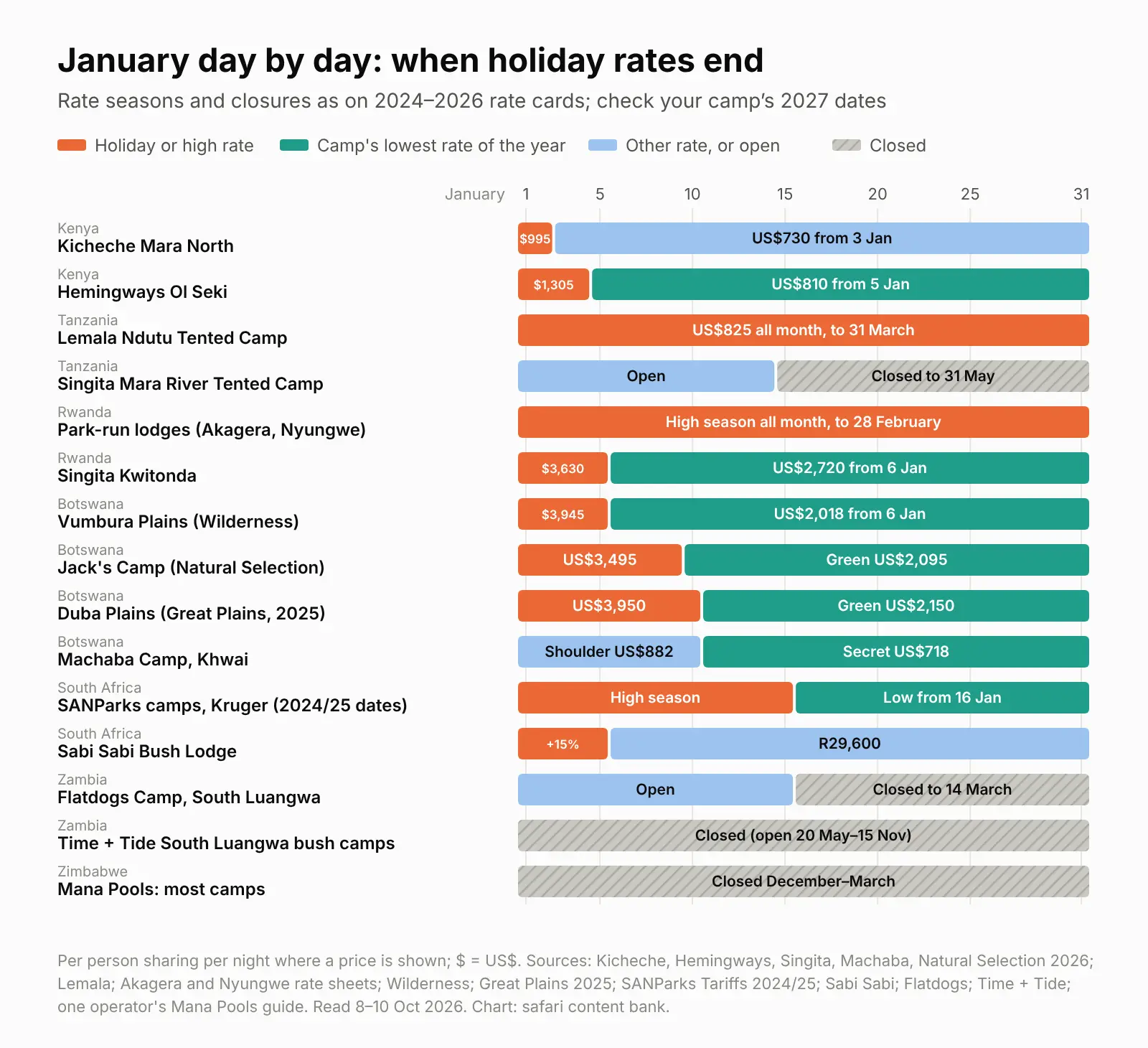 Sources: Kicheche, Hemingways, Singita, Machaba and Natural Selection 2026 cards; Lemala; Akagera and Nyungwe rate sheets; Wilderness; Great Plains 2025; SANParks Tariffs 2024/25; Sabi Sabi; Flatdogs; Time + Tide; one operator’s Mana Pools guide. Read 8–10 October 2026. Chart: safari content bank.
See also: Christmas safari.
Which camps are closed in January
Closures in January are a southern African matter: South Luangwa, the Lower Zambezi and Mana Pools lose most of their camps, and a few camps in Tanzania, Botswana and Namibia close for the rains. We found no Kenyan camp closed in January; Kenya’s closures fall in April–May.
| Area (country) | Closed in January | Dates | Source |
|---|---|---|---|
| South Luangwa (Zambia) | Time + Tide bush camps; Nsefu Camp (opens in February); Flatdogs Camp from 16 January | Time + Tide open 20 May–15 November; Flatdogs closed 16 January–14 March | South Luangwa |
| Lower Zambezi and Kafue (Zambia) | Chiawa, Old Mondoro; Busanga Plains camps | Mid-November–April; Busanga open June–end of October | Zambia safari cost |
| Mana Pools (Zimbabwe) | Most camps | December–March | One operator’s Mana Pools guide |
| Northern Serengeti (Tanzania) | Singita Mara River Tented Camp | 15 January–31 May (2026 sheet) | Singita Serengeti 2026 (PDF) |
| Ngorongoro crater rim (Tanzania) | andBeyond Ngorongoro Crater Lodge, rebuild | Reopening expected January 2027 | Ngorongoro |
| Makgadikgadi (Botswana) | Natural Selection’s San Camp | Open only 1 April–15 October | NS 2026 (PDF) |
| Okavango Delta (Botswana) | Boat trips at seasonal-floodplain camps; Natural Selection’s Skybeds | No boats January–February; Skybeds open 1 April–31 October | Two camp operators’ seasonal guides; green-season safari |
| NamibRand and the north (Namibia) | Wolwedans Desert Lodge; Natural Selection’s Hoanib Elephant Camp and Nkasa Linyanti | Wolwedans Desert Lodge closed 11 January–31 March 2026 (its 2027 card prices it in green season); the Natural Selection camps close in green season | green-season safari |
| Sossusvlei (Namibia) | Balloon flights | 15 January–15 February | A Namibia travel-booking site’s ballooning page |
Read 8–10 October 2026. Closure dates for 2027 were not published for every camp; ask your camp before you book.
Package prices in January
One Kenya safari company’s published fly-in packages cost about a fifth less from 3 January 2027 than over the holidays (our sum). Operators are not named here; the ranges are their published prices.
| Package type | Holiday departures | January–March 2027 | Source |
|---|---|---|---|
| Kenya fly-in conservancy safaris, 10–11 nights, internal flights and park and conservancy fees included | US$10,195 per person sharing (11 nights, 20 December–2 January) | US$7,400–7,915 per person sharing; the 11-night package 22% less than over the holidays, our sum | One Kenya safari company’s 2026–27 published prices, read 8 October 2026 |
Package prices per person, read 8 October 2026; names and links in our editor notes. Compare inclusions line by line: what each covers differs.
- Entry costs come on top of every package: Kenya’s eTA is US$30 plus a government health policy of up to US$44 (eCitizen) (Kenya visitor insurance); Tanzania’s visa is US$50 plus US$44 government insurance per adult as of October 2026 (Tanzania visitor insurance).
- Southern Africa’s cheaper January is in the camp rate, not the fee: see the camp table above, and green-season safari for the whole green season.
Worked examples: what the January dates do to the bill (our sums)
The same three nights cost 38% less at Governors’ Camp and 39% less at Jack’s Camp after the holiday switch, fees included, and nothing less at Lemala Ndutu (our sums from the rates and fees above). Flights, tips, drinks and the guide and vehicle are left out.
| Trip | Over the holidays | In January | Difference |
|---|---|---|---|
| Couple, 3 nights at Governors’ Camp, with 3 days’ Mara reserve fee and the US$50 community fee | 21–31 December: 2 × 3 × (US$998 + US$200 + US$50) = US$7,488 | 2 × 3 × (US$623 + US$100 + US$50) = US$4,638, if the 2026 rate and the last published fee carry over | US$2,850 |
| Couple, 3 nights at Jack’s Camp, with the US$60 community, conservation and reserve fee (park fees included in the rate) | 1–9 January: 2 × 3 × (US$3,495 + US$60) = US$21,330 | From 10 January: 2 × 3 × (US$2,095 + US$60) = US$12,930 | US$8,400 |
| Couple, 3 nights at Lemala Ndutu, with NCAA entry and concession (US$129.80 a night) | 20–31 December: 2 × 3 × (US$825 + US$129.80) = US$5,728.80 | Same: US$5,728.80 | US$0 |
| Two adults, 3 days in Kruger, park fee only | — | January 2027: 2 × 3 × R692 = R4,152 (January 2026 at R602: R3,612) | R540 more than a year earlier |
| Two Kibale chimp permits (Uganda) | December 2026: 2 × US$250 = US$500 | January 2027: 2 × US$300 = US$600 | US$100 more |
Governors’ rates exclude park and community fees; Lemala’s exclude guide and vehicle; Natural Selection’s include park entry fees and exclude its US$60 fee. Mara fee: Narok County FY2025/26, the last published schedule. NCAA fees from the undated NCAA tariffs page, read 9 October 2026.
Malaria and rain in January
January falls in the rains and the malaria peak across southern Africa, and between the two rainy seasons in East Africa, where malaria risk runs all year. Take medical advice for your dates and route; this page gives no tablet advice.
| Area | January rain | Malaria in January | Source |
|---|---|---|---|
| Masai Mara (Kenya) | 95 mm | Risk all year in the entire country; low only in Nairobi and above 2,500 m | Climates to Travel (aggregator); WHO ITH country list 2022 (PDF) |
| Amboseli (Kenya) | 45 mm | As above | Climates to Travel; WHO |
| Serengeti and Ndutu (Tanzania) | Thunderstorms; no January figure in our sources | Risk all year below 1,800 m | A camp operator’s migration guide; WHO |
| Zanzibar (Tanzania) | 85 mm | As above | Tanzania safari and Zanzibar |
| Kruger (South Africa) | Wet season; Skukuza 635 mm a year | Highest risk November–April, “generally low, even in summer” | SANParks malaria |
| Okavango and Chobe (Botswana) | Rains November–March; no monthly figure in our sources | High October–May | TravelHealthPro |
| Etosha (Namibia) | Tsumeb 120 mm | Rainy-season risk, November–April | Climates to Travel; a safari booking site |
| South Luangwa (Zambia) | Peak rains, January–March; no monthly figure | Present across Zambia, all year in the valleys (one UK operator; no official source read) | South Luangwa |
| Hwange, Victoria Falls (Zimbabwe) | Rains November–March | Highest November–May in the Zambezi Valley and Victoria Falls (a Zimbabwe travel site; no official source read) | Zimbabwe safari questions |
| Bwindi (Uganda) | Drier months, about December–February; 7–20 °C | No official source read | One operator’s guide; UWA |
| Volcanoes (Rwanda) | Short dry season | Risk all year in the whole country | WHO |
Read 8–10 October 2026. No national weather service’s monthly normals are in our sources.
- Wet-season roads can be slow. A traveller in the southern Serengeti in March 2026 wrote “We were stuck 11 times in 7 days” (TripAdvisor forum, traveller report); our sources hold no January road reports.
- More on the rainy months, and what they save: green-season safari.
Common mistakes about a January safari
| What you’ll often read | What is correct |
|---|---|
| “Holiday rates end on New Year’s Day” | At the camps we checked they end between 1 and 15 January: Kicheche on 3 January, Singita Kwitonda and Vumbura Plains on 6 January, Natural Selection on 10 January, Great Plains on 11 January, SANParks after 15 January. |
| “January is cheap everywhere” | Not at the calving camps. Lemala Ndutu charges US$825 a night from 20 December 2026 to 31 March 2027, and the migration camps we checked charge the same in January–February as in July–October. |
| “Calving peaks in January” | The first calves are born in January; calving peaks in February, in two to three weeks, around Ndutu. |
| “January is dry in East Africa” | It is drier, not dry. The Masai Mara averages 95 mm in January and Amboseli 45 mm, and the southern Serengeti plains get thunderstorms. |
| “Kruger’s fee is R602” | Kruger’s fee is R692 (R602 until 31 October 2026), so January 2027 costs R692 per international adult a day. |
| “The Okavango is flooded in January” | The Delta’s water is low in January; seasonal camps run no boats in January and February. |
| “Gorilla permits are cheaper in January” | Uganda’s is US$800; the US$600 rate is only for April, May and November. Rwanda’s US$1,050 rate needs a stay in Akagera or Nyungwe. |
| “The Mara’s January 2027 fee is confirmed at US$100” | It is the rate on the last published schedule, which expired on 30 June 2026; no schedule covering January 2027 had been published by 9 October 2026. |
Frequently asked questions
Is January a good month for a safari? Yes, for the southern Serengeti and Ndutu, gorilla trekking and Botswana’s Kalahari pans. Rates fall after the holidays at most camps, but the rains are falling across southern Africa, and South Luangwa’s bush camps and most Mana Pools camps are closed. For a first safari aimed at waterhole game, the dry season is the better choice: see best time for a safari.
Where is the Great Migration in January? On the southern plains, around Ndutu and the Serengeti’s Naabi, Kusini and Moru plains, where the first calves are born (a camp operator’s migration guide). Calving peaks in February. There are no river crossings in January; see Great Migration month by month.
When do Christmas safari rates end? Between 1 and 15 January at the camps we checked: Governors’ Camp on 1 January, Kicheche on 3 January, Hemingways on 5 January, Singita Kwitonda and Vumbura Plains on 6 January, Natural Selection on 10 January, Great Plains on 11 January and SANParks’ high season after 15 January (2024–2026 cards and tariffs). The Ndutu calving camps and Rwanda’s park lodges keep their high rate into February or March.
Is January dry in East Africa? Drier, not dry. January falls between the short and the long rains in Kenya, with 95 mm in the Masai Mara and 45 mm at Amboseli (Climates to Travel, an aggregator), and the southern Serengeti plains get thunderstorms. Rwanda is in its short dry season, and Uganda’s drier months run about December–February.
What is the Kruger park fee in January 2027? R692 per international adult per day. Kruger’s fee is R692 (R602 until 31 October 2026), and the 2026/27 schedule runs to 31 October 2027. Two adults spending 3 days pay R4,152 in fees (our sum).
How much is the Masai Mara fee in January 2027? On Narok County’s last published schedule (FY2025/26), US$100 per non-resident adult per day from 1 January to 30 June. That schedule expired on 30 June 2026 and no schedule covering January 2027 had been published by 9 October 2026, so check before you book. A Mara conservancy charges US$130 per adult per night instead.
Can you go gorilla trekking in January? Yes: a safari booking site rates Bwindi “Excellent” in January, and Rwanda is in its short dry season. Uganda’s permit costs US$800 (the US$600 rate is only for April, May and November), and Rwanda’s US$1,500, or US$1,050 with two nights in Akagera or Nyungwe. Treks go ahead in rain.
Which safari camps are closed in January? Time + Tide’s South Luangwa bush camps, Nsefu Camp until February and Flatdogs from 16 January; Lower Zambezi’s Chiawa and Old Mondoro; most Mana Pools camps; Singita’s Mara River Tented Camp from 15 January; and Natural Selection’s San Camp in the Makgadikgadi. Kenya’s camps close in April–May, not January.
Sources
- Seasons and herds: a camp operator’s migration guide and a camp operator’s Mara vs Serengeti guide; Africa Geographic, Okavango Delta; a camp operator’s best-time guide for Botswana; a Botswana camp operator’s seasonal guide (PDF); safari operators’ guides (Serengeti migration, Hwange, Mana Pools, Uganda and Rwanda gorillas, Zambia malaria); a safari booking site (Bwindi weather, Namibia malaria, Nkasa Rupara, Khaudum); a self-drive operator (gate queues); a Namibia travel-booking site (ballooning); names and links kept in our editor notes
- Climate and health: Climates to Travel (Kenya, Namibia; an aggregator); SANParks climate, gates and malaria; TravelHealthPro, Botswana; WHO ITH country list 2022 (PDF); Visit Rwanda (gorilla kit list)
- Fees and permits: Narok County, Maasai Mara fee schedule FY2025/26 (PDF), the last published; KWS, Legal Notice 160 of 2025 (PDF); TANAPA, Tariffs 2023/24 (PDF), the last published tariff; NCAA tariffs; SANParks daily conservation fees 2025/26 (PDF), 2026/27 (PDF) and Tariffs 2024/25 (PDF); Tourism Update, DWNP fees (1 April 2022); Government Gazette 8877 (Government Notice 115 of 2026); a safari agent’s guide to park entry fees, read 17 October 2026; ZimParks Tariff 2026 (PDF); UWA letter TDO 93/04 (PDF); Visit Rwanda; RDB low-season discount; African Parks, Akagera price list 2024 (PDF)
- Rate cards: as linked in the holiday-rates table and sections (Governors’, Kicheche, Hemingways, Lemala, Singita, Ruzizi, Wilderness, Natural Selection, Great Plains, Machaba, Chobe Safari Lodge, Chobe Princess, Sabi Sabi, Kwandwe, Wolwedans, The Bushcamp Company, Time + Tide, NWR via a booking agent’s listing, read 17 October 2026; a safari agent’s listings)
- Package prices: one Kenya safari company’s 2026–27 fly-in packages (name and links kept in our editor notes)
- Traveller reports: TripAdvisor Kenya and Tanzania forums, linked in the text or on the pages linked
- More on this site: best time for a safari, safari in February, safari in March, safari in April, safari in May, safari in June, safari in July, safari in August, safari in September, safari in October, safari in November, safari in December, Great Migration month by month, green-season safari, Okavango flood calendar, Great Migration safari cost, safari cost per day by country
Rates, fees and seasons checked 8–10 October 2026, fee lines copied from the cost pages on 17 October 2026; SANParks fees checked 1 November 2026. We will update this page by 30 November 2026, and again when camps publish their 2027 rate cards and when Narok County, TANAPA, SANParks or DWNP publish a new fee schedule.