 Experience

Last verified · Next check due
On this page
- Where to see pangolins: places, odds and what it costs (2026)
- Botswana: the concessions, Moremi and the Kalahari
- Namibia: pangolin tracking at Okonjima
- South Africa: Tswalu Kalahari
- Mozambique and Zimbabwe: Gorongosa and Matusadona
- Night drives and pangolin activities: where they are allowed
- Which to choose
- Timing and booking rules
- How many pangolins are there?
- Watching pangolins responsibly
- Common mistakes about seeing pangolins
- Frequently asked questions
- Sources
Short answer: Nowhere is a pangolin likely. Across Botswana, 2% of one operator’s traveller groups saw one on their trip (read September 2026), and 0% in Zambia’s South Luangwa. The only place in our sources that sells pangolin tracking as an activity is Namibia’s Okonjima Nature Reserve, at N$385–420 per person (2026). In South Africa, Tswalu Kalahari lists pangolin among its wildlife. In Botswana, night drives run only on private concessions, never inside the parks.
Key facts
- A pangolin is one of the rarest sightings on a safari: across Botswana, 2% of one operator’s traveller groups saw a pangolin, the same as aardvark, against 18% for brown hyena and 91% for lion (its Botswana wildlife page: 11,679 sightings from 1,356 groups since May 2018, read September 2026). These are per-trip rates over a whole stay, not the chance on one drive.
- The regional figures barely move: 2% in Kwando-Linyanti, Moremi and the Central Kalahari, 1% in the Okavango Delta reserves (same operator, read September 2026), and 0% in South Luangwa (its Zambia page, read October 2026).
- Okonjima, in Namibia, sells pangolin tracking at N$385–420 per person (low to high season), on top of the room rate; its Plains Camp costs N$4,830–5,320 per person a night with dinner and breakfast (Okonjima 2026 rack rates, PDF).
- Tswalu Kalahari, South Africa’s largest private reserve, lists pangolin among its wildlife; Motse costs R46,400 per adult sharing a night in 2026, private vehicle included (Tswalu rates; Wikipedia). It publishes no pangolin sighting rate.
- No population estimate exists for any African pangolin species, and estimates for most species worldwide are outdated or missing, the IUCN said in August 2025 (IUCN).
- Pangolins are trafficked on a large scale: seizures between 2016 and 2024 involved more than half a million pangolins in 75 countries, and 99% of the parts seized were scales (IUCN SSC Pangolin Specialist Group report for CITES CoP20, via IUCN, 2025). We therefore name reserves and lodges, never where an animal was seen.
Where to see pangolins: places, odds and what it costs (2026)
Okonjima is the only place in our sources that sells a pangolin activity; everywhere else a pangolin is a lucky find, and the best published figure is 2%. We name reserves, lodges and broad areas only, and print no local pangolin numbers.
| Place | Country | Pangolin evidence | Seen by (per trip) | Night drives | What it costs, per adult | Source |
|---|---|---|---|---|---|---|
| Okonjima Nature Reserve | Namibia | Pangolin tracking sold as an activity | Not published | Yes, N$2,000–2,200 | Tracking N$385–420; Plains Camp N$4,830–5,320 a night, DBB (2026) | Okonjima 2026 rates (PDF); Erindi, Okonjima or Etosha |
| Tswalu Kalahari (private reserve) | South Africa | Pangolin on the reserve’s wildlife list | Not published | Not in the inclusions we hold; ask the lodge | Motse R46,400 a night, sharing (2026), flights extra | Tswalu rates; Wikipedia |
| Kwando-Linyanti (incl. Selinda) | Botswana | Private concessions | 2% | Yes | Camp rate plus levy | one operator’s Kwando-Linyanti page |
| Moremi Game Reserve (incl. Khwai, in the operator’s figures) | Botswana | Night drives only on Khwai’s concessions, not in the reserve | 2% | No in the reserve | P270 a day (last published DWNP schedule, 1 April 2022) | one operator’s Moremi page; Moremi |
| Central Kalahari Game Reserve | Botswana | Desert park | 2% | No | P190 a day (same DWNP schedule) | one operator’s Central Kalahari page; Central Kalahari |
| Okavango Delta reserves | Botswana | Private concessions | 1% | Yes | In the camp rate at many camps | one operator’s Okavango Delta page; Okavango Delta |
| Botswana, all areas | Botswana | Baseline | 2% | Concessions only | See Botswana safari cost | one operator’s Botswana wildlife page |
| South Luangwa National Park | Zambia | None seen by the operator’s travellers | 0% | Yes, inside the park | See South Luangwa safari cost | one operator’s South Luangwa page; South Luangwa |
| Gorongosa National Park | Mozambique | A pangolin centre on the park’s activities list (rescued animals) | Not published | Not in our sources | No price in our sources | Gorongosa activities |
| Matusadona National Park | Zimbabwe | Temminck’s pangolin on the park’s species list; pangolin work with the Tikki Hywood Foundation | Not published | Not in our sources | Not in our sources | visitmatusadona.org; African Parks |
Sighting rates: one operator’s traveller reports, share of groups who saw a pangolin at least once on their trip; Botswana pages read September 2026, South Luangwa read October 2026. Fees per non-resident adult, as on our Botswana park fees page; Botswana’s fee lines are the last published DWNP schedule, and no official current tariff is published. Okonjima and Tswalu rates are the lodges’ own 2026 sheets, read 8 October 2026. Lodge claims about their wildlife are the lodges’ own, not independent counts.
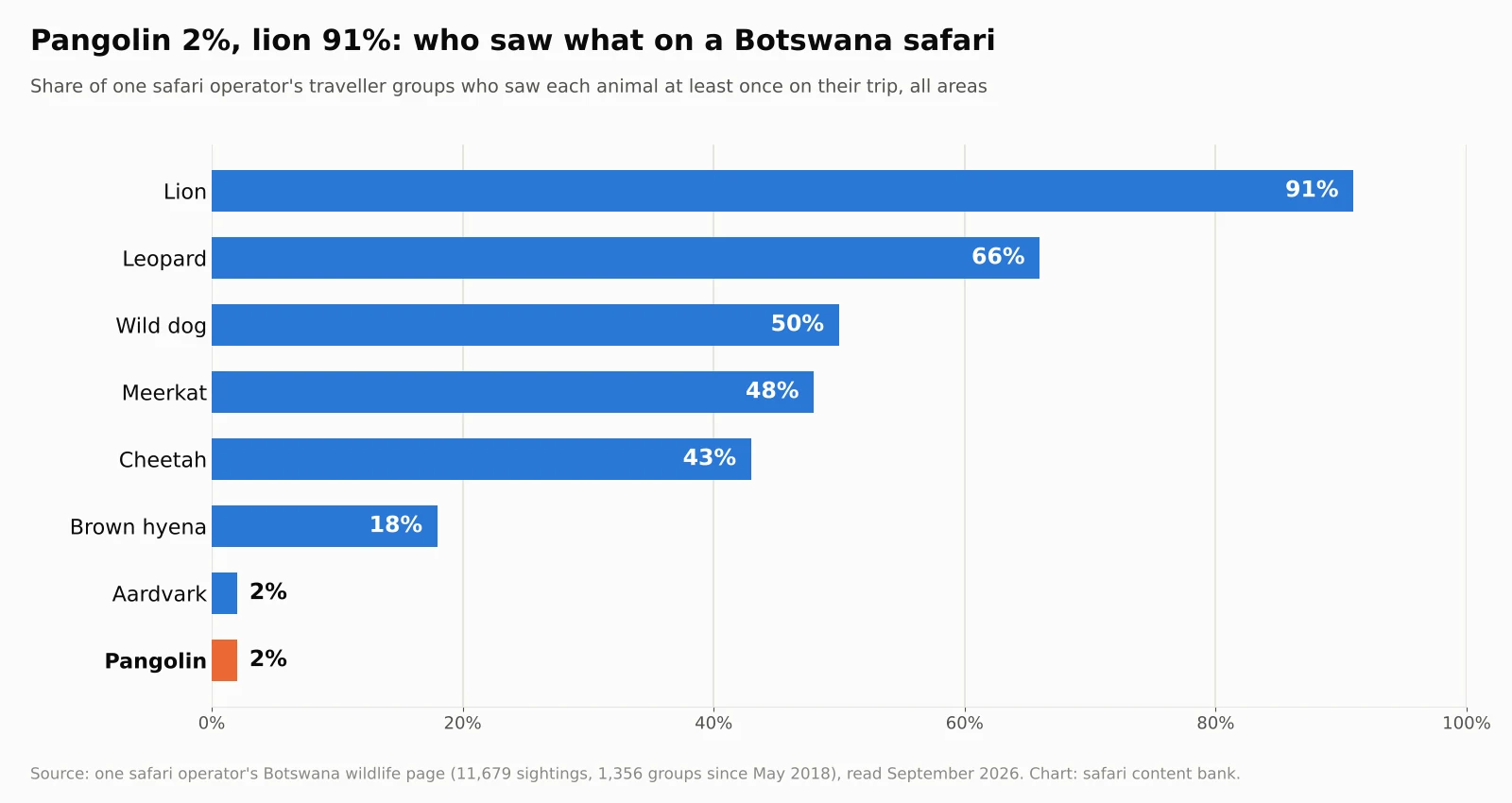 Traveller-reported, per trip, from one operator’s clients; 11,679 sightings from 1,356 groups since May 2018. Source: one operator’s Botswana wildlife page, read September 2026. Chart: safari content bank.
- Read these as best-case numbers. They come from one operator’s own clients, who tend to take longer, guided, dry-season trips, and the operator does not say how many groups each regional figure rests on.
- A regional figure can include sightings from elsewhere on the trip. The same dataset credits elephant to the Central Kalahari, a desert reserve, which suggests that some groups report a whole itinerary against every area on it. With rates of 1–2%, treat the regional differences as noise.
Botswana: the concessions, Moremi and the Kalahari
Botswana publishes the only regional pangolin figures in our sources, and they are all 1–2%: Kwando-Linyanti, Moremi and the Central Kalahari 2%, the Okavango Delta reserves 1% (one operator, read September 2026).
- The rule that decides your odds: Botswana Tourism states that in the national parks and reserves “off-roading and night driving [are] prohibited”, while “private concession areas outside the parks and reserves provide opportunities for off-road driving and night drives” (Botswana Tourism). Chobe, Moremi, the Central Kalahari and the Makgadikgadi and Nxai Pan parks are parks; the Delta, Kwando, Linyanti, Selinda and Khwai concessions are not. See night drives, walking and off-road driving in Botswana.
- Moremi’s 2% is not a Moremi night drive. Night drives and walking are not permitted in Moremi Game Reserve; the operator’s Moremi figures include Khwai, where both Khwai concessions allow night drives (Botswana’s concession rules).
- An itinerary of four in-park camps has no night drive at all. Whether that matters is your call, but it should be a choice, not a discovery on day six (night drive safaris).
- Fees: Chobe and Moremi charge P270 per non-resident adult per day, and the Central Kalahari, Nxai Pan and Makgadikgadi Pans P190, in the last published DWNP schedule (1 April 2022, via Tourism Update). In February 2026 the government news agency BOPA called the existing non-resident fee P380; a P500 rise was announced, then reported postponed. No official current tariff is published; confirm with DWNP or your operator (Botswana park fees).
More on Botswana’s odds: Botswana safari questions, Okavango Delta, water or land camps and Moremi or Chobe?.
Namibia: pangolin tracking at Okonjima
Okonjima Nature Reserve, between Windhoek and Etosha, is the only place in our sources that sells pangolin tracking as an activity: N$385–420 per person in 2026, low to high season (Okonjima 2026 rack rates, PDF).
- Activities are priced separately from the room: leopard and brown hyena tracking N$1,450–1,600, night drive N$2,000–2,200 and pangolin tracking N$385–420 per person (2026). Plains Camp costs N$4,830–5,320 per person a night with dinner and breakfast, and the park levy of N$350 per adult was included in the room rate on the 2026 sheet (Erindi, Okonjima or Etosha; Namibia park fees).
- This is tracking, not chance. Okonjima is a fenced private reserve built around the AfriCat Foundation’s carnivore research, and AfriCat reports eight years of pangolin tracking data (africat.org). Our sources describe Okonjima’s tracking activities as following known, collared animals. Okonjima does not publish a pangolin success rate in our sources, so ask before you book.
- Low season is 1 January–30 June and high season 1 July–31 December on the 2026 sheet. Okonjima’s 2027 sheet is out (dated 11 July 2026), but our sources cannot match its activity prices to activities reliably, so we print the 2026 figures.
- Namibia’s national picture: 40 pangolin seizures in 2022, down 54% on 2021 (NACSO and MEFT, State of Community Conservation 2022 (PDF)); combined pangolin, rhino and elephant cases fell from 181 in 2019 to 59 in 2025 (a safari agent’s guide, 12 June 2026).
Etosha itself is covered on Etosha and Namibia safari cost.
South Africa: Tswalu Kalahari
Tswalu Kalahari lists pangolin among its wildlife, alongside Kalahari lion, cheetah, wild dog, desert black rhino and meerkat; it has no elephant, so it is not a Big Five reserve (Tswalu; Wikipedia; malaria-free safaris).
- What it costs: Motse costs R46,400 per adult sharing a night (single R57,700), valid to 31 December 2026; Loapi R55,800. The rate includes a private vehicle, guide and tracker for every booking, all meals and drinks, walks, horse riding and the habituated meerkat colonies; flights to the reserve are extra. Children aged 0–11 sharing stay free and 12–17s pay R10,900 (Tswalu rates).
- Minimum stay: 2 nights, or 3 from 20 December 2026 to 6 January 2027. Tswalu’s 2026 offers are 50% off the first of four nights, or a fifth night free (same page).
- Our sources hold no pangolin sighting rate and no pangolin season for Tswalu. Its site and Wikipedia name pangolin among the reserve’s wildlife; that is the lodge’s own claim, not an independent figure.
Tswalu’s meerkats are on where to see meerkats; South African prices are on South Africa safari cost.
Mozambique and Zimbabwe: Gorongosa and Matusadona
Neither park sells a wild pangolin sighting in our sources, but both name pangolins in their own material.
- Gorongosa National Park (Mozambique) lists a pangolin centre among visitor activities, with the E.O. Wilson Biodiversity Lab tour and walking safaris (Gorongosa activities). The animals there are rescued, so it is a visit, not a wild sighting. Activities run 1 March–15 December; the park closes from mid-December to the end of February (Gorongosa, things to know).
- Matusadona National Park (Zimbabwe, on Lake Kariba) lists Temminck’s pangolin among its species (visitmatusadona.org), and African Parks, which manages the park, reports pangolin work with the Tikki Hywood Foundation (African Parks). No pangolin activity or sighting rate is published. See Zimbabwe.
Night drives and pangolin activities: where they are allowed
A pangolin activity is sold at one reserve in our sources; night drives, the other route, depend on whose land you are on.
| Where | Night drives | Pangolin activity | Source |
|---|---|---|---|
| Botswana’s parks and reserves (Chobe, Moremi, Central Kalahari, Makgadikgadi and Nxai Pan) | No | None | Botswana Tourism |
| Botswana’s private concessions (Delta, Kwando, Linyanti, Selinda, Khwai) | Yes, run by the camps | None sold; sightings by chance | Botswana Tourism; Botswana night drives |
| Okonjima Nature Reserve (Namibia) | Yes, N$2,000–2,200 per person (2026) | Pangolin tracking, N$385–420 | Okonjima 2026 rates (PDF) |
| Etosha National Park (Namibia) | NWR guided drives only, about N$620 | None | Night drive safaris |
| Tswalu Kalahari (South Africa) | Not in the inclusions we hold | None sold | Tswalu rates |
| Gorongosa (Mozambique) | Not in our sources | Pangolin centre (rescued animals) | Gorongosa activities |
Read September–October 2026. Check the night-drive rules for your own camps before you book; more countries are on night drive safaris.
Which to choose
Choose Okonjima if you want a pangolin activity you can book; choose a Botswana concession or Tswalu if you want a wild sighting and accept that it is a long shot.
| If you want… | Choose | Why |
|---|---|---|
| A pangolin activity you can book | Okonjima (Namibia) | The only pangolin tracking sold in our sources: N$385–420 per person (2026) |
| A pangolin chance on a classic Botswana trip | Concession camps with night drives (Delta, Kwando-Linyanti, Khwai) | 1–2% per trip, and night drives are allowed there, not in the parks |
| A private vehicle on a malaria-free Kalahari trip | Tswalu Kalahari (South Africa) | Lists pangolin; private vehicle in the R46,400 rate (2026) |
| The lowest spend with a pangolin activity | Okonjima Plains Camp | N$4,830–5,320 a night DBB plus N$385–420 tracking (2026) |
| To see pangolins without looking for wild ones | Gorongosa’s pangolin centre (Mozambique) | On the park’s activities list; animals are rescued, not wild |
| Night drives for their own sake | South Luangwa or Botswana’s concessions | But South Luangwa’s pangolin figure is 0% (one operator) |
Timing and booking rules
No source we hold names a best month for pangolins anywhere; the dates below are the lodges’ and parks’ own seasons and booking rules.
| Place | Seasons and rules | What changes | Source |
|---|---|---|---|
| Okonjima | Low 1 Jan–30 Jun; high 1 Jul–31 Dec (2026) | Pangolin tracking N$385 low, N$420 high | Okonjima 2026 rates |
| Tswalu Kalahari | Minimum 2 nights; 3 nights from 20 Dec 2026 to 6 Jan 2027 | 2026 offers: 50% off the first of four nights, or a fifth night free | Tswalu rates |
| Gorongosa | Activities 1 March–15 December; closed mid-December to end of February | Pangolin centre only when the park is open | Gorongosa |
| Botswana concessions | No pangolin season in our sources | The 2% is across all seasons and trip lengths | one operator’s Botswana page |
How many pangolins are there?
Nobody knows: no population estimate exists for any African pangolin species, and the IUCN says estimates for most species are outdated or missing (IUCN, August 2025). What is counted is the trade.
| Measure | Figure | Period | Source |
|---|---|---|---|
| Pangolins in seizures, worldwide | More than half a million, in 75 countries, on 178 trade routes | 2016–2024 | IUCN SSC Pangolin Specialist Group report for CITES CoP20, via IUCN |
| Share of seized parts that were scales | 99% | 2016–2024 | same |
| Seizure incidents | 1,270 in 67 countries and territories; 46,760 whole animals plus about 120 tonnes by weight | 2010–2015 | TRAFFIC (PDF) |
| Large scale shipments from Africa | About 55% of shipments of 1 tonne or more | 2010–2015 | same |
| Hunted in Central African forests | An estimated 0.4–2.7 million a year | Ingram et al. 2018 | UCL Discovery |
| Namibia, pangolin seizures | 40, down 54% on 2021 | 2022 | NACSO |
| International trade status | All eight species moved to CITES Appendix I | CoP17, 2016 | via IUCN |
Read 8–9 October 2026. The IUCN stresses that seizures show only a fraction of the real trade; only 32 CITES Parties, 15 of them range states, answered its questionnaires.
- The pangolin of southern Africa’s savanna reserves is Temminck’s ground pangolin, the species Matusadona lists on its visitor site (visitmatusadona.org).
- Prices have risen while the visible trade has not: in the Ingram study, urban market prices rose 5.8-fold for giant pangolin and 2.3-fold for the tree pangolins, while market counts showed no trend, which suggests the animals now move through other supply chains (UCL Discovery).
Watching pangolins responsibly
Watch, do not handle, and keep the place to yourself.
- Do not share where you saw a pangolin. Pangolins are trafficked, so treat a sighting the way our rhino guide treats a rhino: no location in captions, posts or reviews, and photos with location data removed.
- A rescued pangolin is not a wild sighting. A rehabilitation centre visit can be worthwhile, but it is a different thing from finding one in the wild; our ethical wildlife activities guide sets out the “watch, do not handle” line.
- Ask how a tracking activity works before you book: whether the animals are collared, how long you stay, how close you go and whether you will be asked to touch the animal (you should not be).
- Follow the guide at night. Spotlights, distance and noise are the guide’s call; see safari etiquette.
Common mistakes about seeing pangolins
| What you’ll often read | What is correct |
|---|---|
| “Go to Botswana and you’ll see a pangolin” | 2% of one operator’s traveller groups saw one across Botswana, over whole trips (read September 2026). |
| “2% means 2% per drive” | It is per trip, over the whole stay, from one operator’s own clients. |
| “Book a Moremi or Chobe camp for night drives” | Night drives are prohibited in Botswana’s parks and reserves; they run on the private concessions (Botswana Tourism). |
| “Pangolin tracking is included at Okonjima” | It is priced separately: N$385–420 per person (2026), on top of the room. |
| “South Luangwa’s night drives find pangolins” | 0% of the same operator’s South Luangwa travellers saw one (read October 2026). |
| “Winter is pangolin season at Tswalu” | Our sources do not confirm a season for Tswalu or anywhere else. |
| “There are X pangolins left” | No population estimate exists for any African species (IUCN, 2025). |
| “Pangolins are the world’s most trafficked mammal” | Our sources do not settle this claim. What they show is more than half a million pangolins in seizures in 2016–2024 (IUCN). |
Frequently asked questions
Where is the best place in Africa to see a pangolin? No place makes it likely. The only pangolin activity sold in our sources is tracking at Namibia’s Okonjima Nature Reserve, at N$385–420 per person in 2026. For a wild sighting, the best published figure is 2%, for one operator’s travellers across Botswana and in Kwando-Linyanti, Moremi and the Central Kalahari (read September 2026).
Can you see a pangolin at Tswalu? Tswalu Kalahari lists pangolin among its wildlife, but publishes no sighting rate and our sources hold no pangolin season. Motse costs R46,400 per adult sharing a night in 2026, with a private vehicle, guide and tracker included.
How much does pangolin tracking cost at Okonjima? N$385 per person in low season (1 January–30 June) and N$420 in high season (1 July–31 December) on Okonjima’s 2026 rate sheet, on top of the room. Plains Camp costs N$4,830–5,320 per person a night with dinner and breakfast.
Do I need a night drive to see a pangolin? Our sources do not say when pangolins are most active, but in Botswana you cannot do a night drive inside the parks, so a concession camp keeps more options open. Night drives at Okonjima cost N$2,000–2,200 per person (2026).
Can you see pangolins in the Okavango Delta? Rarely: 1% of one operator’s traveller groups in the Okavango Delta reserves saw one, and 2% in Moremi including Khwai (read September 2026). Night drives run on the private concessions, not in Moremi Game Reserve.
Is a pangolin centre visit the same as a sighting? No. Gorongosa National Park lists a pangolin centre among its visitor activities, but the animals there are rescued. A visit can be worthwhile; it is not a wild sighting.
How many pangolins are left in the wild? Nobody knows. No population estimate exists for any African species, the IUCN said in 2025. Seizures between 2016 and 2024 involved more than half a million pangolins in 75 countries.
Can I post my pangolin photo? Yes, but leave out where you took it and remove location data from the file. Pangolins are trafficked, so we treat their locations the way we treat rhino locations.
Sources
- Sighting rates: one operator’s pages on Botswana wildlife, the Okavango Delta reserves, Moremi, Kwando-Linyanti and the Central Kalahari (read September 2026), and South Luangwa (read October 2026) (names and links kept in our editor notes)
- Pangolin status and trade: IUCN press release on the Pangolin Specialist Group’s CoP20 report, August 2025, read 8 Oct 2026; TRAFFIC, The Global Trafficking of Pangolins 2010–2015 (PDF); Ingram et al. 2018, via UCL Discovery, read 8 Oct 2026
- Botswana: Botswana Tourism, game viewing; DWNP schedule effective 1 April 2022 via Tourism Update, 23 Feb 2022; BOPA and the postponed rise as on our Botswana park fees page
- Namibia: Okonjima 2026 rack rates (PDF), read 8 Oct 2026; AfriCat Foundation; NACSO and MEFT, State of Community Conservation 2022 (PDF); a safari agent’s guide, 12 June 2026
- South Africa: Tswalu rates, read 8 Oct 2026; Wikipedia, Tswalu Kalahari Reserve (secondary)
- Mozambique and Zimbabwe: Gorongosa activities and things to know, read 8 Oct 2026; visitmatusadona.org and African Parks, Matusadona, read 8 Oct 2026
More on where to see the other animals: cheetahs, leopards, meerkats and rhino.
Figures, rates and fees checked 10 October 2026. We will update this page when the operator’s sighting rates change, when Okonjima’s 2027 activity prices can be confirmed, when Tswalu publishes 2027 rates, when DWNP publishes an official Botswana tariff, and when the IUCN Red List publishes new pangolin assessments.
| Fee | Amount | In force from | Source |
|---|---|---|---|
| Chobe National Park and Moremi Game Reserve (DWNP), non-resident adult, per person per day | BWP 270 (SADC residents BWP 205; Botswana citizens and residents BWP 30) | Last published DWNP schedule, 1 April 2022 (via Tourism Update). In Feb 2026 the government news agency BOPA called the existing non-resident fee P380; a P500 rise was announced, then reported postponed. No official current tariff: confirm with DWNP or your operator | Tourism Update, 23 Feb 2022 (DWNP fee schedule) |
| Other DWNP parks and reserves (Central Kalahari Game Reserve, Khutse, Nxai Pan, Makgadikgadi Pans), non-resident adult, per person per day | BWP 190 (SADC residents BWP 145; Botswana citizens and residents BWP 20) | Last published DWNP schedule, 1 April 2022 (via Tourism Update). In Feb 2026 the government news agency BOPA called the existing non-resident fee P380; a P500 rise was announced, then reported postponed. No official current tariff: confirm with DWNP or your operator | Tourism Update, 23 Feb 2022 (DWNP fee schedule) |