 Experience

Last verified · Next check due
On this page
- Masai Mara vs Okavango Delta at a glance (2026)
- Wildlife: herds and cats or water and wild dogs
- Night drives, walks and off-road driving: what each area allows
- Crowds: a public reserve against private concessions
- Best months: herds or floods
- Getting there: Nairobi airstrips or Maun light aircraft
- Park fees and private-land levies
- What a night costs, tier by tier
- Visas, health and entry
- Can you combine the Masai Mara and the Okavango Delta?
- Which should you choose?
- Common mistakes in Masai Mara vs Okavango Delta comparisons
- Frequently asked questions
- Sources
Short answer: Choose the Masai Mara (Kenya) for the wildebeest herds, usually there from July to October, resident big cats and a road trip or one-hour flight from Nairobi. Choose the Okavango Delta (Botswana) for mokoro and boat trips, wild dogs and fly-in camps; its water is highest about May–August. The Mara reserve charges US$100 per adult a day January–June and US$200 July–December; Delta camps publish US$530–5,345 a night, and Moremi’s last published fee is P270 a day (DWNP, 2022).
Key facts
- The herds come to the Mara; the water comes to the Delta. The wildebeest are usually in the Mara from mid or late July to October, most of them in August and September (Masai Mara). The Delta floods in its dry season with Angolan rain, highest in most areas from about May to August (Okavango Delta).
- The Mara is a road or short-flight trip; the Delta is a fly-in trip. Nairobi Wilson to the Mara is about 1 hour by air for US$200 + US$20 one way, or 275 km by road. Most Delta camps are reached only by light aircraft from Maun: US$250 a seat to Kwara plus US$25 tax (Kwando, 2024).
- The Mara fee doubles on 1 July. US$100 per non-resident adult per day from January to June, US$200 from July to December, under Narok County’s last published schedule (FY2025/26, which expired on 30 June 2026; press reports say US$200 still applies for July–December 2026).
- No official current Botswana park fee is published. The last published DWNP schedule (1 April 2022) gives P270 a day in Moremi; in February 2026 the government news agency BOPA called the existing non-resident fee P380, and a P500 rise was announced, then reported postponed. Confirm with DWNP or your operator.
- Night drives and walks are on private land in both. Not in the Mara reserve or in Moremi Game Reserve; sold in the Mara conservancies (US$130 per adult a night on camps’ 2026 sheets) and on the Delta’s private concessions.
- Kenya charges before you fly; Botswana does not, for UK passports. Kenya’s eTA costs US$30, and since 5 October 2026 arrivals have also needed a government health policy, up to US$44 (eCitizen). British citizens get 90 days in Botswana without a visa.
Masai Mara vs Okavango Delta at a glance (2026)
The Masai Mara is a county-run reserve ringed by Maasai-owned conservancies, reached by road or a short flight from Nairobi; the Okavango Delta is a fly-in wetland in which only Moremi Game Reserve is formally protected and most of the best land is leased to a few camps. Country-level questions (budget trips, malaria, the rest of each country) are on Kenya vs Botswana; this page compares the two places.
| Masai Mara (Kenya) | Okavango Delta (Botswana) | Source | |
|---|---|---|---|
| Who runs the land | Narok County (the western Mara Triangle: the Mara Conservancy); 24 conservancies on about 450,000 acres leased from Maasai landowners | Moremi Game Reserve (DWNP), the only formally protected part; the rest mostly private and community concessions | Masai Mara; Okavango Delta |
| Main draw | Wildebeest herds and river crossings; resident big cats | Water: mokoro, boats, floodplain game; wild dog | Hub pages |
| Park fee, adult | Reserve US$100 a day (1 Jan–30 Jun), US$200 (1 Jul–31 Dec) | Moremi P270 a day (last published DWNP schedule, 1 April 2022; no official current tariff) | Narok County FY2025/26 (last published); DWNP via Tourism Update |
| Private-land fee | Conservancies US$130 per adult a night (US$150 for Mara North on Offbeat’s sheet) | Camp levies US$20–100 a night (Kwando 2024 to Great Plains 2025) | Mara reserve vs conservancies; Okavango Delta safari cost |
| Camp rates, per person a night | US$115–2,028 (2026), mostly before fees | US$530–5,345 (2024–2026 rate cards), meals and activities included | Camps’ rate sheets, below |
| Getting in | Nairobi Wilson → Mara about 1 h, US$200 + US$20 one way; or 275 km by road, 5.5–6.5 h | Maun, then light aircraft: US$250 Maun → Kwara (Moremi Air, 2024) + US$25 tax | Nairobi to the Masai Mara; Botswana bush flights |
| Best months | July–October for the herds; January–June for half the reserve fee | June–October for game; water highest about May–August | Great Migration month by month; Okavango flood calendar |
| Night drives | Not in the reserve; sold in conservancies | Not in Moremi; allowed on private concessions | Mara reserve vs conservancies; Botswana night drives and walking |
| Visitors | Reserve: 213,000 in 2025, down from 420,000 in 2023 | No Delta count in our sources; Maun took 42,112 tourist air arrivals in 2024 | Kenya Economic Survey 2026 via Business Daily; Statistics Botswana |
| Entry, UK passport | eTA US$30 + government health policy of up to US$44 (eCitizen) | Visa-free, 90 days; no border levy | Kenya eTA; Botswana visa |
Non-resident adult. Fees and rates as on our Masai Mara, Masai Mara safari cost, Okavango Delta and Okavango Delta safari cost pages, checked 9–10 October 2026. The Botswana pula has no dated exchange rate in our sources, so pula amounts are not converted.
Wildlife: herds and cats or water and wild dogs
The Mara has the wildebeest herds from about July to October and its big cats all year; the Delta has water-based wildlife, mokoro trips and the best published wild dog odds in our sources.
| Masai Mara | Okavango Delta | Source | |
|---|---|---|---|
| Wildebeest herds | Usually in the Mara from mid or late July to October, most in August–September; crossings on the Mara River and the Sand River, in the reserve | Not a wildebeest area; Botswana’s migration is zebra, between the Chobe floodplains and Nxai Pan | Masai Mara; Africa Geographic |
| A second herd | The smaller Loita herd moves into Ol Kinyei conservancy in January and calves there in February–March | – | Mara reserve vs conservancies |
| Big cats | Lions, leopards and cheetahs resident all year; no sighting rate in our sources | Of one UK safari operator’s travellers to the Delta’s reserves, 93% saw lion, 73% leopard and 56% cheetah | Kenya vs Botswana; Okavango Delta |
| Wild dog | No dated count or sighting rate in our sources | 61% of that operator’s Delta travellers, 65% in Moremi | Where to see wild dogs |
| Elephant and hippo | No comparable rate in our sources | Elephant 99%, hippo 98% of that operator’s Delta travellers | Okavango Delta |
| Mokoro and boats | Not in our Kenya safari sources | Seasonal floodplains: about late May to September; permanent water: all year; none at seasonal camps in January–February | Okavango flood calendar |
| Minimum ages | Reserve fee free under 9; Kicheche Bush and Valley take children from 7, Porini camps from 8 | Mokoro: 12 at Kwando, 8 at Great Plains | Camps’ rate sheets |
The Delta’s rates are per trip, not per drive: that operator’s traveller groups, read September 2026. No comparable sighting dataset for the Mara is in our sources. Read 9–10 October 2026.
- No one can date a river crossing. The Mara Conservancy says crossings “happen frequently during the migration but are difficult to predict”; positions month by month are on where the Great Migration is each month and when the river crossings happen.
- A mokoro is about quiet and birds, not big game: mokoro trips focus on “silence and birdlife rather than large animals”, one forum regular says (TripAdvisor forum). Pair a water camp with a land camp if big cats matter: see water camp or land camp.
- Birds are a Delta strength. UNESCO lists 482 bird species in the Okavango Delta World Heritage Site (UNESCO); we hold no comparable Mara list.
Night drives, walks and off-road driving: what each area allows
The public core of each place, the Mara reserve and Moremi Game Reserve, keeps vehicles on tracks and in daylight; the private land around them, the Mara conservancies and the Delta concessions, sells night drives, walks and off-road driving to its own guests.
| Mara reserve | Mara conservancies | Moremi Game Reserve | Delta private concessions | |
|---|---|---|---|---|
| Fee per adult | US$100 (Jan–Jun) or US$200 (Jul–Dec) a day | US$130 a night | P270 a day (last published schedule) | Camp levy US$20–100 a night |
| Night drives | Not sold | Sold at some camps: Kicheche Valley (Naboisho), Porini Lion Camp (Olare Motorogi) | Prohibited | Allowed “in moderation” |
| Walking | None sold, as far as we found | Included at all three Kicheche camps and at Porini Lion Camp | Not permitted | Usually offered |
| Off-road driving | Prohibited, except to approach big cats on nearby open ground, no closer than 25 m | Practised | Prohibited | Allowed |
| Vehicles at one sighting | Five; others wait at least 100 m away | No published cap | No published rule in our sources | No published rule in our sources |
| Who drives there | Safari vehicles; private cars banned from game drives since 3 June 2024 | Camp guests | Anyone with a park ticket, self-drivers included | Camp guests; the Khwai community concession also admits self-drivers |
Sources: Narok County’s Greater Maasai Mara Ecosystem Management Plan, as reported by Business Daily; Kenyans.co.ke (Narok memo); Kicheche 2026 (PDF); Porini Lion Camp factsheet (PDF); Botswana Tourism, game viewing; one UK safari operator’s Moremi guide. Read 9–10 October 2026.
- Mara conservancies and Delta concessions sell the same thing: private land, fewer vehicles, night drives and walks. Fee by fee and rule by rule on the Kenyan side: Mara reserve vs conservancies.
- Not every private-land camp sells night drives. Kicheche lists them only at its Naboisho camp, not at Kicheche Mara North; ask each camp what it runs on your dates.
- The rule follows the land, not the price. A Delta camp inside Moremi works under reserve rules whatever it charges; every area’s rules in Botswana are on night drives, walking and off-road driving.
- The river crossings are in the Mara reserve. A conservancy guest who drives in for the Mara River pays that day’s reserve fee as well as the conservancy fee.
Crowds: a public reserve against private concessions
Neither side publishes vehicle counts at sightings. The Mara reserve caps a sighting at five vehicles but travellers still report queues; the Delta’s concessions admit only their own camps’ guests.
| Masai Mara | Okavango Delta | |
|---|---|---|
| Visitors | Reserve: 213,000 in 2025, 343,000 in 2024, 420,000 in 2023 | No Delta count in our sources; Maun took 42,112 tourist air arrivals in 2024, 34.3% of Botswana’s |
| Limits | Reserve: five vehicles at a sighting. Conservancies: no published cap; Olare Motorogi’s camps have no more than 24 beds each | Each concession is leased to one operator or community trust with a limited number of beds; no published bed cap per concession |
| Traveller reports | Reviews on a safari booking site (2019–2026) describe 20 to 40 vehicles at a single sighting in the reserve; forum travellers found the Mara Triangle and Keekorok quieter | A safari booking site’s Botswana page says that in the July–October high season “only Chobe gets crowded” |
Sources: Kenya Economic Survey 2026 via Business Daily; Olare Motorogi Conservancy; Statistics Botswana; The Ngami Times, 7 Sep 2026; TripAdvisor; a safari booking site’s Mara reviews and Botswana page. Read 9–10 October 2026. Traveller reports, not counts.
- The two visitor figures are not like for like: one counts reserve visitors, the other tourist air arrivals at the Delta’s gateway town.
- The Delta’s quiet is bought with the bed. The government calls its policy high-value, low-volume (The Ngami Times). Moremi’s public tracks are open to self-drivers and mobile safaris, so the low density is a property of the concessions.
- In the Mara, the conservancy is the quiet option. A Nairobi-based operator on the TripAdvisor Kenya forum said what the conservancy premium buys is fewer vehicles, off-road driving, night drives and walking (August 2026, traveller report).
Best months: herds or floods
July to October is peak season in both: the herds are in the Mara, and the Delta’s game gathers at the remaining water while the flood is high. Outside it, the Mara halves its reserve fee from January to June and has the Loita calving in the conservancies; the Delta has its lowest camp rates from January to March, with low water.
| Months | Masai Mara | Okavango Delta | Better fit |
|---|---|---|---|
| January–February | Herds in Tanzania; the Loita herd arrives in Ol Kinyei and calves from February; fee US$100; Governors’ Camp US$623 | Water low; Botswana’s rains; no boats at seasonal camps; lowest camp rates (Kwara US$820) | Mara, for half the fee and the Loita calving |
| March–May | Long rains (April 210 mm, the wettest month); lowest camp rates in April–May (Governors’ US$453); Kicheche Mara North closed 1 April–22 May | Flood rising; boats resume late May; Machaba’s High season from 1 May | Mara for the lowest rates if you accept rain; the Delta from late May |
| June | Herds usually still in Tanzania’s Western Corridor; fee US$100 to 30 June | Highest water in most of the Delta; dry season; game starts to gather at water | Delta |
| July–August | Herds arrive from mid or late July; the Mara is full in August; fee US$200; Governors’ US$998 | Highest water to August; top camp rates | Either: herds or water |
| September–October | Most animals in the Mara in September; the tail crosses back into Tanzania in October | Water falling; game concentrated on the remaining water; October the hottest month, above 40°C at times; some water activities may stop | Either; the Mara for the herds |
| November–December | Short rains; fee still US$200; camps back to lower rates until about 20 December | Lowest water; rains start in November; holiday rates from 20 December | Either, at lower camp rates |
Typical year, not a forecast. Mara: Masai Mara, from a camp operator’s migration guide, a Kenyan camp operator’s Loita migration page, Climates to Travel (aggregator, Masai Mara station) and 2026 rate sheets. Delta: Okavango flood calendar and Okavango Delta, from a UK safari operator’s flood guide, IntechOpen, Africa Geographic, two camp operators’ seasonal guides and rate cards. Read 9–10 October 2026.
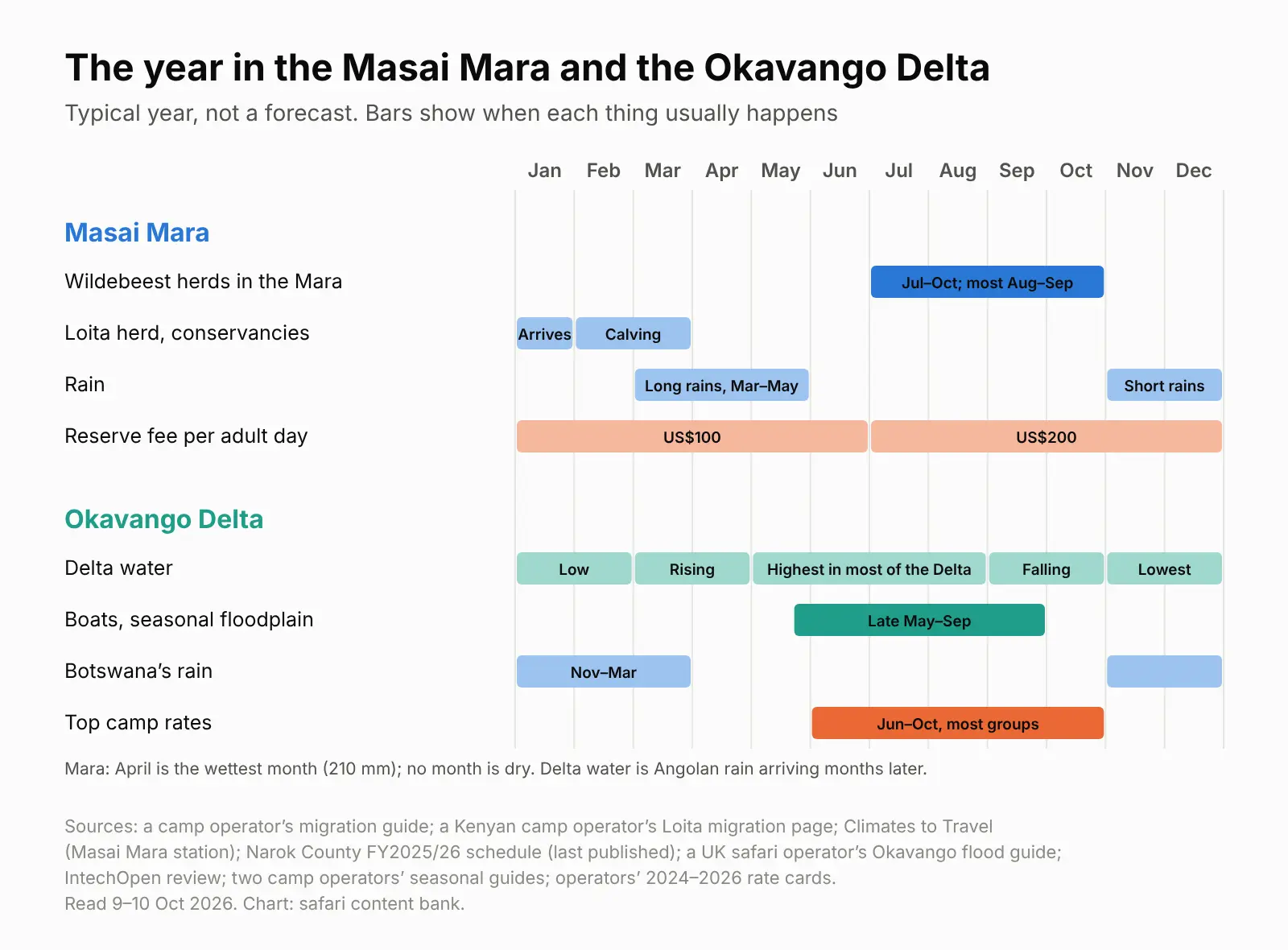 Typical year, not a forecast. Sources: a camp operator’s migration guide; a Kenyan camp operator’s Loita migration page; Climates to Travel; Narok County FY2025/26 schedule (last published); a UK safari operator’s flood guide; IntechOpen review; two camp operators’ seasonal guides; operators’ 2024–2026 rate cards. Read 9–10 October 2026. Chart: safari content bank.
- The two peaks fall in the same months, so a July–October trip pays the Mara’s US$200 fee or the Delta’s top camp rates.
- The Delta floods in its dry season. The water is rain that fell on the Angolan highlands from October to April; one camp’s high water can come two months after another’s (Okavango flood calendar).
- Book early for the Mara’s river months. Travellers on the TripAdvisor Mara forum report reserve camps near the river booking up to a year ahead for mid-July to early September (Masai Mara).
Getting there: Nairobi airstrips or Maun light aircraft
The Mara is about an hour by air from Nairobi’s Wilson Airport, or a day’s drive on tarmac to Sekenani Gate; the Delta’s camps are reached by light aircraft from Maun, and by road you reach only Moremi’s tracks, Khwai and the Panhandle.
| Masai Mara | Okavango Delta | Source | |
|---|---|---|---|
| Gateway | Nairobi; light aircraft from Wilson Airport | Maun | Nairobi to the Masai Mara; Botswana bush flights |
| By air | Mombasa Air Safari: about 1 h, US$200 + US$20 fuel surcharge one way; US$370 + US$40 return | Moremi Air US$250 Maun → Kwara + US$25 tax; Desert & Delta US$284–594 a seat + US$20 tax (2024); Great Plains includes air on stays of 2+ nights | Mombasa Air Safari 2026; Kwando 2024 |
| Return seat, per person | US$410 | US$525–1,208 unless the camp includes it (our sums) | Cost pages |
| By road | 275 km, 5.5–6.5 h by gate, tarmac to Sekenani Gate | Moremi is about 80 km from Maun in a 4x4; no road to the inner Delta camps | Masai Mara safari cost; Okavango Delta safari cost |
| Luggage on light aircraft | 15 kg per person including hand luggage, soft bags | 20 kg, soft bag, hand luggage included | Masai Mara; Okavango Delta |
| After dark | Reserve tickets run 06:00–18:00 | Light aircraft do not fly at night; a late regional arrival means a night in Maun | Masai Mara park fees; Okavango Delta safari cost |
| Self-drive | Narok County banned private vehicles from game drives on 3 June 2024; we found no 2026 statement on how it is applied | Moremi’s public tracks and Khwai only; concessions closed to non-guests | Kenyans.co.ke; Botswana self-drive |
Fares as published, read 9–10 October 2026. Safarilink and AirKenya do not publish their Nairobi–Mara fares. Botswana fares are from camp groups’ 2024 cards, the latest from those groups in our sources.
- The Mara can be done entirely by road; the inner Delta cannot. If small aircraft worry you, that settles it.
- Every Delta move costs a flight and, by traveller reports, half a day of game viewing. Forum regulars suggest three nights per camp (Botswana safari questions). By road, stay at least two nights in the Mara: one night leaves two half-days in a vehicle.
- Pack for 15 kg if you do both. The Mara’s limit is 5 kg below the Delta’s.
Park fees and private-land levies
The Mara reserve charges US$100 per non-resident adult a day from January to June and US$200 from July to December; Moremi’s last published fee is P270 a day, and Delta concession camps charge a levy of US$20–100 a night, often inside the rate. One is set in US dollars and the other in pula; we do not convert.
| 3 nights, per adult (our sums) | January–June | July–December | What it covers |
|---|---|---|---|
| Mara reserve camp: 3 day tickets | US$300 | US$600 | US$400 or US$800 with a game drive on the departure day |
| Mara conservancy camp: 3 × US$130 | US$390 | US$390 | Add one reserve day for a river trip: US$490 or US$590 |
| Moremi Game Reserve: 3 × P270 (last published schedule) | P810 | P810 | Same all year; a 3-night self-drive counts 4 days, P1,080 |
| Delta concession camp, levy only: 3 × US$20–100 | US$60–300 | US$60–300 | Kwando US$20, Machaba US$35, Natural Selection US$60, Great Plains US$100 a night |
Mara: Narok County fee schedule FY2025/26, the last published (expired 30 June 2026; July–December 2026 per The Kenya Times, 6 Aug 2026, secondary); conservancy fee from camps’ 2026 rate sheets. Moremi: DWNP schedule of 1 April 2022 via Tourism Update, 23 Feb 2022. Levies: Kwando 2024, Machaba 2026, Natural Selection 2026, Great Plains 2025. Fees and levies only: bed rates are extra. Checked 10 October 2026.
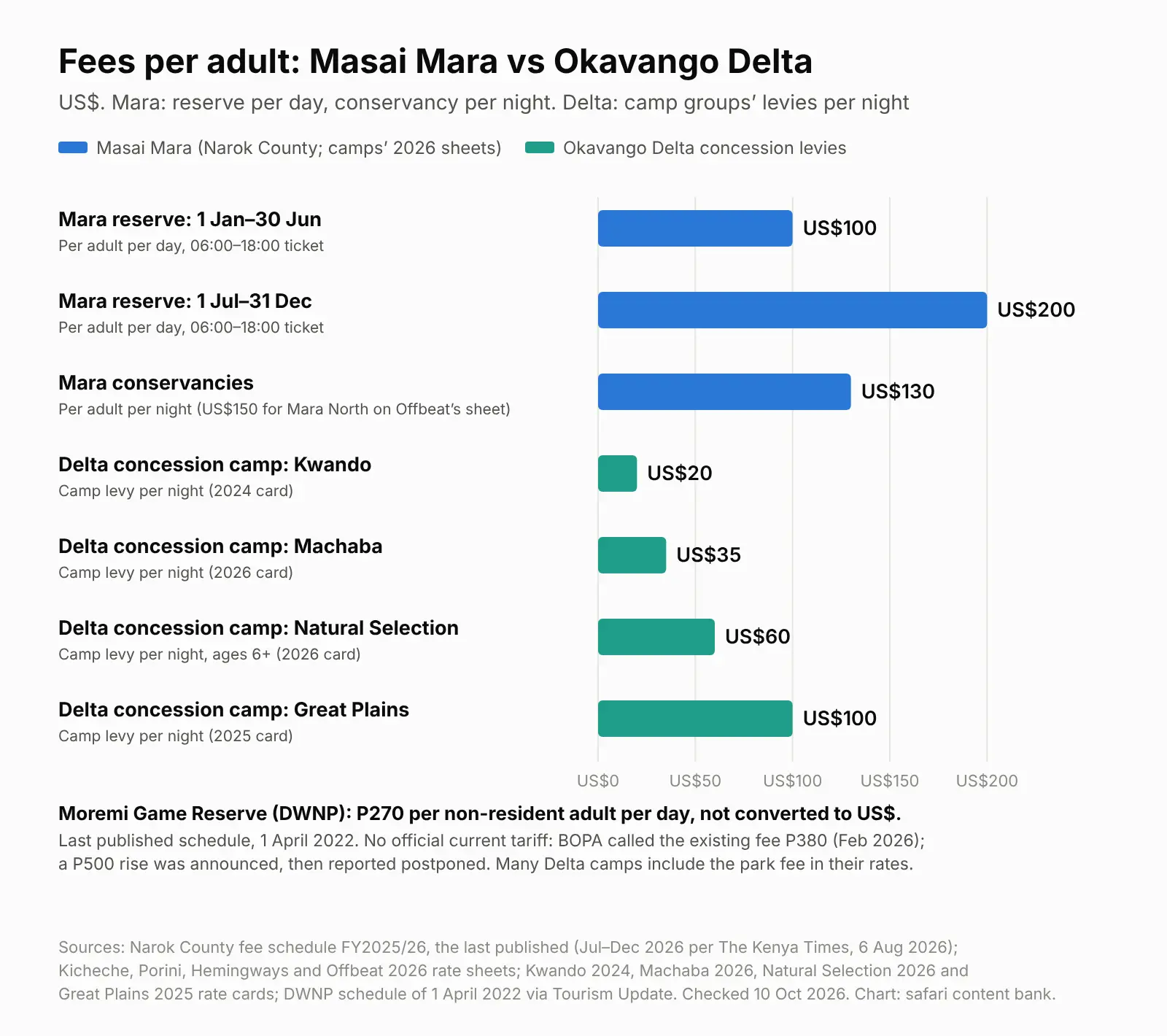 Sources: Narok County fee schedule FY2025/26, the last published; Kicheche, Porini, Hemingways and Offbeat 2026 rate sheets; Kwando 2024, Machaba 2026, Natural Selection 2026 and Great Plains 2025 rate cards; DWNP schedule of 1 April 2022 via Tourism Update. Checked 10 October 2026. Chart: safari content bank.
- One Mara ticket covers one calendar day, 06:00–18:00, and “will not carry overnight”. The rate is the same whether you sleep inside or outside the reserve (Masai Mara park fees).
- Mara camps usually bill fees on top; many Delta camps include them. Governors’ adds a US$50 community fee a night to the reserve fee, and Kicheche, Hemingways and Offbeat add the conservancy fee, even on free nights. In the Delta, Natural Selection, Wilderness and Desert & Delta include park fees; at Desert & Delta’s camps inside Moremi, levies and 14% VAT are included too (Okavango Delta safari cost).
- Children: the Mara reserve charges 9–17s US$50 a day and is free under 9. In Botswana’s parks children under 8 enter free and older children pay half (a safari operator’s public campsite sheet, as on Botswana park fees).
- Botswana’s fee may change without a new schedule. In February 2026 BOPA described the existing non-resident fee as P380 and reported a rise to P500 from 1 April 2026 (Botswana Daily News); the rise was then reported postponed, by two years according to Gabz FM (5 May 2026). At P380 three Moremi days would be P1,140, at P500 P1,500 (our sums).
Every fee line and rule: Masai Mara park fees and Botswana park fees.
The official fee lines, with the date each took effect and the authority’s own source:
| Fee | Amount | In force from | Source |
|---|---|---|---|
| Maasai Mara National Reserve, non-resident adult, per day (12-hour ticket, 06:00–18:00), 1 Jan–30 Jun | USD 100 | Since 1 Jan 2024; Narok County FY2025/26 schedule, the last published | Narok County fee schedule FY2025/26 |
| Maasai Mara National Reserve, non-resident adult, per day (12-hour ticket, 06:00–18:00), 1 Jul–31 Dec | USD 200 | Since 1 Jul 2024; Narok County FY2025/26 schedule, the last published, expired 30 Jun 2026 (no 2026/27 schedule as of 9 Oct 2026); The Kenya Times (6 Aug 2026, secondary) reports US$200 still applies for Jul–Dec 2026 | Narok County fee schedule FY2025/26 |
| Maasai Mara National Reserve, non-resident child 9–17 or student, per day (under 9 free) | USD 50, all year | Narok County FY2025/26 schedule, the last published | Narok County fee schedule FY2025/26 |
| Chobe National Park and Moremi Game Reserve (DWNP), non-resident adult, per person per day | BWP 270 (SADC residents BWP 205; Botswana citizens and residents BWP 30) | Last published DWNP schedule, 1 April 2022 (via Tourism Update). In Feb 2026 the government news agency BOPA called the existing non-resident fee P380; a P500 rise was announced, then reported postponed. No official current tariff: confirm with DWNP or your operator | Tourism Update, 23 Feb 2022 (DWNP fee schedule) |
What a night costs, tier by tier
At entry level on private land the two overlap; the gap is at the top, where Delta camps publish up to US$5,345 a night against US$2,028 at the Mara’s dearest camp on our pages, and in the flights. Mara figures include that day’s reserve or conservancy fee; Delta camp rates include meals and activities.
| Tier, per person | Masai Mara (with that day’s fee, our sums) | Okavango Delta | Source |
|---|---|---|---|
| Cheapest guided trip, per day | Budget group safari about US$157–160 (Jan–Jun) or US$257–260 (Jul–Dec) | Guided mokoro trip from Maun US$214–307 | Operators’ published prices, our sums |
| Self-drive | No price we can give: private cars banned from Mara game drives | Moremi campsites US$40–50 a night + P270 park fee + a 4x4 at US$260–300 a day | Masai Mara safari cost; Okavango Delta safari cost |
| Mid-range | Mara Serena lodge about US$352–695 plus a vehicle; Governors’ Camp US$603–1,248 | Mobile safari US$450–593 a day; entry fly-in camps US$530–1,160 a night (Moremi Crossing, Camp Moremi, Camp Xakanaxa) | Cost pages; Okavango Delta |
| Private land | Conservancy camps US$730–1,440 (Offbeat Mara, Kicheche Mara North, Hemingways Ol Seki) | Classic concession camps US$660–2,100 + levy US$20–60 (Little Sable, Splash, Kwara, Sable Alley) | Camps’ rate sheets |
| Premium and top end | Governors’ Il Moran US$667–1,592 + fees; Wilderness Mara US$1,324–2,028, fees included | Premium US$1,195–2,511 (Duke’s, Duba Explorers); top end US$2,018–5,345 (Vumbura Plains, Duba Plains and others) | Camps’ rate sheets |
| Return flight, if not included | US$410 from Nairobi Wilson | US$525–1,208 from Maun | Cost pages |
Per person sharing, lowest to top season, read 9–10 October 2026. Mara: 2026 rate sheets and agent listings as on Masai Mara safari cost. Delta: Kwando and Desert & Delta 2024, Great Plains 2025, Natural Selection 2026 and Wilderness 2026–27 rate cards, as on Okavango Delta. Package per-day figures divide the published price by its days (our sums).
One night, bed plus fees, lowest and top season
| One adult sharing, one night (our sums) | Lowest season | Top season |
|---|---|---|
| Governors’ Camp (Mara reserve) + reserve fee + US$50 community fee | US$603 (Apr–May) | US$1,248 (Jul–Oct) |
| Kicheche Mara North (conservancy) + US$130 | US$755 | US$1,125 |
| Hemingways Ol Seki (conservancy) + US$135 | US$945 | US$1,440 |
| Wilderness Mara (Mara Triangle), fees included | US$1,324 (1 Nov–15 Dec 2026) | US$2,028 (1 Jun–31 Oct 2026) |
| Moremi Crossing (Delta) + US$20 levy | US$550 | US$870 |
| Camp Xakanaxa (Delta, inside Moremi), fees and levies included | US$645 | US$1,160 |
| Kwara (Delta) + US$20 levy | US$840 | US$2,120 |
| Duba Plains (Delta) + US$100 levy, air included on 2+ nights | US$2,250 | US$4,050 |
Our sums from Governors’ 2026, Kicheche 2026, Hemingways 2026, Wilderness Mara, Kwando 2024, Desert & Delta 2024 and Great Plains 2025, with the Narok County FY2025/26 reserve fee. Flights, tips and premium drinks not included.
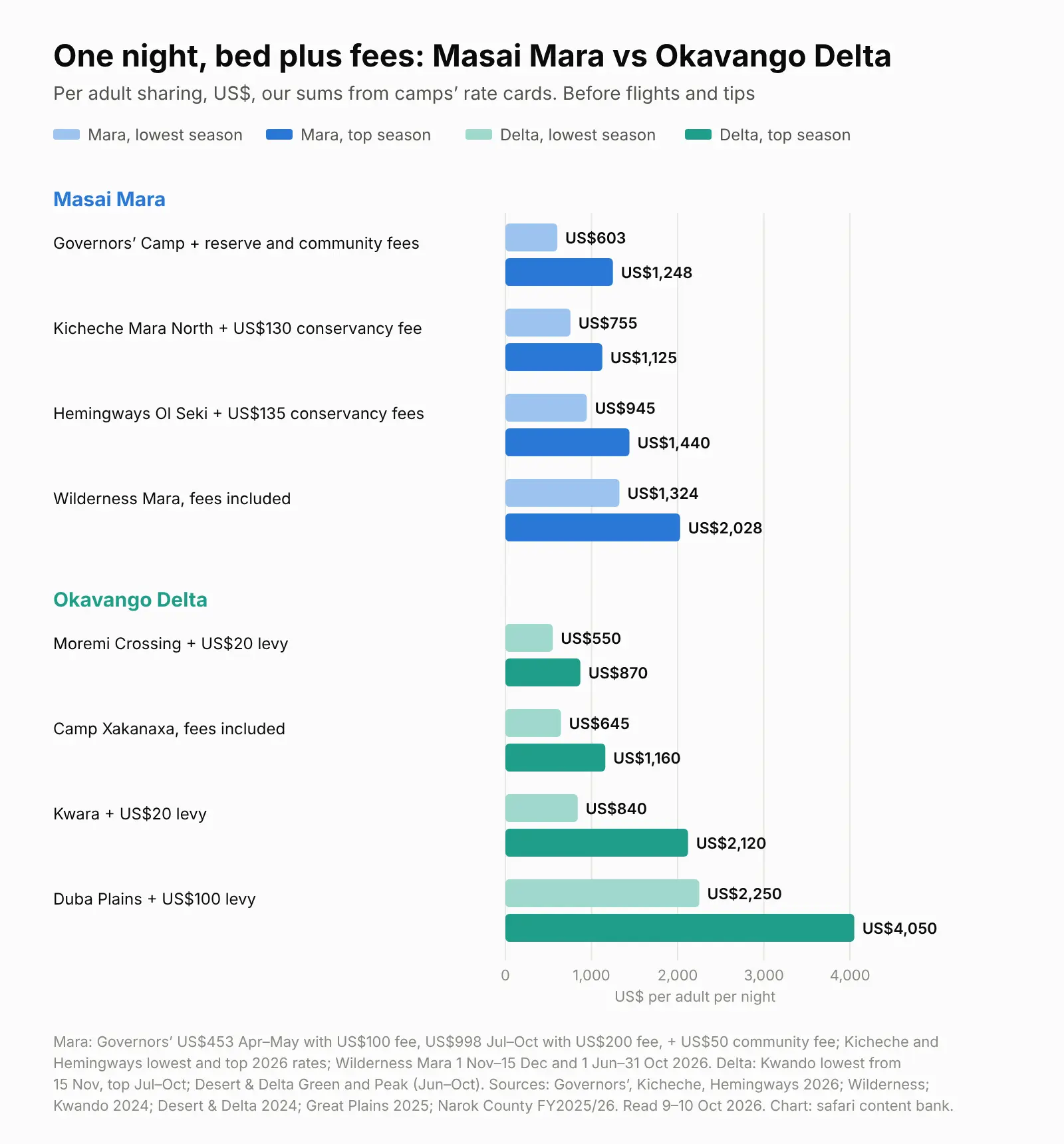 Our sums. Sources: Governors’, Kicheche and Hemingways 2026 rate sheets; Wilderness; Kwando 2024; Desert & Delta 2024; Great Plains 2025; Narok County FY2025/26 schedule (last published). Read 9–10 October 2026. Chart: safari content bank.
- Three fly-in nights in peak season cost about the same at the entry level of each: US$4,154 per person at Governors’ Camp in August with return flights from Nairobi, before tips, and US$4,188–4,808 at Camp Xakanaxa inside Moremi in June–October with flights from Maun and US$120 in tips (our sums on the Masai Mara and Okavango Delta cost pages).
- Season moves the Delta bill more. Three July nights at Kwara with levies and a Maun return seat come to US$6,860 per person before flight taxes, against US$3,020 from 15 November (Kwando 2024 card, our sums). Governors’ Camp rises 61% per day with fees from June to July.
- The Mara’s cheapest months are April and May, at US$603 a day with fees at Governors’ Camp, though many conservancy camps close; the Delta’s are January to March.
Whole-trip costs with worked examples: Masai Mara safari cost and Okavango Delta safari cost.
Visas, health and entry
Kenya charges before you fly: an eTA of US$30 plus a government health policy of up to US$44 (eCitizen). Botswana lets British citizens in for 90 days without a visa and charges no border levy. Malaria risk is year-round in Kenya and seasonal in northern Botswana. Checked 9–11 October 2026.
| Kenya (Masai Mara) | Botswana (Okavango Delta) | Source | |
|---|---|---|---|
| Visa or authorisation | No visa since 5 January 2024, no visa on arrival; eTA US$30 plus card charges at etakenya.go.ke, 3 working days | UK: visa-free, 90 days. Botswana Tourism: “most European and Commonwealth countries” need none; US citizens are not named; others use the eVisa, 7–14 days | Kenya eTA; Botswana visa |
| Compulsory insurance or levy | Government travel health policy required for arrivals since 5 October 2026, up to US$44 (eCitizen); your own policy not accepted | None. The US$30 tourism levy Bill was withdrawn on 11 December 2017 | Kenya visitor health insurance; Botswana visa |
| Children | Every child, infants included, needs their own eTA; no child discount | Full (unabridged) birth certificate naming both parents; families have been turned away without it | Kenya eTA; Botswana visa |
| Malaria | Risk all year in the entire country (WHO) | North high risk October–May, low June–September (TravelHealthPro) | Kenya vs Botswana |
| Yellow fever certificate | Only if arriving from a risk country | Needed if arriving from, or transiting through, a risk country; Kenya is one | Yellow fever and safaris |
Which malaria tablets to take is a decision for a travel clinic. Check the official Kenya eTA portal, not a third-party site, the week you apply, and confirm Botswana’s rules on evisa.gov.bw.
Can you combine the Masai Mara and the Okavango Delta?
Yes, but our sources hold no direct flight between Nairobi and Maun, and Botswana asks for a yellow fever certificate from travellers arriving from Kenya. Kenya is a yellow fever risk country, and Botswana asks for the certificate from travellers aged 1 and over arriving from, or transiting through, one (Yellow fever and safaris).
- Flights: Maun’s published links in our sources run to Windhoek, Livingstone and Lusaka; check the live timetable for a connection from Nairobi (Kenya vs Botswana).
- Season: July to September works for both: the herds are in the Mara and the Delta’s water is high or just past its peak.
- Luggage: pack to the Mara’s 15 kg light-aircraft limit and it fits the Delta’s 20 kg.
- The usual pairings are elsewhere. The Mara pairs with the Serengeti (Serengeti vs Masai Mara); the Delta with Chobe and Victoria Falls. The Delta against the Serengeti: Okavango Delta vs Serengeti.
Which should you choose?
Choose the Masai Mara for the wildebeest herds, resident big cats, a road-based or short-flight trip and a lower top end; choose the Okavango Delta for water, mokoro, wild dogs and concessions where few other vehicles reach the sightings. From July to September either works, for different sights.
| If you… | Pick | Why |
|---|---|---|
| Want the wildebeest herds or a river crossing | Masai Mara, July–October | Herds usually in the Mara from mid or late July, most in August–September |
| Want mokoro or boat trips | Okavango Delta | Late May–September on seasonal floodplains, all year on permanent water |
| Want the best published odds of wild dog | Okavango Delta | 61% of one operator’s Delta travellers; no Mara rate in our sources |
| Travel January–June | Masai Mara for half the reserve fee; the Delta from late May | Mara fee US$100 a day; the Loita herd calves in February–March; Delta water is low until the flood arrives |
| Want night drives or walks | Either, on private land | Mara conservancies (US$130 a night on top) or Delta concessions; not the Mara reserve or Moremi |
| Want fewer other vehicles | A Delta concession, or a Mara conservancy | Concessions admit only their own camps’ guests; the Mara reserve allows five vehicles at a sighting and travellers report queues |
| Are wary of small aircraft | Masai Mara | Nairobi to Sekenani Gate is tarmac all the way; the inner Delta has no road |
| Have 3–4 days | Masai Mara | About an hour’s flight from Nairobi; the Delta works best at three nights per camp, with a flight between camps |
| Want a top-end camp for less | Masai Mara | Wilderness Mara US$1,324–2,028 with fees; Delta top-end camps US$2,018–5,345 |
| Want the lowest malaria risk | Okavango Delta, June–September | TravelHealthPro rates the north low risk then; Kenya has risk all year |
Choosing between the two countries rather than the two places: see Kenya vs Botswana. Whichever you choose, check that your operator holds a current licence: see how to check a safari operator is licensed.
Common mistakes in Masai Mara vs Okavango Delta comparisons
| What you’ll often read | What is correct |
|---|---|
| “The Okavango floods in the rainy season” | It floods in the dry season: highest in most of the Delta about May–August, after Botswana’s rains of November–March. |
| “You can see the Great Migration in the Okavango Delta” | Botswana’s migration is zebra, between the Chobe floodplains and Nxai Pan; the wildebeest herds move between the Serengeti and the Masai Mara. |
| “The Masai Mara costs US$200 a day all year” | US$100 from 1 January to 30 June, US$200 from 1 July to 31 December, per non-resident adult, under Narok County’s last published schedule. |
| “Stay outside the Mara reserve to avoid the fee” | The rate is the same inside and outside. A camp outside saves it only on days you do not drive in. |
| “Night drives are part of any Mara or Delta safari” | Not in the Mara reserve or in Moremi. Only in Mara conservancies and on Delta private concessions. |
| “Botswana park fees are P500 from April 2026” | The P500 rise was announced, then reported postponed. The last published schedule (1 April 2022) gives P270; BOPA called the existing fee P380 in February 2026. Confirm with DWNP or your operator. |
| “A Delta camp price includes the flight” | Only at some groups. Great Plains includes air on 2+ nights; Kwando and Desert & Delta sell seats at US$220–594 one way (2024). |
| “Kenya visa on arrival” | Kenya has had no visa since January 2024; the eTA costs US$30, plus a government health policy of up to US$44, required for arrivals since 5 October 2026. |
Frequently asked questions
Which is better, the Masai Mara or the Okavango Delta? It depends on what you want to see and when. The Masai Mara has the wildebeest herds, usually from July to October, and resident big cats, and can be reached by road or a one-hour flight from Nairobi. The Okavango Delta has mokoro and boat trips, high water from about May to August, the best published wild dog odds in our sources and private concessions with night drives.
Is the Okavango Delta more expensive than the Masai Mara? At the top, yes. Delta camps publish US$530–5,345 per person a night with meals and activities (2024–2026 rate cards); Mara camps US$115–2,028, mostly before the reserve or conservancy fee. At entry level on private land the two overlap: Moremi Crossing costs US$550–870 a night with its levy, Kicheche Mara North US$755–1,125 with the conservancy fee (our sums). A return seat from Maun adds US$525–1,208 unless included, against US$410 from Nairobi to the Mara.
Which has higher park fees, the Masai Mara or the Okavango Delta? The Mara reserve: US$100 per non-resident adult a day from January to June and US$200 from July to December (Narok County’s last published schedule, FY2025/26). Moremi Game Reserve’s last published DWNP fee is P270 a day (1 April 2022), and Delta concession camps charge levies of US$20–100 a night instead; many Delta camps include the park fee in their rates. No official current Botswana tariff is published, so confirm with DWNP or your operator.
When is the best time to visit the Masai Mara and the Okavango Delta? July to October suits both: the herds are usually in the Mara, and the Delta’s game gathers at the water, which is highest to August. For half the Mara reserve fee and the Loita calving in the conservancies, go from January to June. For mokoro on the Delta’s seasonal floodplains, go between late May and September.
Can you see the Great Migration in the Okavango Delta? No. The wildebeest migration moves between Tanzania’s Serengeti and Kenya’s Masai Mara, where the herds usually are from July to October. Botswana’s migration is zebra, moving between the Chobe floodplains and Nxai Pan (Africa Geographic), outside the Delta.
Are night drives allowed in the Masai Mara and the Okavango Delta? Not in the Masai Mara reserve, where none are sold, and not in Moremi Game Reserve, where Botswana Tourism says night driving is prohibited. Some Mara conservancy camps and the Delta’s private concessions run them; ask each camp what it offers on your dates.
Can I combine the Masai Mara and the Okavango Delta on one trip? Yes, but our sources hold no direct flight between Nairobi and Maun, so plan a connection and check the live timetable. Carry a yellow fever certificate: Kenya is a risk country, and Botswana asks for one from travellers aged 1 and over arriving from or transiting through a risk country. Kenya’s eTA and health policy apply to the Kenyan leg only.
Which is less crowded, the Masai Mara or the Okavango Delta? The Delta’s private concessions, which admit only their own camps’ guests; no one counts vehicles at sightings on either side. Reviews of the Mara reserve describe 20 to 40 vehicles at a single sighting, although reserve visitors fell from 420,000 in 2023 to 213,000 in 2025. A Mara conservancy is the quieter Kenyan option.
Sources
- Fees: Narok County, Maasai Mara fee schedule FY2025/26 (PDF), the last published, expired 30 June 2026; The Kenya Times, 6 Aug 2026 (press, secondary); DWNP schedule of 1 April 2022 via Tourism Update, 23 Feb 2022; Botswana Daily News (BOPA), 24 Feb 2026; Gabz FM, 5 May 2026
- Rules: Narok County management plan via Business Daily; Kenyans.co.ke, Narok memo; Botswana Tourism, game viewing; Olare Motorogi Conservancy; The Ngami Times, 7 Sep 2026; one UK safari operator’s Moremi guide (name and link kept in our editor notes)
- Mara camp rates and conservancy fees (2026): Governors’, Kicheche, Hemingways, Offbeat, Porini and Porini Lion Camp factsheet, Wilderness Mara; agent listings and operators’ published package prices (names and links kept in our editor notes)
- Delta camp rates and levies: Kwando 2024; Desert & Delta 2024; Natural Selection 2026; Machaba 2026; Great Plains 2025; Wilderness camp pages; operators’ published package prices (names and links kept in our editor notes)
- Travel: Mombasa Air Safari 2026 schedule; Moremi Air and Desert & Delta fares from the Kwando and Desert & Delta 2024 cards
- Visitors and wildlife: Kenya Economic Survey 2026 via Business Daily; Statistics Botswana, Tourism Statistics Annual Report 2024 (PDF); Africa Geographic, zebra migrations; UNESCO, Okavango Delta; one UK safari operator’s sighting statistics, read September 2026
- Seasons: a camp operator’s migration guide; a Kenyan camp operator’s Loita migration page; a UK safari operator’s Okavango flood guide; two camp operators’ seasonal guides (names and links kept in our editor notes); Climates to Travel, Kenya (aggregator)
- Entry and health: Kenya eTA portal; evisa.gov.bw; WHO, TravelHealthPro and yellow fever rules as on our Kenya vs Botswana and yellow fever pages
- Traveller reports (opinion and experience, not official findings): TripAdvisor threads as linked in the text; a safari booking site’s Mara reviews and Botswana page, read 9–10 Oct 2026
- Our own pages for the detail: Masai Mara, Masai Mara park fees, Masai Mara safari cost, Nairobi to the Masai Mara, Mara reserve vs conservancies, Okavango Delta, Okavango Delta safari cost, water camp or land camp, Botswana park fees, Botswana night drives and walking, Kenya vs Botswana, Okavango Delta vs Serengeti
Fees, rates and times checked 9–11 October 2026. We will update this page when Narok County publishes a 2026/27 Mara fee schedule, when DWNP publishes a new fee schedule, an official current tariff or a start date for the increase reported postponed, when Kenya publishes an official price for the health policy, and when camps move to 2027 rates.
Ask for a quote
Tell us your dates and we send you a priced itinerary. Free, no obligation.
- Free quote, no obligation
- Trips run by licensed local operators