 Experience

Last verified · Next check due
On this page
- Nyerere vs Serengeti at a glance (2026)
- Park fees: one fee line, different extras
- What a day costs in each park
- Boats, walks, night drives and balloons
- Wildlife: the migration or wild dogs and the river
- When to go, and when Nyerere closes
- Getting there: Arusha or Dar es Salaam
- Crowds: how busy each park is
- Adding Zanzibar to either park
- Doing both on one trip
- Which should you choose?
- Common mistakes in Nyerere vs Serengeti comparisons
- Frequently asked questions
- Sources
Short answer: Choose the Serengeti for the wildebeest migration and a road safari from Arusha, with group camping trips from US$300 a day. Choose Nyerere for boat safaris, walks and night drives, about 4 hours by road from Dar es Salaam, with Zanzibar a short ferry or flight beyond. Park fees are identical: US$129.80–153.40 per adult a night inside either park (last published tariff, 2023/24). Most Nyerere camps close from mid-March to May.
Key facts
- The same park fees buy different safaris. Nyerere and the Serengeti share one TANAPA fee line: US$82.60 entry plus US$59–70.80 concession per adult per night (last published tariff, 2023/24). The Serengeti adds the migration and balloon flights; Nyerere adds boat safaris, night drives and fly camping.
- The cheapest trips are in the Serengeti. Group camping from Arusha costs US$300 per person per day with park fees; we found no group trip to Nyerere with park fees included. The lowest published camp rate is US$250 in the Serengeti and US$410 in Nyerere (agent listings, 2026–27).
- Nyerere is reached from Dar es Salaam, the Serengeti from Arusha. Dar es Salaam to Nyerere is 175 km and about 4 hours by road in one published travel-time table; Arusha to Seronera, in the central Serengeti, is 7–7.5 hours and crosses the Ngorongoro Conservation Area at US$70.80 per adult each way.
- Nyerere shuts in the long rains; the Serengeti stays open. Most Nyerere camps with published rates list a closure from mid-March to May; Serengeti camps publish their lowest rates for those months.
- Nyerere is twice the size and far less visited. It covers 30,893 km² against 14,763 km², and appears in 13 of 150 published Tanzania itineraries with a stated route in our dataset (9%), against 131 (87%) for the Serengeti.
- Only one published itinerary in our dataset visits both parks: a 14-day private fly-in safari that adds Tarangire, Ngorongoro and Ruaha (our count, captured 8 October 2026).
Nyerere vs Serengeti at a glance (2026)
Both are national parks run by Tanzania National Parks (TANAPA) on the same fee line, but the Serengeti is a savannah park on the northern road circuit and Nyerere a river park in the south, reached from Dar es Salaam. Circuit against circuit, with Ngorongoro, Tarangire and Ruaha: Tanzania’s northern or southern circuit. Nyerere against its southern neighbour: Ruaha vs Nyerere.
| Serengeti National Park | Nyerere National Park (former northern Selous) | Source | |
|---|---|---|---|
| Area | 14,763 km² | 30,893 km², Tanzania’s largest national park | A safari agent’s guide to Serengeti, read 10 October 2026; Wikipedia, Nyerere |
| Landscape | Plains, with the Grumeti and Mara rivers | The Rufiji River and its lakes | Serengeti; Nyerere |
| Park fees, a night inside, per adult | US$129.80–153.40 | US$129.80–153.40 | TANAPA 2023/24 (PDF), last published; our sums |
| Gateway | Kilimanjaro airport, then Arusha; 7–7.5 h by road to Seronera, or a light aircraft | Dar es Salaam: 175 km, about 4 h by road, or a light aircraft | One operator’s Serengeti guide; one operator’s travel-times table |
| Headline wildlife | The wildebeest migration: 1,366,109 counted at the end of March 2023 | Wild dog: about 800 in the Selous, one of Africa’s strongholds | TAWIRI 2023 (PDF); IUCN via CMS (PDF) |
| Activities beyond game drives | Walks with a TANAPA ranger, balloon flights; no night drives inside the park | Boat safaris, walks, night drives, fly camping | TANAPA 2023/24 |
| Cheapest published trip | Group camping from Arusha, US$300 a day, park fees included | None found with park fees included | Serengeti safari cost; Nyerere safari cost |
| Camp rates, per person a night | US$250–2,250 inside the park (2026–27) | US$410–1,375 (2026–27) | Lemala; agent listings |
| March–May | Long rains; camps such as Lemala Ewanjan publish their lowest rates | Most camps closed | 2026 camp listings |
| Visitors | 491,398 in the 2024/25 financial year | No count in our sources | The Citizen, 18 Dec 2025 |
Non-East African adult, with 18% VAT. TANAPA fees are the last published tariff, 2023/24; no later tariff had been published by 10 October 2026. Camp rates are agent listings and Lemala’s own rate page, as printed on our Serengeti and Nyerere pages; Serengeti rates exclude Singita’s Grumeti reserve outside the park (US$2,210–3,220). Checked 10 October 2026.
Park fees: one fee line, different extras
A night inside either park costs US$129.80 per adult from 15 March to 15 May, US$141.60 for most of the year and US$153.40 in July–September (entry plus concession; TANAPA, last published tariff, 2023/24; our sums). What differs is what you pay on top: the Ngorongoro crossing on the road to the Serengeti, and boat and guide fees in Nyerere.
| Fee, with 18% VAT (non-East African adult) | Serengeti | Nyerere |
|---|---|---|
| Entry, adult 16+, per 24 hours | US$82.60; US$70.80 from 15 Mar to 15 May | US$82.60; US$70.80 from 15 Mar to 15 May |
| Concession fee, per adult per night in a camp or lodge inside | US$59 Oct–Jun; US$70.80 Jul–Sep | US$59 Oct–Jun; US$70.80 Jul–Sep |
| A night inside, entry + concession (our sum) | US$129.80–153.40 | US$129.80–153.40 |
| 3 nights inside (our sums) | US$389.40 / US$424.80 / US$460.20 | US$389.40 / US$424.80 / US$460.20 |
| Ngorongoro Conservation Area entry on the road in | US$70.80 per adult each way, single entry (NCAA’s page does not say whether VAT is included) | None |
| Guide or ranger fee, per group per day | US$23.60 (ranger, for walks) | US$47.20 |
| Walking safari, per adult | US$23.60 (1–4 h) or US$29.50 (over 4 h) | US$23.60 (1–4 h) or US$29.50 (over 4 h) |
| Boating safari, per person | Not sold | US$23.60 |
| Night game drive | Not allowed inside the park | US$59 adult; US$29.50 child |
| Balloon operation fee, per person per flight | US$59 (the flight itself is extra) | None in our sources |
| Fly campsite, per adult per night (booked in advance) | Not priced for the Serengeti in our sources | US$59 |
| Public campsite, per adult per night | US$35.40 | US$35.40 |
Sources: TANAPA Tariffs 2023/24 (PDF), the last published tariff, valid 1 July 2023 to 30 June 2024; on 9 October 2026 still the only tariff on TANAPA’s “Park Fees and Regulations” page. NCAA tariffs, undated, read 9 October 2026. Amounts as printed on our Serengeti park fees, Nyerere safari cost and Tanzania park fees pages. The 3-night columns are 15 Mar–15 May, 16 May–30 Jun and 1 Oct–14 Mar, and 1 Jul–30 Sep.
- Driving into the Serengeti adds US$141.60 per adult, two Ngorongoro crossings at US$70.80 each (single entry per 24 hours; Ngorongoro park fees). Nothing comparable applies on the road to Nyerere.
- Two adults on a short walk pay US$70.80 in TANAPA fees in the Serengeti and US$94.40 in Nyerere (our sums: 2 × US$23.60 plus the ranger or guide fee), because Nyerere’s guide fee is twice the usual rate.
- No fee rise is due without notice. TANAPA froze fee increases for 12 months on 24 March 2025 (The Citizen), and in May 2025 the government promised “a minimum of 12 months’ notice before any future changes” (Tourism Update).
The official fee lines, with the date each took effect and the authority’s own source:
| Fee | Amount | In force from | Source |
|---|---|---|---|
| Serengeti and Nyerere National Parks, non-East African adult, entry per day, 16 May–14 Mar | USD 70 + 18% VAT = USD 82.60 | 1 Jul 2023 (2023/24 tariff, last published) | TANAPA Tariffs 2023/24 |
| Serengeti and Nyerere National Parks, non-East African adult, entry per day, 15 Mar–15 May | USD 60 + 18% VAT = USD 70.80 | 1 Jul 2023 (2023/24 tariff, last published) | TANAPA Tariffs 2023/24 |
| Serengeti and Nyerere, concession fee per person per night inside the park | Jul–Sep USD 60 + VAT = USD 70.80; Oct–Jun USD 50 + VAT = USD 59 | 1 Jul 2023 (2023/24 tariff, last published) | TANAPA Tariffs 2023/24 |
| Nyerere boating safari fee, per person | USD 20 + 18% VAT = USD 23.60 | 1 Jul 2023 (2023/24 tariff, last published) | TANAPA Tariffs 2023/24 |
| Nyerere guide or ranger fee, per group per day (USD 20 in most other parks) | USD 40 + 18% VAT = USD 47.20 | 1 Jul 2023 (2023/24 tariff, last published) | TANAPA Tariffs 2023/24 |
| Walking safari, adult, per person (Nyerere and other TANAPA parks) | Short (1–4 h) USD 20, long (over 4 h) USD 25; + 18% VAT = USD 23.60 / USD 29.50 | 1 Jul 2023 (2023/24 tariff, last published) | TANAPA Tariffs 2023/24 |
| Serengeti walking safari, per person, plus ranger fee per group per day | Short (1–4 h) USD 20, long (over 4 h) USD 25; ranger USD 20; all + 18% VAT | 1 Jul 2023 (2023/24 tariff, last published) | TANAPA Tariffs 2023/24 |
| Night game drive (Katavi, Ruaha, Mikumi, Tarangire, Lake Manyara, Nyerere, Burigi-Chato, Ibanda-Kyerwa), per person | Adult USD 50 + VAT = USD 59; child USD 25 + VAT = USD 29.50 | 1 Jul 2023 (2023/24 tariff, last published) | TANAPA Tariffs 2023/24 |
| Fly campsite, adult, per night (booked in advance) | USD 50 + 18% VAT = USD 59 | 1 Jul 2023 (2023/24 tariff, last published) | TANAPA Tariffs 2023/24 |
| Serengeti balloon operation fee, per person per flight | USD 50 + 18% VAT = USD 59 | 1 Jul 2023 (2023/24 tariff, last published) | TANAPA Tariffs 2023/24 |
| TANAPA public campsite, adult, per night (all parks except Kilimanjaro, Ugalla and Kigosi) | USD 30 + 18% VAT = USD 35.40 | 1 Jul 2023 (2023/24 tariff, last published) | TANAPA Tariffs 2023/24 |
| Ngorongoro Conservation Area, non-East African adult, entry per 24 h (single entry) | USD 70.80 (NCAA's page does not say whether VAT is included) | Undated official page, read 9 Oct 2026 | NCAA |
What a day costs in each park
The Serengeti is cheaper at the budget end, with group camping from US$300 a day; in the mid-range the two overlap at about US$480–900 a day, and at the top the Serengeti costs more, up to US$2,403.40 a day. All prices are per person sharing, park fees included, without international flights.
| Per person per day, park fees included | Serengeti | Nyerere | Source |
|---|---|---|---|
| Group camping trip | US$300 (3 days from Arusha with Ngorongoro, US$900) | None found with park fees included | One operator’s published 2026 price, read 9 Oct 2026 |
| Camping, park fees only (own kit and vehicle) | US$106.20–118 | US$106.20–118 | TANAPA 2023/24; our sums |
| Mid-range camp | US$479.80–898.40 (Serengeti Wilderness Camp, Lemala Ewanjan, with half a private vehicle for two) | US$551.60–835.40 (Rufiji River Camp, Selous Impala Camp, game drives included) | Our cost pages |
| Luxury camp | US$869.80–2,403.40 (Namiri Plains, Sayari) | US$1,091.60–1,528.40 (Roho ya Selous, Beho Beho) | Our cost pages |
| Lowest camp rate, before fees | Serengeti Wilderness Camp US$250 (Apr–May, 1 Nov–14 Dec) | Rufiji River Camp US$410 (June, 1 Nov–23 Dec) | Agent listings, 2026–27 |
Our sums = camp rate + entry and concession fees for one adult (last published tariff, 2023/24), plus, for the Serengeti mid-range, half the US$200–300 daily price of a private vehicle and guide. Nyerere’s camps include game drives, so no vehicle is needed once you are there. As printed on our Serengeti safari cost and Nyerere safari cost pages; read 8–10 October 2026.
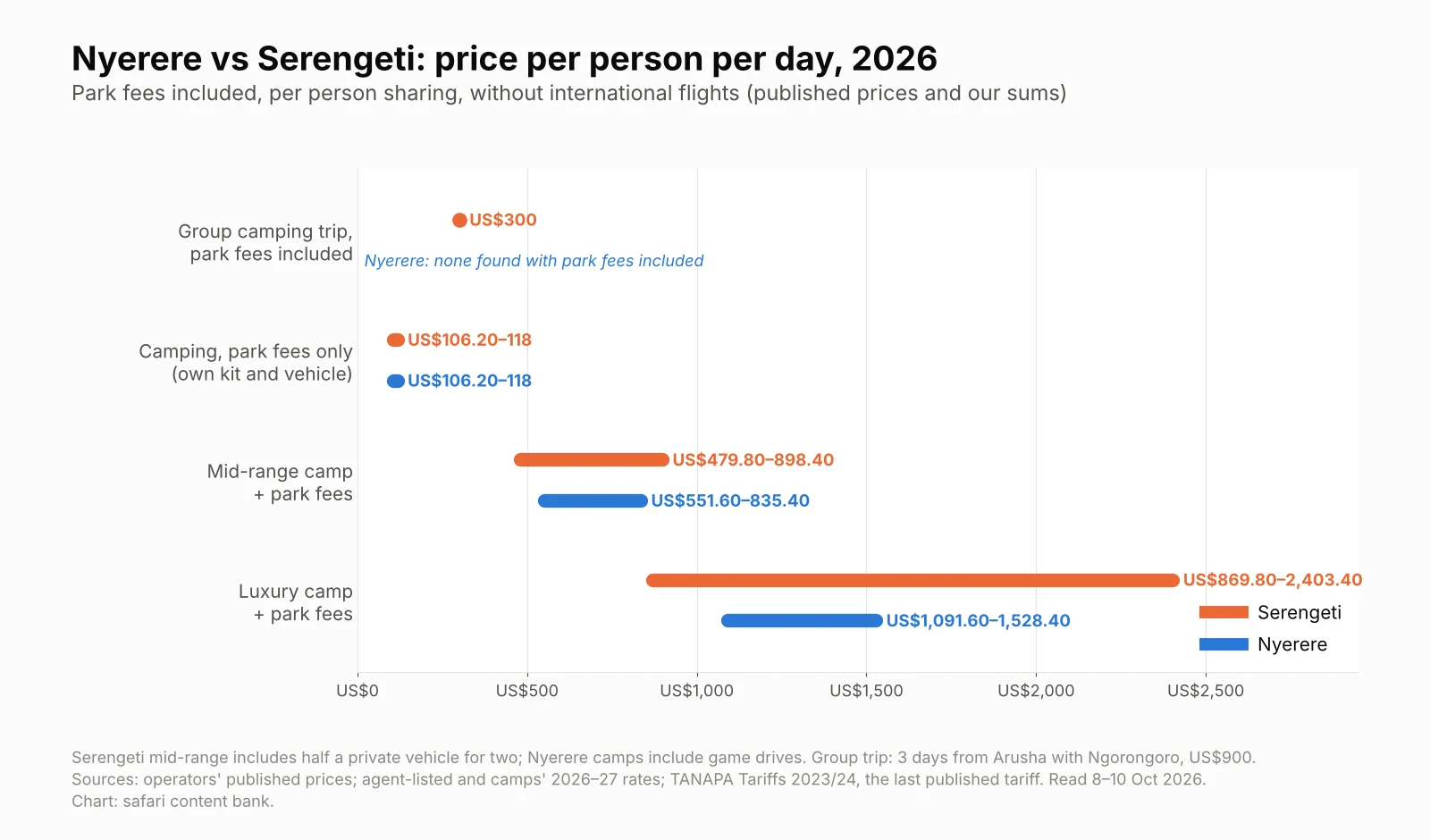 Published prices and our sums of camp rates, TANAPA fees (last published tariff, 2023/24) and vehicle, read 8–10 October 2026. Sources: operators’ published prices; Lemala; agent listings. Chart: safari content bank.
Three nights mid-range by road, two sharing a private vehicle (our sums):
| Per person | Serengeti: Lemala Ewanjan, from Arusha | Nyerere: Rufiji River Camp, from Dar es Salaam |
|---|---|---|
| Low season | US$1,846–2,046 (April to mid-May 2027) | US$1,854.80–1,954.80 (1 Nov–23 Dec 2026) |
| Peak season | US$2,786.80–2,986.80 (July–September 2026) | US$2,100.20–2,200.20 (July–September) |
| Of which park fees | US$389.40–460.20, plus US$141.60 for two Ngorongoro crossings | US$424.80–460.20 |
| Of which vehicle | 4 days, US$400–600 | 2 days, US$200–300 (transfers only) |
From the worked examples on our Serengeti safari cost and Nyerere safari cost pages: Lemala’s own rates; Rufiji River Camp from an agent listing; vehicle and guide US$200–300 a day (one operator’s published price). Tips, visa and insurance not included.
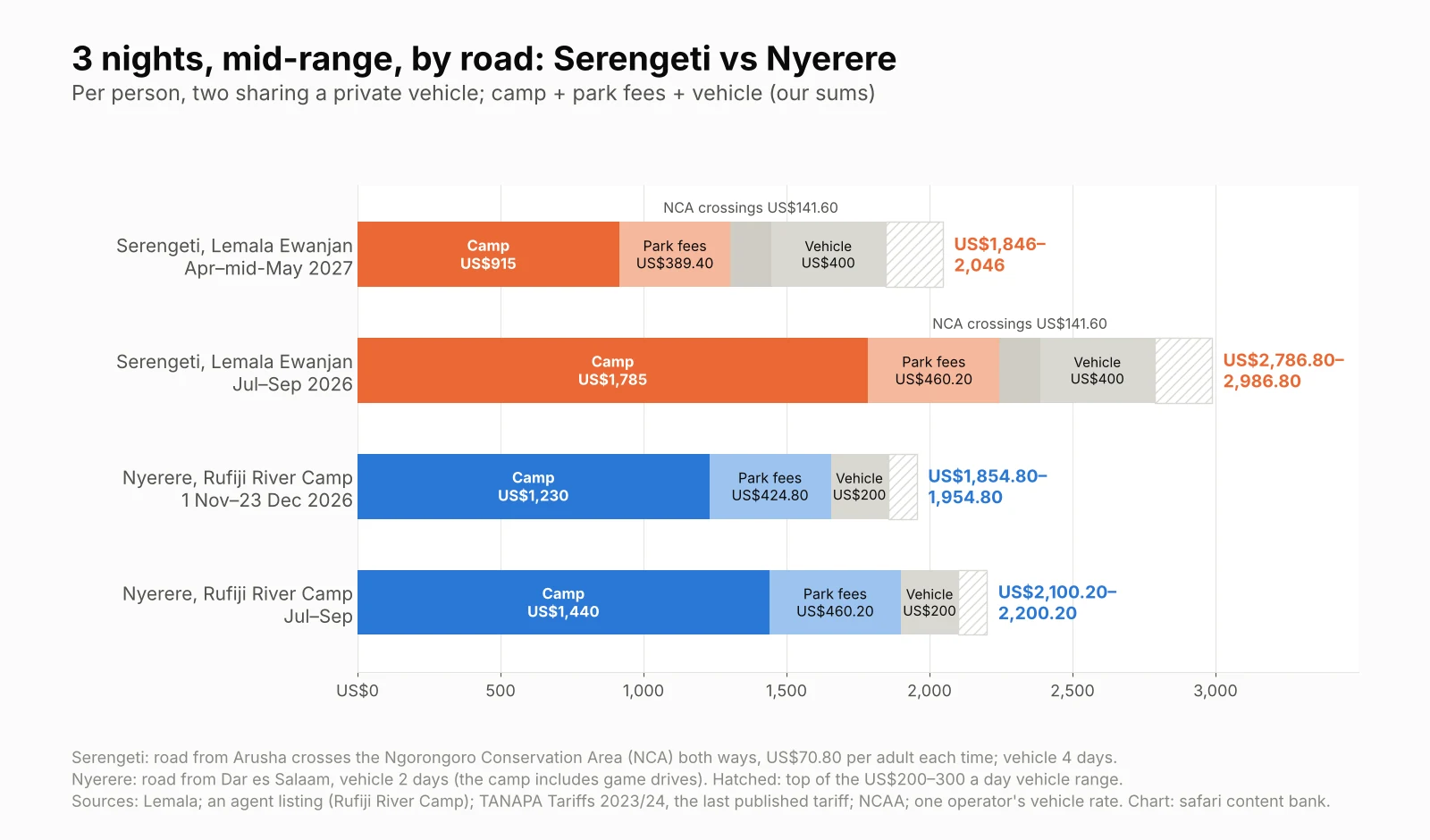 Our sums of camp rates, park fees, Ngorongoro crossings and a US$200–300 vehicle shared by two. Sources: Lemala; an agent listing; TANAPA Tariffs 2023/24, the last published tariff; NCAA; one operator’s vehicle rate. Chart: safari content bank.
- In peak season Nyerere’s mid-range comes out cheaper by road, because its camps include game drives, so you pay the vehicle for two days, not four, and there is no Ngorongoro crossing.
- At the luxury end the Serengeti’s peak is much higher. Three nights at Namiri Plains cost US$2,609.40 in April–May and US$7,210.20 in July–September; at Roho ya Selous US$3,274.80–4,090.20, before flights in both cases (our sums).
- Ask what the rate includes. Namiri Plains, Sayari and Lemala exclude park fees, and so does Roho ya Selous; budget group trips from Arusha include them.
Country-wide prices, visa and insurance: Tanzania safari cost.
Boats, walks, night drives and balloons
Nyerere sells boat safaris, walks, night drives and fly camping inside the park; the Serengeti sells walks and balloon flights but no night drives. Each is a TANAPA fee line on top of entry, and camps or balloon companies add their own charge.
| Activity | Serengeti | Nyerere | TANAPA fee, with VAT |
|---|---|---|---|
| Boat safari | None in our sources | On the Rufiji and its lakes | Nyerere US$23.60 per person |
| Night game drive | Not inside the park; the private concessions on its edge, Grumeti in the west and Klein’s in the north-east, sell them at their own rates | On TANAPA’s list | US$59 adult, US$29.50 child |
| Walking safari | With a TANAPA ranger | “In the company of an armed ranger” (a safari agent’s guide, read 9 October 2026) | US$23.60 (1–4 h) or US$29.50 (over 4 h) per adult, plus US$23.60 (Serengeti ranger) or US$47.20 (Nyerere guide) per group per day |
| Fly camping | Not priced for the Serengeti in our sources | Sand Rivers, Selous Impala and Rufiji River Camp run fly-camps | US$59 per adult per night |
| Hot-air balloon | Yes; no balloon company in our sources prints its own price, and one tour operator’s 2026 guide gives US$600–799 | None in our sources | Serengeti US$59 per person per flight |
Sources: TANAPA Tariffs 2023/24 (PDF), the last published tariff; camps and fly-camps as on our Nyerere page; balloon price as on our hot-air balloon safari page, read 9 October 2026.
- A boat day in Nyerere costs US$106.20 in TANAPA fees in the main season: US$82.60 entry plus the US$23.60 boat fee (our sum, as on our boat safari page). Some camps include boat trips in their rate, Beho Beho among them.
- Night drives are a southern option in Tanzania. TANAPA’s night-drive list names Nyerere, not the Serengeti; see Tanzania safari questions and night drive safaris.
- Walking is best from June to October in Nyerere, in a tour operator’s walking guide. Rules and costs across Africa: walking safaris.
Wildlife: the migration or wild dogs and the river
The Serengeti has the wildebeest migration and is one of Africa’s lion strongholds; Nyerere has one of Africa’s wild dog strongholds, elephants and a river system you explore by boat. Neither park publishes sighting rates in our sources.
| Serengeti | Nyerere | Source | |
|---|---|---|---|
| Wildebeest | 1,366,109 at the end of March 2023 (aerial count); fewer than 600,000 in August 2022 and 2023 (satellite study) | No migration | TAWIRI 2023 (PDF); Mongabay, 3 Oct 2025 |
| Lion | One of four strongholds with more than 1,000 lions each (Craig Packer, 2012) | So is the Selous (same source) | PBS, 6 Sep 2012 |
| Wild dog | No dated count or sighting rate in our sources | About 800 in the Selous | IUCN via CMS (PDF) |
| Elephant | No verified count in our sources | About 13,000 in 2013, down from more than 100,000 in the mid-1970s | Wikipedia, Nyerere |
| Birds | No species count in our sources | About 440 species | A safari agent’s guide to Nyerere, read 9–10 October 2026 |
Read 9–10 October 2026. Counts are from different years and methods; none is a sighting rate.
- Quote the wildebeest figure with its method and date. The two latest counts differ by more than half because they used different methods in different months (Serengeti).
- Lions, country-wide: Tanzania holds more than 8,000 of Africa’s about 23,000 wild lions (CITES, 2023, PDF).
- Rhino, national counts only: Tanzania’s 2025 census counted 285 black rhinos in the whole country (The Star / Xinhua, 22 Sep 2026). We do not publish where rhino are found; see where to see rhino.
- For wild dog, Nyerere is the Tanzanian pick; parks with published sighting rates are on where to see wild dogs.
When to go, and when Nyerere closes
The Serengeti has something every month because the herds move; Nyerere is a dry-season park, best from June to October and mostly shut from mid-March to May. Park fees follow the same calendar in both.
| Months | Serengeti | Nyerere |
|---|---|---|
| January–February | Herds on the southern plains around Ndutu; calving peaks around February (Ndutu is in the Ngorongoro Conservation Area, so NCAA fees apply). Serengeti station 80–100 mm of rain | Camps open at lower rates; Dar es Salaam 55–75 mm |
| March–May | Long rains, 155 mm in April; herds pass Seronera in April–May. Entry US$70.80 from 15 Mar to 15 May; lowest camp rates (Serengeti Wilderness Camp US$250, Namiri Plains US$740 against US$2,250 in peak) | Closures listed: Sand Rivers March–May; Roho ya Selous and Beho Beho 15 March–31 May; Rufiji River Camp lists a rate to 31 May. “Some parts of the park are temporarily closed for game drives due to poor accessibility” (a safari agent’s guide, read 8–10 October 2026). April 255 mm at Dar es Salaam |
| June | Western Corridor; Grumeti River crossings in about the first half of June | Camps reopen at low-season rates |
| July–September | Mara River crossings in the north (Kogatende, Lamai); July the driest month (15 mm); concession US$70.80 | Peak dry season, peak camp rates (Sand Rivers US$950); concession US$70.80; Dar es Salaam 25 mm |
| October | Herds move south through Lobo; Lemala Mara Tented Camp US$560 against US$825 in July–September; concession back to US$59 | Concession back to US$59 on 1 October; peak camp rates to 31 October; Dar es Salaam 70 mm |
| November–December | Short rains (115 mm in November); herds head back south | On 1 November Sand Rivers drops to US$625 and Rufiji River Camp to US$410; Dar es Salaam 125 mm in November |
Typical year, not a forecast: herd timing “is entirely dependent upon the rainfall patterns each year” (one safari operator’s migration guide). Rain: Climates to Travel (an aggregator), Serengeti and Dar es Salaam stations; there is no station inside Nyerere. Camp seasons: 2026–27 rates as on our Serengeti and Nyerere pages; game-drive closures: a safari agent’s guide. Fees: TANAPA 2023/24, the last published tariff. Read 8–10 October 2026.
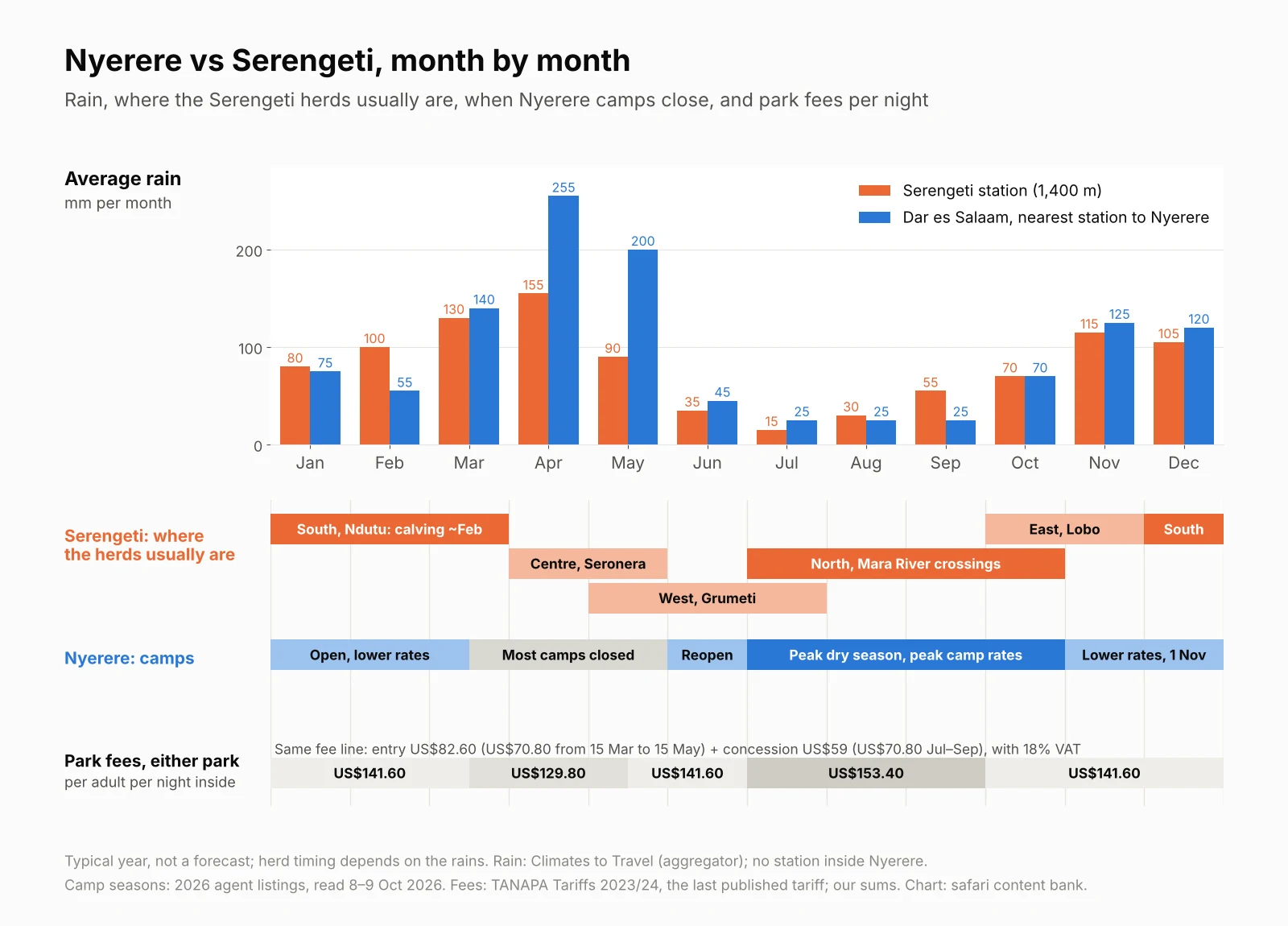 Rain: Climates to Travel (aggregator). Herds: our Serengeti page. Camp seasons: 2026 agent listings, read 8–9 October 2026. Fees: our sums from TANAPA Tariffs 2023/24, the last published tariff. Chart: safari content bank.
- Mid-March to May is the Serengeti’s low season and Nyerere’s closed season. Both parks charge US$70.80 entry from 15 March to 15 May, but most Nyerere camps are closed, while Serengeti camps such as Lemala Ewanjan publish March–May rates; a TripAdvisor destination expert warned of heavy rain “most of April” and plains away from Seronera that may be impassable (TripAdvisor; a traveller forum).
- November is Nyerere’s value month. Camps drop their rates on 1 November and stay open, while park fees stay at US$141.60 a night.
- For the migration, plan by month, not by park: where the herds are each month, the calving season and the river crossings. Wet-season trade-offs: green-season safaris.
Getting there: Arusha or Dar es Salaam
The Serengeti starts at Kilimanjaro airport and Arusha, then a long drive or a light aircraft; Nyerere starts at Dar es Salaam, about 4 hours by road or a short flight.
| Route | Serengeti | Nyerere | Source |
|---|---|---|---|
| Gateway airport | Kilimanjaro (JRO), then Arusha: 55 km, about 1 h 20 | Dar es Salaam; light aircraft also fly from Zanzibar | One operator’s travel-times page; Nyerere |
| By road | Arusha → Seronera 7–7.5 h, via the Ngorongoro Conservation Area (US$70.80 per adult each way) | Dar es Salaam → Nyerere 175 km, about 4 h via Kisarawe; the road to the eastern Mtemere gate ends in 90 km of gravel, “very challenging in the rainy season” | One operator’s Serengeti guide; NCAA; one operator’s travel-times table; a self-drive operator’s guide |
| By air | Arusha or Kilimanjaro → Serengeti airstrips 1–2 h; Flightlink and Regional Air serve the park. Fares not printed: our sources disagree | Dar es Salaam → Nyerere US$150–220 one way, 10–15% more June–October (secondary source); no verified flight time | One operator’s Serengeti guide; a travel-guide site relaying Coastal Aviation’s fares, 2 Jun 2026 |
| Vehicle once there | A vehicle and guide every day, about US$200–300 per vehicle per day, unless the camp includes drives | Camps include game drives; the vehicle is only needed for the transfer | One operator’s published price |
| Airstrip supplement | None in our sources | Safari Air Link adds US$30 for “Selous Upper” (Stiegler’s, Sumbazi) | Safari Air Link 2026–27 (PDF) |
| From Kenya | No road from the Masai Mara: the Bologonja border has been closed since 1977; you fly | Not on a Kenya route | Mara to Serengeti |
Times as published by each source, read 9–10 October 2026, as printed on our Serengeti, Serengeti safari cost, Nyerere and Nyerere safari cost pages; operators, the self-drive guide and the travel-guide site are unnamed, with their names kept in our editor notes.
- For two sharing, the road to Nyerere costs US$200–300 each, in and out, and a return flight US$300–440 each (our sums, as on Nyerere safari cost). The Serengeti road trip needs the vehicle every day.
- Tourists are not driven outside towns after dark, so a same-day road transfer needs a flight landing at Kilimanjaro, Arusha or Dar es Salaam before 13:00 (one operator’s travel-times page).
- Auric Air allows 20 kg including hand luggage on its light aircraft (Auric Air), and lists both parks among its destinations.
Entry documents are the same for both: a tourist visa at US$50 (US$100 for US citizens), see Tanzania visa, and the compulsory inbound travel insurance at US$44, see Tanzania visitor insurance.
Crowds: how busy each park is
The Serengeti is Tanzania’s busiest safari park and Nyerere one of its quietest, but no Tanzanian authority publishes vehicle counts at sightings, so the evidence is visitor figures, itinerary counts and traveller reports.
| Measure | Serengeti | Nyerere | Source |
|---|---|---|---|
| Visitors to the park | 491,398 in the 2024/25 financial year, up from 430,219 | No visitor count in our sources | The Citizen, 18 Dec 2025 |
| Share of surveyed international visitors, 2025 | 13.1% | Not in the top five | Bank of Tanzania, 2025 exit survey (PDF) |
| Published itineraries that include the park | 131 of 150 (87%) | 13 of 150 (9%) | Our count of operators’ published Tanzania itineraries with a stated route, captured 8 October 2026 |
| Area per visitor | 14,763 km² for nearly half a million visitors | 30,893 km², about twice the area | A safari agent’s guide, read 9–10 October 2026; Wikipedia |
| Vehicles at one sighting | No count published | No count published | — |
Visitor shares are the share of surveyed visitors who went to each attraction, not park entries. Read 9–10 October 2026.
What travellers report (traveller reports, not counts):
- Serengeti river crossings: “it is not uncommon for fifty or more trucks to be parked” at a crossing point, according to a regular on the Serengeti forum (TripAdvisor).
- Calving season, just outside the park: at Ndutu, in the Ngorongoro Conservation Area, one reviewer wrote that it “was common to see 15–20 vehicles at a single sighting” in March 2026 (TripAdvisor).
- The south: “on rencontre moins de monde sur les pistes”, you meet fewer people on the tracks, a French forum post said of southern Tanzania in May 2026 (Routard).
Adding Zanzibar to either park
Both parks pair easily with Zanzibar: from the Serengeti side by a one-hour flight from Kilimanjaro, from US$200 one way; from Nyerere by light aircraft, or back to Dar es Salaam by road and over by fast ferry or a 25-minute flight. One visa and one insurance policy cover the mainland and Zanzibar.
| Route to Zanzibar, one way | Time | Fare per person | Source |
|---|---|---|---|
| Kilimanjaro (JRO) → Zanzibar (Serengeti side) | 13:00 → 14:00 | From US$200 | Flightlink, read 9 Oct 2026 |
| Arusha → Zanzibar (Serengeti side) | Not obtained | US$200–280; about 10–15% more June–October | A travel-guide site relaying Coastal Aviation’s fares, 2 Jun 2026 (secondary) |
| Ndutu or Kogatende (Serengeti) → Zanzibar | About 2 h 45 from Ndutu; about 3 h, with stops, from Kogatende | Not published per route | One operator’s travel-times page |
| Nyerere → Zanzibar | Light aircraft in published southern itineraries | No verified fare or time | Operators’ published southern itineraries (unnamed) |
| Nyerere → Dar es Salaam → Zanzibar, road and fast ferry | About 4 h by road, then 1.5–2 h by ferry | Ferry from about US$42 economy | One operator’s travel-times table; Seat61, April 2026 |
| Dar es Salaam → Zanzibar, flight | 25 minutes | Not collected | One operator’s travel-times page |
As printed on our Tanzania safari and Zanzibar and Nyerere pages, read 9 October 2026. Flightlink fares include taxes and fuel.
- Zanzibar is on a similar share of trips to each park: 3 of the 13 published Nyerere itineraries in our dataset include Zanzibar, and 26 of the 131 Serengeti itineraries (our count, captured 8 October 2026).
- April and May are weak for both halves of a Nyerere trip: most Nyerere camps are closed, Zanzibar averages 385 mm of rain in April, and some beach hotels close (Pongwe Beach Hotel 10 April–31 May). A Serengeti trip in those months has its camps open.
- From Zanzibar, a short southern safari is one option. On a June–July 2026 forum thread, a destination expert told honeymooners in Zanzibar to do a southern park such as Nyerere first, then fly to Zanzibar (TripAdvisor; a traveller forum, not official advice).
- One insurance policy, for your first port of entry, US$44 per adult; arriving in Zanzibar first, you buy Zanzibar’s policy instead (UK FCDO).
Routing, beach hotel prices and Zanzibar taxes: Tanzania safari and Zanzibar.
Doing both on one trip
It can be done, but published trips rarely do it: one of the 13 Nyerere itineraries in our dataset also visits the Serengeti, a 14-day private fly-in safari through Tarangire, Ngorongoro, the Serengeti, Ruaha and Nyerere with park fees and internal flights included (our count, captured 8 October 2026).
- No north–south flight is priced in our sources. Published trips that do both include the flight in the package price (Tanzania’s northern or southern circuit).
- The fees do not change: three nights in each park in July–September cost US$920.40 per adult in park fees (2 × US$460.20; our sum, last published tariff, 2023/24).
- Plan the pair for June to mid-March, when Nyerere’s camps are open; in July–October that means the Serengeti’s northern river-crossing season.
Which should you choose?
Choose the Serengeti for the migration, a first safari on a budget, balloon flights or a trip from mid-March to May; choose Nyerere for boats, night drives, wild dogs, a quieter park and a short trip from Dar es Salaam or Zanzibar. The park fees are the same either way.
| If you… | Pick | Why |
|---|---|---|
| Want the wildebeest migration | Serengeti | 1,366,109 wildebeest (TAWIRI, 2023); there is none in Nyerere |
| Want a boat safari | Nyerere | US$23.60 per person on the Rufiji and its lakes; none in the Serengeti in our sources |
| Want a night drive inside the park | Nyerere | US$59 per adult; not allowed inside the Serengeti |
| Want a balloon flight | Serengeti | US$59 park fee per flight; one tour operator gives US$600–799 for the flight |
| Have the lowest budget | Serengeti | Group camping from Arusha at US$300 a day with park fees; none found for Nyerere |
| Have 3 nights or fewer from Dar es Salaam or Zanzibar | Nyerere | About 4 hours by road from Dar es Salaam |
| Travel mid-March to May | Serengeti | Camps open at their lowest rates; most Nyerere camps are closed |
| Want wild dog | Nyerere | About 800 in the Selous (IUCN); no Serengeti count in our sources |
| Want fewer vehicles | Nyerere | In 9% of published itineraries, against 87% for the Serengeti |
| Count park fees | Either | US$129.80–153.40 a night in both (last published tariff, 2023/24) |
| Want walking | Either | Same walking fee; Nyerere’s guide fee is US$47.20 per group per day, the Serengeti’s ranger fee US$23.60 |
Whichever you choose, check that your operator holds a current licence. More on Tanzania; safety and health: is a Tanzania safari safe? See also: Serengeti vs Masai Mara, Serengeti vs Ngorongoro and Ruaha vs Nyerere.
Common mistakes in Nyerere vs Serengeti comparisons
| What you’ll often read | What is correct |
|---|---|
| “Nyerere (the Selous) is the cheap alternative to the Serengeti” | Park fees are the same: US$82.60 entry and US$59–70.80 concession per adult per night (last published tariff, 2023/24). Nyerere’s lowest camp rate, US$410, is above the Serengeti’s US$250. |
| “You can see the migration in Nyerere” | You cannot. The herds move between the southern Serengeti, around Ndutu, and Kenya’s Masai Mara. |
| “Add a night drive in the Serengeti” | Not inside the park. Night drives are sold in Nyerere and in the private concessions on the Serengeti’s edge. |
| “Nyerere is open all year, like the Serengeti” | Most Nyerere camps close from mid-March to May; Serengeti camps such as Serengeti Wilderness Camp and Lemala Ewanjan publish rates for those months. |
| “Driving to the Serengeti costs only the park fee” | The road from Arusha crosses the Ngorongoro Conservation Area at US$70.80 per adult each way. |
| “Nyerere entry is US$70 a day” | US$70 is before VAT. You pay US$82.60 (US$70.80 from 15 March to 15 May), the Serengeti’s rate. |
| “Nyerere is still the Selous Game Reserve” | The photographic north has been Nyerere National Park, run by TANAPA, since 2019; the reserve to the south stays under the Tanzania Wildlife Management Authority (TAWA). |
Frequently asked questions
Which is better, Nyerere or the Serengeti? It depends on what you want to do. The Serengeti has the wildebeest migration, balloon flights and the cheapest group trips, from US$300 a day. Nyerere has boat safaris, night drives and wild dogs, is far less visited, and is about 4 hours by road from Dar es Salaam. Park fees are the same: US$129.80–153.40 per adult a night (last published tariff, 2023/24).
Is Nyerere cheaper than the Serengeti? Not in park fees: both are on the same TANAPA line, US$82.60 entry plus US$59–70.80 concession per adult per night (last published tariff, 2023/24). Mid-range camps with fees cost about US$480–900 a day in the Serengeti and US$550–835 in Nyerere. The cheapest trips are Serengeti group camping trips at US$300 a day, and the dearest luxury camps in our sources are in the Serengeti too.
Can you see the Great Migration in Nyerere? No. The wildebeest migration moves between the southern Serengeti, around Ndutu, and Kenya’s Masai Mara; Nyerere is not on its route. For the herds, plan by month with where the herds are each month.
Can you do a boat safari or a night drive in the Serengeti? Not inside the park. TANAPA’s night-drive list names Nyerere but not the Serengeti, and we found no boat safari in the Serengeti. The private concessions on its edge, Grumeti and Klein’s, sell night drives and walks at their own rates. In Nyerere a boat safari costs US$23.60 per person and a night drive US$59 per adult in TANAPA fees.
Which park is better to combine with Zanzibar? Both work. From the Serengeti side, Flightlink flies Kilimanjaro–Zanzibar from US$200 one way. From Nyerere, published southern itineraries fly to Zanzibar by light aircraft, or you drive back to Dar es Salaam, about 4 hours, and take the fast ferry, 1.5–2 hours from about US$42. Avoid April–May for Nyerere and Zanzibar: most Nyerere camps are closed.
When should you go to Nyerere or the Serengeti? Nyerere from June to October, or November to mid-March for lower camp rates; most camps close from mid-March to May. The Serengeti all year: calving around February in the south, the Western Corridor around June, the Mara River crossings from July to October, and its lowest rates in the long rains, April–May.
Can you visit Nyerere and the Serengeti on one trip? Yes, by light aircraft, but it is rare: one of the 13 published Nyerere itineraries in our dataset also visits the Serengeti, a 14-day private fly-in safari with park fees and flights included. We found no priced north–south flight. Three nights in each park in July–September cost US$920.40 per adult in park fees (our sum).
Which park is less crowded, Nyerere or the Serengeti? Nyerere, on every measure we have. The Serengeti had 491,398 visitors in the 2024/25 financial year and appears in 87% of published Tanzania itineraries in our dataset; Nyerere appears in 9%, and we found no visitor count for it. No authority publishes vehicle counts at sightings in either park.
Sources
- Fees: TANAPA, Tariffs 2023/24 (PDF), the last published national parks tariff, site checked 9 Oct 2026; NCAA, tariffs, undated, read 9 Oct 2026; The Citizen, 24 Mar 2025; Tourism Update
- Parks and visitors: a safari agent’s guides to Serengeti and Nyerere, read 9 Oct 2026; Wikipedia, Nyerere National Park; The Citizen, 18 Dec 2025; Bank of Tanzania, 2025 International Visitors Exit Survey (PDF); our count of operators’ published Tanzania itineraries, captured 8 Oct 2026
- Wildlife: TAWIRI 2023 wildebeest census (PDF); Mongabay, 3 Oct 2025; IUCN via CMS (PDF); PBS, Craig Packer, 6 Sep 2012; CITES, 2023 (PDF); The Star / Xinhua, 22 Sep 2026
- Seasons: Climates to Travel, Serengeti and Dar es Salaam stations (aggregator), read Oct 2026; a safari operator’s migration guide; a tour operator’s walking guide
- Camp rates (read 8–10 Oct 2026): Lemala; agent listings for Serengeti Wilderness Camp, Namiri Plains, Sayari, Rufiji River Camp, Selous Impala Camp, Sand Rivers, Roho ya Selous and Beho Beho, as cited on our cost pages; Singita
- Travel: Flightlink; Safari Air Link 2026–27 (PDF); Auric Air baggage policy; Seat61, April 2026; a travel-guide site relaying Coastal Aviation’s fares (2 Jun 2026, secondary); a self-drive operator’s guide
- Entry: UK FCDO, Tanzania entry requirements; visa and insurance as on our Tanzania visa and Tanzania visitor insurance pages
- Tour operators’ published 2026 package prices, vehicle rate, travel-times pages, Serengeti guide and southern itineraries, read 8–10 Oct 2026 (names and links kept in our editor notes)
- Traveller reports (opinion and experience, not official findings): TripAdvisor threads as linked in the text; Routard
- Our own pages for the detail: Serengeti, Serengeti park fees, Serengeti safari cost, Nyerere, Nyerere safari cost, Tanzania park fees, Tanzania safari cost, Tanzania’s northern or southern circuit, Ruaha vs Nyerere, Tanzania safari and Zanzibar, Great Migration month by month
Fees, rates and travel times checked 8–10 October 2026 against the sources above and our park and cost pages. We will update this page when TANAPA publishes a new tariff, when the camps above publish their 2027–28 rates, and when a Dar es Salaam–Nyerere or Zanzibar–Nyerere fare can be confirmed from the airline.