 Experience

Last verified · Next check due
On this page
- What to wear on safari at a glance (2026)
- Colours: what to wear, what to avoid, and why
- Camouflage: what we could confirm
- Layers for cold early game drives, by country and month
- Walking safaris: what to wear on foot
- Gorilla and chimpanzee treks: gloves, long sleeves, boots
- Sun protection
- Laundry at camps: pack for three or four days
- Luggage limits on light aircraft: how they shape your clothes
- Common mistakes
- Frequently asked questions
- Sources
Short answer: Wear neutral colours, and leave dark blue and black at home where tsetse flies live: operators say the flies are drawn to dark colours. Plain colours also avoid any question over camouflage. Pack a fleece and a windproof for dawn drives: Masai Mara nights average 11–13 °C all year, Windhoek’s 7.2 °C in July. Gorilla treks need long sleeves, gloves and boots (Visit Rwanda). Most inclusive camps do laundry, so a 15–20 kg bush-flight bag is enough.
Key facts
- Dark blue and black are the colours to avoid, and only where tsetse flies live. An operator’s guide says tsetse are attracted to dark colours and names Zambia’s and Zimbabwe’s tsetse areas; guides on the Tanzania forum place tsetse in parts of the Serengeti and at Tarangire, but report none at Seronera or in Ngorongoro.
- We hold no confirmed official text on camouflage clothing for any of the nine safari countries we cover, so we state no ban. Check your own government’s travel advice for each country on your route; plain neutral colours avoid the question.
- Dawn is cold in the dry season. Windhoek averages 7.2 °C on July nights and Tsumeb, near Etosha, 8 °C in June and July; one safari operator says late-July nights in Hwange “can fall to freezing” (Climates to Travel, an aggregator; Zimbabwe safari questions).
- Rwanda’s official gorilla kit is solid walking shoes with gaiters, sturdy long clothing against stinging nettles, gardening or leather gloves and a light rain jacket (Visit Rwanda).
- Laundry is part of the rate at most of the camps whose rate sheets we hold, including Governors’ Camp in the Masai Mara, Camp Savuti in Chobe and Xigera in the Okavango Delta (2026 rate sheets).
- Your clothes share the bush-flight allowance with your camera and hand luggage: 15 kg on Safarilink, AirKenya and Aerolink, 20 kg on Auric Air, Mack Air and Moremi Air (carriers’ pages, read 9 October 2026). Full bag rules are on our safari packing list.
What to wear on safari at a glance (2026)
Neutral colours, a warm layer for the dawn drive, long sleeves at dusk, a hat and closed shoes; on a gorilla or chimp trek, tough long clothes, gloves and boots. Each row gives the reason and who says so.
| Situation | Wear | Avoid | Why | Source |
|---|---|---|---|---|
| Game drives in tsetse areas | Neutral colours (khaki, olive, tan) | Dark blue, black and bright clothing (blue jeans, black shirts) | Tsetse are attracted to dark colours | An operator’s guide |
| Any country | Plain neutral colours | Camouflage prints | We hold no confirmed official rule; plain colours avoid the question | — (see the camouflage section) |
| Dawn drives, June–August in southern Africa | Fleece, windproof, warm hat, gloves | Shorts and T-shirt alone | Windhoek 7.2 °C on July nights; Hwange nights can fall to freezing | Climates to Travel; one operator |
| Dawn drives in the Masai Mara and Serengeti, all year | A fleece | — | Mara nights 11–13 °C, Serengeti 14–16 °C in every month | Climates to Travel |
| Evenings in malaria areas | Long sleeves and trousers | Bare arms and legs | Avoid bites “day and night” | TravelHealthPro, Kenya |
| Gorilla trek | Boots with gaiters, long sleeves and trousers, gardening or leather gloves, light rain jacket | — | Mud, stinging nettles, rain | Visit Rwanda (official) |
| Midday, all year | Hat, sunglasses, high-factor sunscreen | — | Sunscreen is a year-round requirement in Botswana | A Botswana camp company’s FAQ; a Namibian lodge group’s guest guide |
Sources as linked or named, read 8–10 October 2026. Operator and lodge-group names are kept in our editor notes.
Colours: what to wear, what to avoid, and why
The one colour rule with a reason is no dark blue or black where tsetse flies live; khaki is a convention, not a requirement. Forum regulars call khaki “an ‘overspill’ from colonial Britain” and say neutral colours and closed shoes are the real rule (TripAdvisor, “Clothing and packing for safaris”; traveller reports).
| Colour | Our sources say | Source | Our reading |
|---|---|---|---|
| Dark blue, black | Tsetse are attracted to dark colours; avoid them in Zambia’s and Zimbabwe’s tsetse areas | An operator’s guide | Leave them at home if your route has tsetse |
| Bright colours | Avoid “bright clothing” in tsetse areas, alongside blue and black | The same operator’s guide | Neutral colours cover both rules |
| White and pale colours | No source in our bank tells you to avoid white. A Namibian lodge group recommends “light-coloured clothing” with long sleeves against malaria mosquitoes | A Namibian lodge group’s guest guide | White is allowed; the drawback is the dust (below) |
| Khaki, olive, tan | Neutral colours are the practical rule; khaki itself is not required | Operator’s guide; TripAdvisor regulars | The safe default |
| Camouflage | No confirmed official text for any of the nine countries | — | Avoid it anyway; see the camouflage section |
Read 8–10 October 2026. The tsetse colour rule comes from operator guidance; we found no park-authority or health-agency text that states it.
Dust is real in the dry season, so pale clothes will not stay pale. The Ngorongoro Conservation Area’s gravel road to the Serengeti is “very dusty June–October” (a drive-time survey in our sources), a Tanzania traveller warned in August 2026 to “prepare for very rough and dusty roads” (a review on a safari listing site), and Kruger visitors on the forum report dust bad enough to need eye drops (TripAdvisor, “Dusty safari drives”; traveller reports). Open vehicles, used at Botswana’s lodges and in South Africa’s private reserves, are “exposed to cold, dust and rain” (safari vehicles).
Where tsetse are, and where they are not
Tsetse are patchy: guides report them in parts of Tanzania’s parks and operators in Zambia and Zimbabwe, and one operator says Botswana has eradicated them.
| Country | What our sources report | Source |
|---|---|---|
| Tanzania | At Kusini, the Western Corridor and the Lobo road in the Serengeti, and at Tarangire’s north gate and river; none at Seronera, in Arusha National Park or in Ngorongoro | TripAdvisor Tanzania forum (guide reports) |
| Zambia | Tsetse areas exist; a traveller who visited three parks in August 2026 reported bites that swelled | Operator’s guide; Zambia safari questions |
| Zimbabwe | Tsetse areas exist | Operator’s guide |
| Botswana | “Tsetse flies have been eradicated” | Operator’s guide |
| Rwanda, Uganda forests | Forum regulars call tsetse a thornbush problem, minor in montane forest | TripAdvisor, “Packing Tips”, Rwanda (traveller reports) |
Traveller and guide reports, not park-authority maps. Read 8–10 October 2026.
- Repellent barely helps against tsetse, according to a guide on the Tanzania forum: “I don’t know of any repellent that works for tsetse fly.” Long sleeves are the better defence.
- The disease risk is low but real: the risk of sleeping sickness from a single bite is put at under 0.1%, and there is no vaccine or preventive tablet (safari vaccinations; Tanzania safety and health).
Camouflage: what we could confirm
We hold no confirmed official text on camouflage clothing for any of the nine safari countries below, so we state no ban. Our research notes mention a restriction on civilians wearing camouflage in Zimbabwe, but we have not been able to confirm it from the UK FCDO’s page, so we do not print it as a rule. Check your own government’s travel advice for each country on your route.
| Country | Camouflage rule in our sources | Source |
|---|---|---|
| Zimbabwe | No confirmed official text in our sources | — |
| Kenya | No confirmed official text in our sources | — |
| Tanzania | No confirmed official text in our sources | — |
| Uganda | No confirmed official text in our sources | — |
| Rwanda | No confirmed official text in our sources | — |
| Zambia | No confirmed official text in our sources | — |
| Botswana | No confirmed official text in our sources | — |
| Namibia | No confirmed official text in our sources | — |
| South Africa | No confirmed official text in our sources | — |
“No confirmed official text” means we hold none, not that camouflage is allowed. Check your own government’s travel advice for each country on your route.
- Plain neutral colours avoid the question. Nothing on a safari requires a camouflage print, so leave camouflage trousers, hats and bags at home for the whole trip.
Layers for cold early game drives, by country and month
Pack a fleece for every safari and a warm jacket, hat and gloves for June–August south of the equator. The coldest dawns in our sources are in Hwange, the Kgalagadi and the Lower Zambezi; East Africa’s nights are milder but never warm, because their weather stations sit at 1,400–1,600 m.
| Country, area | Coldest months | Night temperatures in our sources | Vehicle at dawn | Source |
|---|---|---|---|---|
| Kenya, Masai Mara | July–August | Average 11–13 °C in every month; in July “temperatures can get down to single figures (centigrade)… there’s no heating” | Closed pop-tops in national parks; open vehicles in private conservancies | Climates to Travel; TripAdvisor regular; safari vehicles |
| Tanzania, Serengeti | July | Average 14–16 °C all year; 14 °C in July | Closed pop-top Land Cruiser (operators) | Climates to Travel |
| Tanzania, Ngorongoro crater rim | June–August | No station in our sources; the nearest, Arusha, averages 14–17 °C lows | 4x4 only on the crater floor (NCAA) | Climates to Travel; safari vehicles |
| Botswana, Okavango, Chobe | June–August | No station average in our sources; a traveller on an August–September mobile safari reports lows of 7–12 °C | Open-sided 4x4 at all lodges | Botswana Tourism; TripAdvisor (traveller report) |
| Namibia, Windhoek, Etosha | June–July | Windhoek 7.5 °C (June), 7.2 °C (July), 9.6 °C (August); Tsumeb, near Etosha, 8 °C in June–July | — | Climates to Travel |
| Zimbabwe, Hwange | Late July–early August | Nights “can fall to freezing” | Open game viewer (operators) | One safari operator’s Hwange guide; safari vehicles |
| Zambia, South Luangwa, Lower Zambezi | June–August | South Luangwa about 10 °C in June; Lower Zambezi near 5 °C in July–August | Open game viewer (operators) | One safari operator’s guides (Zambia, Lower Zambezi) |
| South Africa, Kruger | May–August | Safari tents about 5 °C on winter nights (July 2026); late-September mornings below 13 °C | Open vehicles in the private reserves | TripAdvisor (traveller reports); Kruger self-drive |
| South Africa, Kgalagadi | July | July mean minimum 0.9 °C at Twee Rivieren | — | Wikipedia (secondary), as on our South Africa hub |
| Uganda, Bwindi | June–July | 7–20 °C through the year; June–July coldest | On foot | UWA Bwindi brochure (PDF) |
Climates to Travel is an aggregator of station averages, not a national weather service; Kenya, Tanzania and Namibia tables read September–October 2026. Operator and traveller figures are reports, not measurements. Read 8–10 October 2026.
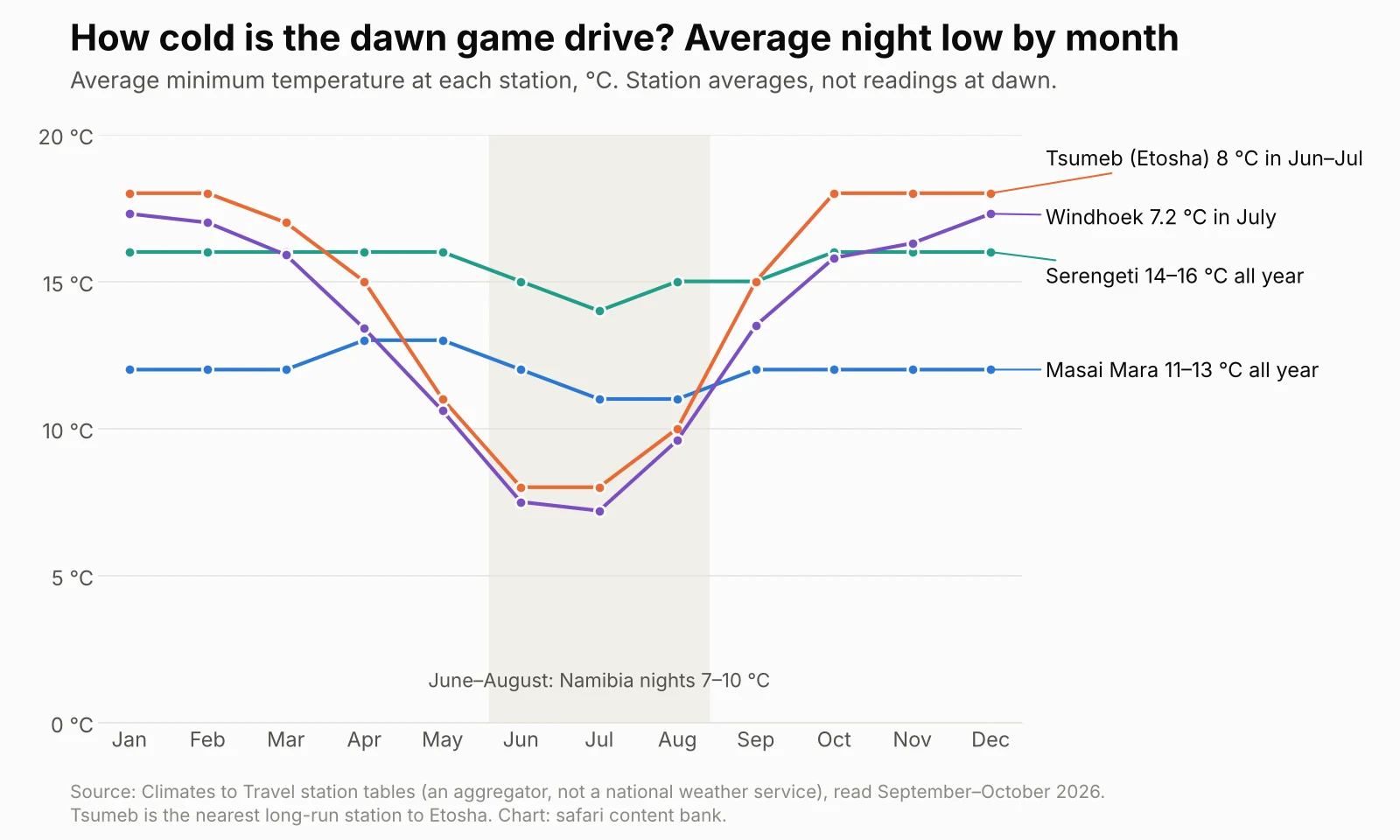 East Africa’s nights barely change through the year; Namibia’s fall to 7–10 °C from June to August. Source: Climates to Travel station tables (an aggregator), read September–October 2026. Chart: safari content bank.
- Southern African camps lend warmth, but do not rely on it. A traveller to Greater Kruger lodges in late September reports that lodges supply ponchos; a travel writer on a Botswana winter safari describes wake-ups near freezing at about 05:30 and camps handing out fleece-lined ponchos (traveller reports; an operator’s blog, 2023).
- Layer, because the day turns hot. The same late-September Kruger thread swung from mornings under 13 °C to very hot days, and forum regulars say heat and cold both come in one day, and recommend layers; vehicles carry blankets (traveller reports).
- September and October reverse the problem. October passes 40 °C at times in Botswana and in the Luangwa and Zambezi valleys (best time for a safari); pack for heat, and still bring a thin layer for the dawn start.
- Month by month, the weather for each country is on our month pages, such as safari in July.
Walking safaris: what to wear on foot
On a walking safari wear neutral colours, long sleeves where tsetse or mosquitoes are about, and closed shoes you can walk in for three to five hours. Rules on guides, rifles and minimum ages are on our walking safari page; this section covers clothing only.
| Item | Why | Source |
|---|---|---|
| Neutral colours; no black or dark blue in tsetse areas | Tsetse are drawn to dark colours; Zambia’s and Zimbabwe’s walking areas include tsetse areas | An operator’s guide |
| Closed shoes | Forum regulars name neutral colours and closed shoes as the real dress rule | TripAdvisor (traveller reports) |
| Sturdy shoes and a water bottle when hiking | Namibia’s desert heat and sun | A Namibian lodge group’s guest guide |
| Long sleeves and trousers | Tsetse bites, and malaria bites at dusk | Operator’s guide; TravelHealthPro |
| A warm layer | South Luangwa’s June nights are about 10 °C, in the June–October walking season | One safari operator’s guides (South Luangwa) |
| Hat and sun protection | Walks of 3–5 hours in Zambia | A safari listing site’s Zambia guide |
Read 8–10 October 2026. We found no park-authority clothing rule for walking safaris in any country.
- On a Kruger backpack trail you carry everything. SANParks’ Mphongolo backpack trail runs 3 nights, and walkers carry their own tent and food (walking safari), so clothing weight matters more than on any bush flight.
- On a canoe trip, add a sarong for the legs, a sunhat, sunblock and cycling gloves. A safari agent’s Zambezi canoe notes list them, with warm layers for dawn and dusk; see canoe safaris.
Gorilla and chimpanzee treks: gloves, long sleeves, boots
Dress for mud, nettles and rain: Rwanda’s tourism board lists solid walking shoes with gaiters, sturdy long clothing against stinging nettles, gardening or leather gloves and a light rain jacket. It is the only official kit list in our sources, and it suits Uganda’s forests too. The day itself, from briefing to the hour with the gorillas, is on a gorilla trekking day.
| Item | Gorillas: Rwanda (Volcanoes), Uganda (Bwindi, Mgahinga) | Chimps: Uganda (Kibale), Rwanda (Nyungwe) | Source |
|---|---|---|---|
| Boots and gaiters | Official list: solid walking shoes with gaiters | No official list in our sources; the same ground of mud and roots | Visit Rwanda |
| Long sleeves and trousers | Official list: sturdy long clothing against stinging nettles | As for gorillas (our advice) | Visit Rwanda |
| Gloves | Official list: gardening or leather gloves | As for gorillas (our advice) | Visit Rwanda |
| Rain jacket | Official list: a light rain jacket | Kibale’s rain falls mostly in March–May and September–November | Visit Rwanda; UWA Kibale brochure |
| Warm layer | Bwindi 7–20 °C, coldest June–July; Mgahinga about 15 °C by day, 10 °C at night; Volcanoes treks reach 2,500–4,000 m | Kibale 14–27 °C; Nyungwe about 20 °C by day, 10 °C at night | UWA brochures; Visit Rwanda; visitnyungwe.org |
| How long you walk | 30 minutes to 4+ hours in Rwanda | 2–5 hours at Kibale | Visit Rwanda; UWA |
Sources: Visit Rwanda, gorilla tracking; UWA Bwindi brochure (PDF), Mgahinga brochure (PDF) and Kibale brochure (PDF); UWA, Kibale; visitnyungwe.org. Read 8–9 October 2026.
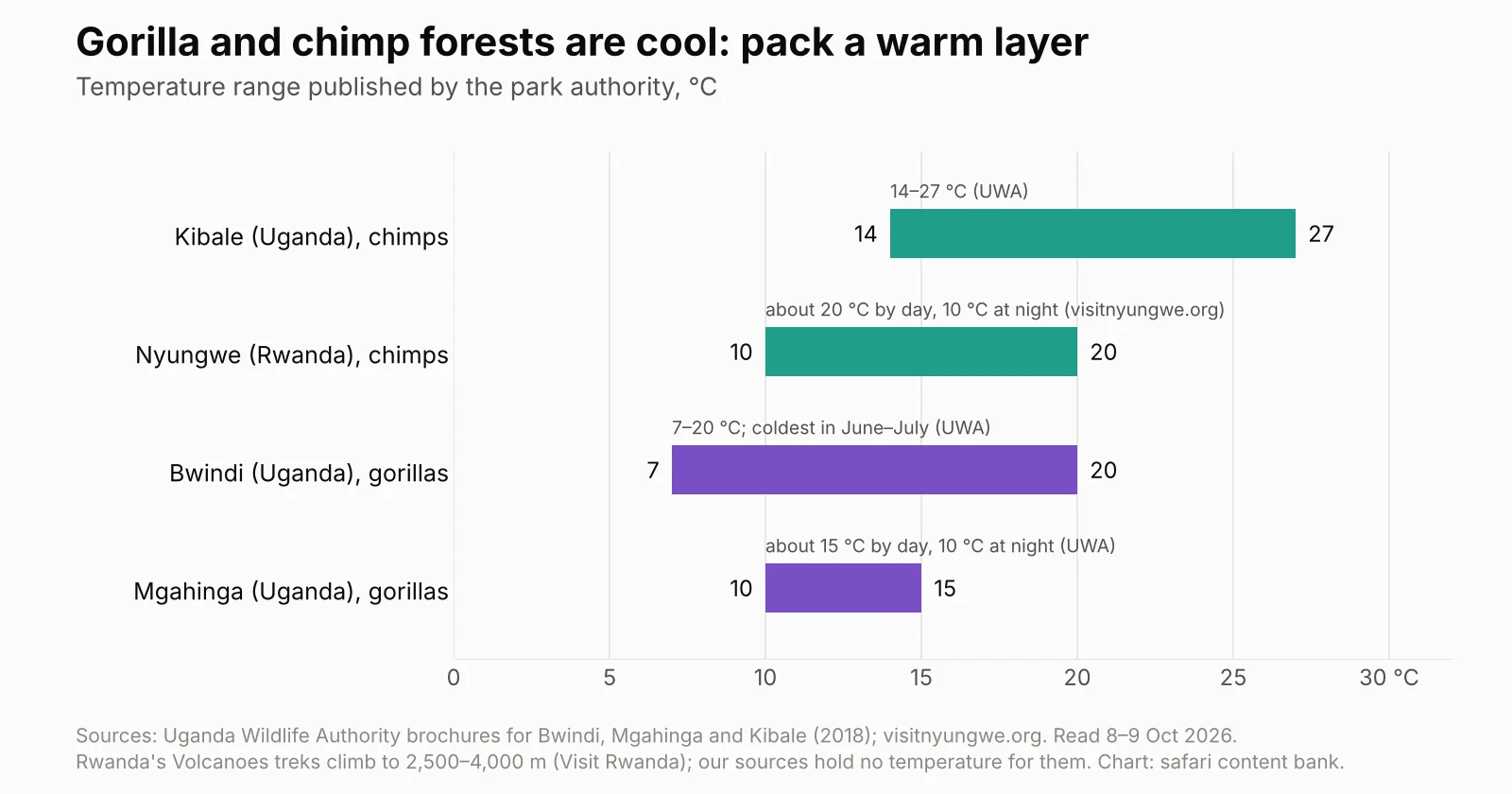 The gorilla forests are the coolest places on a typical East African trip. Sources: UWA park brochures (2018 editions); visitnyungwe.org; read 8–9 October 2026. Chart: safari content bank.
- Gaiters and gloves can be hired at some lodges. Mountain Gorilla View Lodge near Volcanoes National Park lists gaiter and glove hire at US$5 (an agent’s page on the lodge).
- A porter carries your daypack: about US$10 plus a tip in Rwanda and about US$20 in Uganda, by one operator’s guide and one tour operator’s trip notes; Nyungwe lists chimp-trek porters at US$10 a full day (chimpanzee trekking permits).
- Pack the fleece for the lodge as well. Bwindi travellers on the forum recommend fleece, waterproof and sturdy boots for late May and describe the forest as cool and damp rather than steamy (TripAdvisor, Bwindi in late May; traveller reports).
- Choosing between the two treks: gorilla or chimpanzee trekking; the best months are on best time for gorilla trekking.
Sun protection
Wear a hat and sunglasses and use high-factor sunscreen all year, winter included. A Botswana camp company’s FAQ calls sunscreen a year-round requirement, not a summer one, and a Namibian lodge group’s guest guide recommends SPF 50 and “always wear hat and sunglasses”, noting strong sun even in winter.
| Situation | What to wear | Source |
|---|---|---|
| Every safari | Sunhat, sunglasses, high-factor sunscreen | A safari agent’s packing notes |
| Namibia, all year | SPF 50; hat and sunglasses always; windbreaker, jumper, hat and scarf in winter | A Namibian lodge group’s guest guide |
| Botswana, all year | Sunscreen year-round | A Botswana camp company’s FAQ |
| Canoe trips | Sunhat, sunblock, a sarong to cover the legs | A safari agent’s Zambezi canoe notes |
| October in Botswana, Zambia, Zimbabwe | Hat; spend the middle of the day at camp | Heat above 40 °C at times (two camp operators’ seasonal guides; one safari operator; safari in October) |
Read 8–10 October 2026. Names are kept in our editor notes. We found no health-agency sun advice specific to safaris in our sources.
Laundry at camps: pack for three or four days
Most inclusive camps wash your clothes as part of the rate, so pack for a few days and rotate. Budget and mobile safaris are the exceptions.
| Camp or type | Laundry | Source |
|---|---|---|
| Governors’ Camp (Masai Mara, Kenya) | Included in the 2026 rate | Governors’ Camp 2026 rate sheet (PDF) |
| Camp Savuti (Chobe, Botswana) | Included, 1 Dec 2025–30 Nov 2026 | Camp Savuti 2026 rack rates (PDF) |
| Xigera Safari Lodge (Okavango Delta, Botswana) | Included in the 2026/27 rate | Xigera tactical rates 2026/27 (trade sheet) |
| Wolwedans (NamibRand, Namibia) | “Limited laundry service” | Wolwedans rack rates 2027 (PDF) |
| Kruger rest camps (SANParks) | All 12 main rest camps have laundry facilities | SANParks, Kruger camps |
| Mountain Gorilla View Lodge (Rwanda) | Charged: RWF 1,500 per item | An agent’s page on the lodge |
| A Botswana mobile safari operator | Excluded; “conditional on weather/water” | The operator’s travel information |
| Budget tours | Often excluded | A budget operator’s cost guide |
Rate sheets fetched 3 September–8 October 2026. Ask your camp what it washes; we found no source on same-day turnaround or on items camps decline to wash.
- Laundry is the travellers’ answer to the bag limit. Forum regulars on Kenya and Greater Kruger threads advise packing light because lodges do laundry (TripAdvisor, Kenya luggage; TripAdvisor, Greater Kruger; traveller reports).
Luggage limits on light aircraft: how they shape your clothes
On a fly-in safari your clothes, shoes, camera and hand luggage share one allowance of 15 kg in Kenya and Uganda or 20 kg in Tanzania and Botswana, in a soft bag. By road there is no airline limit; the trade-offs are on fly-in vs drive-in safari.
| Airline | Country | Allowance per person | What it means for clothing | Source |
|---|---|---|---|---|
| Safarilink | Kenya | 15 kg incl. hand baggage | Everything you carry counts | Safarilink |
| AirKenya | Kenya | 15 kg incl. 5 kg hand luggage | 10 kg in the hold (our sum); soft-sided bag 60 × 45 × 33 cm | AirKenya |
| Aerolink | Uganda | 15 kg incl. 5 kg hand luggage | 10 kg in the hold (our sum): gorilla boots and rain gear included | Aerolink 2025 (PDF) |
| Auric Air | Tanzania | 20 kg incl. hand luggage and cameras | Camera kit eats into clothes | Auric Air |
| Mack Air | Botswana, Zimbabwe | 20 kg incl. hand luggage | Soft-shell bag, 70 × 42 × 30 cm | Mack Air |
| Moremi Air | Botswana | 20 kg incl. cameras and hand luggage | “Hard case bags will not be accepted” | Kwando 2024 rate sheet |
| FedAir | South Africa | 20 kg in the hold + 5 kg hand luggage | The roomiest of the light-aircraft rules here | FedAir |
| Skeleton Coast fly-in safaris | Namibia | 10 kg incl. hand luggage | The tightest limit in our sources | A safari agent’s reference page |
Carriers’ pages read 9 October 2026; Kwando rate sheet read 10 October 2026; agent page read 8 October 2026. Every airline, size and excess rule is on our safari packing list and fly-in safari cost pages.
- Wear the heavy layers on the plane. A Kenya forum regular who paid excess the year before was told that Safarilink is lenient on size but strict on the 15 kg total including hand luggage, and to wear a pocket vest to carry the extra (traveller report, TripAdvisor).
- Plan the wardrobe around laundry, not around days. With laundry at most inclusive camps (above), a few days’ clothes plus one warm layer fits inside 15 kg.
- City clothes can stay behind. AirKenya stores luggage free at Wilson Airport for returning passengers, and FedAir at Johannesburg and Kruger airports (carriers’ pages, via our safari packing list).
- A gorilla trip by air still needs boots in the bag. Aerolink’s 15 kg includes 5 kg hand luggage, so wear the boots on the flight.
Common mistakes
| What you’ll often read | What our sources say |
|---|---|
| “Wear khaki on safari” | Khaki is not required. The rule with a reason is no dark blue or black in tsetse areas (an operator’s guide; forum regulars). |
| “Never wear white” | No source in our bank says so. One Namibian lodge group recommends light-coloured clothing against mosquitoes; the drawback of white is dry-season dust. |
| “Camouflage is banned across Africa” | We hold no confirmed official text for any safari country. Check your own government’s advice; plain neutral colours avoid the question. |
| “Africa is hot, so pack summer clothes” | Dawn is cold: Windhoek averages 7.2 °C on July nights, and Hwange’s late-July nights can fall to freezing (one operator). |
| “East Africa is warm all year” | Masai Mara nights average 11–13 °C in every month, and a July forum report describes single figures with “no heating”. |
| “Insect repellent keeps tsetse off” | Guides say no repellent works well against tsetse; neutral colours and long sleeves do more. |
| “Pack an outfit for every day” | Most inclusive camps include laundry, and bush flights allow 15–20 kg in all. |
Frequently asked questions
What colours should you not wear on safari? Dark blue and black in tsetse areas, because tsetse flies are attracted to dark colours, according to an operator’s guide that also advises against bright clothing there. Guides report tsetse in parts of the Serengeti and at Tarangire, and operators name Zambia’s and Zimbabwe’s tsetse areas. Elsewhere, any neutral colour is fine.
Can you wear white on safari? Yes; no source we hold rules it out. The practical drawback is dust: the Ngorongoro road is “very dusty June–October”, and open vehicles are exposed to it. A Namibian lodge group even recommends light-coloured clothing against malaria mosquitoes.
Is camouflage clothing illegal on safari? We hold no confirmed official text on camouflage for Kenya, Tanzania, Uganda, Rwanda, Zambia, Zimbabwe, Botswana, Namibia or South Africa, so we state no ban. Check your own government’s travel advice for each country on your route; plain neutral colours avoid the question.
How cold is a morning game drive? In the Masai Mara, night lows average 11–13 °C in every month and in the Serengeti 14–16 °C (Climates to Travel). In southern Africa’s winter it is colder: Windhoek averages 7.2 °C on July nights, and one operator says Hwange’s late-July nights can fall to freezing.
What should you wear for gorilla trekking? Rwanda’s tourism board lists solid walking shoes with gaiters, sturdy long clothing against stinging nettles, gardening or leather gloves and a light rain jacket. Add a warm layer: Bwindi averages 7–20 °C, and Rwanda’s treks climb to 2,500–4,000 m.
What should you wear for chimpanzee trekking? No park authority in our sources publishes a chimp kit list, so we suggest the gorilla list: boots, long sleeves and trousers, gloves and a rain jacket. Kibale walks last 2–5 hours, with rain mostly in March–May and September–November and temperatures of 14–27 °C (UWA).
Do safari camps do laundry? Most inclusive camps do, as part of the rate: Governors’ Camp, Camp Savuti and Xigera include it in their 2026 rates, and Kruger’s main rest camps have laundry facilities. Budget tours and mobile safaris often exclude it; one Rwandan lodge charges RWF 1,500 per item.
How many clothes fit in a 15 kg bush-flight bag? Our sources give no item count, but the limit includes hand luggage: AirKenya’s 15 kg includes 5 kg of hand luggage, which leaves 10 kg in the hold (our sum). Pack a few days of clothes, one warm layer and rely on camp laundry; wear boots and fleeces on the plane.
Sources
- Government and park authorities: Visit Rwanda (Rwanda Development Board), gorilla tracking, read 9 Oct 2026; Uganda Wildlife Authority brochures for Bwindi (PDF), Mgahinga (PDF) and Kibale (PDF) and the Kibale page, read 8–9 Oct 2026; visitnyungwe.org, as on our Nyungwe page; Botswana Tourism, game drives; SANParks, Kruger camps; read 8–10 Oct 2026
- Health: TravelHealthPro, Kenya, read 8 Oct 2026; sleeping-sickness data as on our safari vaccinations page
- Climate: Climates to Travel, Kenya, Tanzania and Namibia (an aggregator), read September–October 2026; Kgalagadi figure from Wikipedia, as on our South Africa hub
- Airlines: Safarilink; AirKenya; Aerolink 2025 (PDF); Auric Air; Mack Air; FedAir; read 9 Oct 2026; Moremi Air from the Kwando 2024 rate sheet, read 10 Oct 2026
- Camps’ own rate sheets: Governors’ Camp 2026 (PDF), fetched 8 Oct 2026; Camp Savuti 2026 (PDF); Xigera tactical rates 2026/27, fetched 8 Oct 2026; Wolwedans rack rates 2027 (PDF), fetched 3 Sep 2026
- Operators, agents, a lodge group and a listing site (names and links kept in our editor notes): an operator’s guide to tsetse and clothing colours; a Botswana camp company’s FAQ; a Namibian lodge group’s guest guide; a Botswana mobile-safari operator’s travel information; a budget operator’s cost guide; a safari agent’s packing and Zambezi canoe notes; a safari agent’s luggage reference page; an agent’s page on Mountain Gorilla View Lodge; a safari listing site’s Zambia guide; an operator’s blog on Botswana in winter (2023); one safari operator’s Hwange, Zambia and Lower Zambezi guides, as on our country pages; read 8–10 Oct 2026
- Traveller reports (forum posts, not rules): TripAdvisor threads on clothing and packing, Kenya, tsetse by location, Tanzania, packing tips, Rwanda, Bwindi in late May, luggage, Kenya, packing for Greater Kruger, dusty drives, Kruger and Botswana mobile safari in winter; a traveller review on a safari listing site; read June–October 2026
More: safari packing list, safari vehicles, where to see chimpanzees, Kenya safari questions, Namibia safari questions, South Africa safari questions.
Clothing rules, temperatures and baggage limits checked 8–10 October 2026. We will update this page when we can read official camouflage rules for any safari country, a park authority’s clothing guidance for chimp treks or walking safaris, and national weather-service normals in place of the aggregator tables.