 Experience

Last verified · Next check due
On this page
- The four Kalahari trips at a glance (2026)
- Namibia’s Kalahari: red dunes near Mariental
- The Kgalagadi: predators in the dry riverbeds
- The Central Kalahari and Khutse: Botswana’s remote Kalahari
- Tswalu: the private Kalahari
- Park fees in the Kalahari parks
- When to go
- Malaria: which Kalahari is malaria-free?
- Combining the Kalahari with the rest of a trip
- Which Kalahari to choose
- Common mistakes about the Kalahari
- Frequently asked questions
- Sources
Short answer: “The Kalahari” is four different trips. Namibia’s Kalahari lodges near Mariental, 261 km from Windhoek on tar, are a red-dune night on the way south, not a big-game safari. The Kgalagadi (South Africa and Botswana) is a self-drive predator park: R662 per international adult a day from 1 November 2026. Botswana’s Central Kalahari is remote 4x4 camping or Tau Pan, best December–May. Tswalu is private and all-inclusive: R46,400 per adult a night (Motse, 2026).
Key facts
- Only three of the four are wildlife destinations. Forum regulars describe Namibia’s Kalahari as “usually a first- or last-night stop near Windhoek; red dunes, no big-game density” (TripAdvisor Namibia forum, traveller reports). The Kgalagadi, the Central Kalahari and Tswalu all hold Kalahari lion and cheetah (Kgalagadi; Central Kalahari; Tswalu rates).
- The seasons differ. One operator gives December–May as the Central Kalahari’s best game viewing, the reverse of the Okavango (Central Kalahari); most of the Kgalagadi’s rain falls January–April (Kgalagadi). Our sources give no best month for Namibia’s Kalahari lodges or for Tswalu.
- The vehicle you need goes from any car to two 4x4s. Namibia’s Kalahari lodges are off the tarred B1; the Kgalagadi’s Botswana side requires a 4x4 and at least two vehicles on all routes; the Central Kalahari needs a 4x4 with low range, and two vehicles are advised; at Tswalu you are driven (Kgalagadi; Central Kalahari).
- Two of the four charge a park fee. SANParks charges R662 per international adult a day in the Kgalagadi from 1 November 2026 (R576 until 31 October 2026). The Central Kalahari’s last published fee is P190 per non-resident adult a day (DWNP, 1 April 2022); confirm it with DWNP or your operator.
- Not every Kalahari is malaria-free. The South African side of the Kgalagadi and Tswalu, in the Northern Cape, are outside the malaria-risk areas (malaria-free safaris); no health authority in our sources calls the Central Kalahari malaria-free (Central Kalahari).
The four Kalahari trips at a glance (2026)
Namibia’s Kalahari is a lodge stop, the Kgalagadi a self-drive national park, the Central Kalahari a remote wilderness reserve and Tswalu a private, all-inclusive reserve. They sit in three countries, and travellers often book one when they meant another.
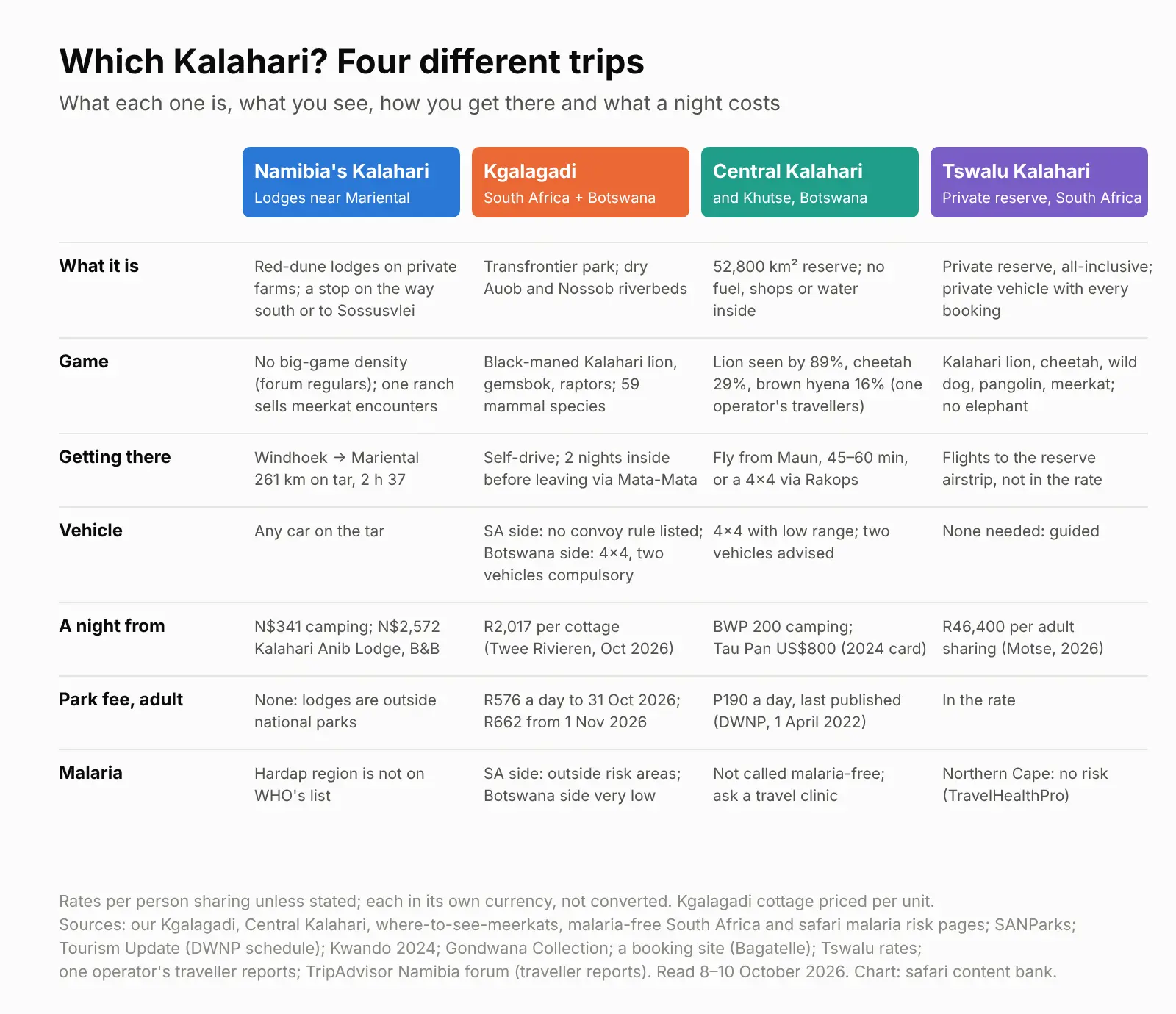 Sources: our Kgalagadi, Central Kalahari, where-to-see-meerkats, malaria-free safaris and safari malaria risk pages; SANParks; Tourism Update (DWNP schedule); Kwando 2024; Gondwana Collection; a booking site (Bagatelle); Tswalu; one operator’s traveller reports; TripAdvisor Namibia forum. Read 8–10 October 2026. Chart: safari content bank.
| Namibia’s Kalahari (Mariental area) | Kgalagadi Transfrontier Park | Central Kalahari and Khutse (Botswana) | Tswalu Kalahari (South Africa) | |
|---|---|---|---|---|
| What it is | Lodges and guest farms on private land, outside national parks | National park across South Africa (27%) and Botswana (73%), 37,256 km² | Game reserves; the Central Kalahari covers 52,800 km² | Private reserve, 118,000 ha |
| Big game | “No big-game density” (forum regulars) | Black-maned Kalahari lion, gemsbok, springbok, brown hyena; 59 mammal species | Lion seen by 89% of one operator’s groups, cheetah 29%, brown hyena 16% | Kalahari lion, cheetah, wild dog, pangolin, meerkat; no elephant |
| How you visit | Drive in; lodge activities | Self-drive from SANParks camps | Self-drive camping, guided mobile trips, or Tau Pan | Guided, private vehicle, guide and tracker with every booking |
| Vehicle | Any car on the B1 tar | No convoy rule in our sources on the South African side; Botswana side 4x4 and two vehicles compulsory | 4x4 with low range; two vehicles advised | None |
| A night from | N$341 camping; Kalahari Anib Lodge N$2,572 B&B | Twee Rivieren family cottage R2,017 per unit (Oct 2026) | Campsite BWP 200; Tau Pan US$800 (Kwando 2024 card) | Motse R46,400 per adult sharing (2026) |
| Park fee, adult | None in our sources | R662 a day (R576 until 31 Oct 2026) | P190 a day, last published (2022) | In the rate |
| Best months | Not in our sources | Not stated; most rain January–April | December–May (one operator) | Not in our sources |
| Malaria | Hardap region is not on WHO’s list | South African side outside risk areas; Botswana side very low all year | Not called malaria-free in our sources | No risk in the Northern Cape (TravelHealthPro) |
Per person sharing unless stated; each in its own currency, not converted. Sources: our Kgalagadi, Central Kalahari, where to see meerkats, malaria-free safaris and safari malaria risk pages; Gondwana Collection; Tswalu rates. Read 8–10 October 2026.
Namibia’s Kalahari: red dunes near Mariental
Namibia’s Kalahari lodges are an easy night on tar south of Windhoek, on the way to Sossusvlei or the Fish River Canyon, and they sell red dunes and sundowners rather than big game. No Namibian national park covers this part of the Kalahari, and our sources hold no destination guide for it, only lodge rates and traveller reports.
| Figure | Source | |
|---|---|---|
| Windhoek → Mariental | 261 km on tar (B1), about 2 h 37 | A travel booking site’s distance table, as on Namibia self-drive distances |
| Mariental → Sossusvlei side | C19 Solitaire–Maltahöhe–Mariental, 332 km; untarred from Solitaire to Maltahöhe, “frequently in bad condition” | Wikipedia, C19, as on the same page |
| Kalahari Anib Lodge (Gondwana), 30 km north-east of Mariental | N$2,572 per person sharing, B&B; Comfort rooms N$3,207; valid 1 Nov 2026–31 Oct 2027 | Gondwana Collection |
| Kalahari Anib Campsite | N$341 per person; private bathroom and power point per pitch | Gondwana Collection |
| Bagatelle Kalahari Game Ranch, near Mariental | From N$3,840 per person sharing, dinner, bed and breakfast (Garden Room, January–October 2026); listed with “cheetah and meerkat encounters” | A booking site’s listing, as on where to see meerkats |
Read October 2026. Kalahari Anib and Bagatelle are on private land, outside Namibia’s national parks, so no park fee applies in our sources.
- Group tours use it the same way: three European escorted-tour brochures in our sources route Windhoek → Kalahari → Sossusvlei or the Fish River Canyon (brochures read 8 October 2026).
- Meerkats: a Namibian listing site describes Suricate Kalahari Tented Lodge, in the Intu Afrika Kalahari Reserve, as meerkat-focused, but gives no rate and no detail of how visits work (where to see meerkats).
- Plan the rest of Namibia with Namibia safari cost and the Namibia itinerary.
The Kgalagadi: predators in the dry riverbeds
The Kgalagadi Transfrontier Park is the Kalahari to drive yourself for predators: SANParks rest camps on the South African side, rough 4x4 routes on the Botswana side, and game concentrated along the dry Auob and Nossob riverbeds. Botswana Tourism names the “black-maned Kalahari lion” first among its wildlife (Kgalagadi).
| South African side (SANParks) | Botswana side (DWNP) | |
|---|---|---|
| Share of the park | 27%, about 10,059 km² | 73%, about 27,197 km² |
| Vehicle | No convoy rule in our sources | 4x4 compulsory; at least two vehicles on all routes |
| Where you sleep | Twee Rivieren, Mata-Mata, Nossob; five wilderness camps and Kalahari Tented Camp | Campsites at Two Rivers, Rooiputs, Polentswa, Mabuasehube; Mpayathuthwa |
| Fuel and shop | At Twee Rivieren; none at the wilderness camps | None in our sources |
| Park fee, international adult | R662 a day (R576 until 31 Oct 2026) | Not confirmed |
Sources: SANParks and Botswana Tourism, as on our Kgalagadi page, read 8 October 2026.
- Leaving for Namibia through Mata-Mata needs at least two nights inside the park first, as does crossing to or from Botswana inside the park (Kgalagadi).
- The riverbeds are normally dry and “flow once or twice a century after heavy rains” (SANParks).
- A night for two at Twee Rivieren comes to R3,341 from 1 November 2026 before the 1% community fund: R2,017 for the cottage (October 2026 price) plus 2 × R662 (our sum). In October 2026, with the R576 fee, it came to R3,169, as on our Kgalagadi page. SANParks had not published its 2026/27 accommodation tariff when we checked on 1 November 2026, so confirm the price when you book.
The Central Kalahari and Khutse: Botswana’s remote Kalahari
The Central Kalahari Game Reserve is 52,800 km² with “no firewood, no fuel, no cell phone reception and no shops”; you camp self-sufficient in a 4x4, join a guided mobile trip, or fly into Tau Pan, the only permanent camp open inside. Khutse adjoins it to the south with the same last published fee (Central Kalahari).
| Figure | Source | |
|---|---|---|
| Best game | December–May, when springbok and gemsbok gather on the short-grass plains of Deception and Passarge valleys | One operator’s Central Kalahari page |
| Sightings | Lion 89%, gemsbok 93%, leopard 33%, cheetah 29%, brown hyena 16%, wild dog and meerkat 10% each (share of one operator’s traveller groups) | same, read September 2026 |
| Camping | Bigfoot Tours sites BWP 200 per non-resident a night (last published); no water at any site | A campsite information sheet |
| Tau Pan (Kwando), 9 rooms above a waterhole | US$800 for 1–5 nights in every season (Kwando 2024 rate card); meals, activities and park fees included | Kwando 2024 (PDF) |
| Getting there | Fly from Maun in 45–60 minutes; Maun–Tau Pan US$315 one way (Kwando 2024); or drive via Rakops, one of the two nearest fuel stops | One operator’s page; Tracks4Africa |
| Self-drive | 4x4 with low range; at least 10 litres of water per person a day plus a 20-litre reserve; every night booked and paid | Tracks4Africa |
As on our Central Kalahari page, read 10 October 2026. Two closed camps, Kalahari Plains Camp and Edo’s Camp, are not listed.
- In the rains the access road turns to mud: Tracks4Africa calls rainy-season travel on the Rakops approach inadvisable, so in the best game months consider flying in (Central Kalahari).
- Botswana’s Kalahari against the salt pans, with their habituated meerkats: Makgadikgadi vs Central Kalahari. Self-drive booking order: Botswana self-drive.
Tswalu: the private Kalahari
Tswalu Kalahari is a private reserve of 118,000 ha in South Africa’s Northern Cape where every booking comes with its own vehicle, guide and tracker; Motse costs R46,400 per adult sharing a night in 2026, flights extra. It has no elephant, so it is not a Big Five reserve (Tswalu rates; where to see pangolins).
| Tswalu, 2026 (valid to 31 December 2026) | |
|---|---|
| Motse | R46,400 per adult sharing a night; single R57,700; family legae R107,400 (2 adults + 2 children) |
| Loapi (one-bedroom home) | R55,800 per adult sharing; single R69,100 |
| Children | 0–11 sharing free; 12–17 R10,900 a night |
| Minimum stay | 2 nights; 3 from 20 December 2026 to 6 January 2027 |
| Included | Private vehicle, guide and tracker; all meals and drinks; walks, horse riding, the habituated meerkat colonies, rock engravings; laundry |
| Not included | Flights and transfers to the reserve, the Malori sleep-out deck, spa, gratuities |
| 2026 offers | 50% off the first of four nights, or a fifth night free |
Source: Tswalu rates, read 8 October 2026, as on our where to see meerkats and malaria-free safaris pages. Tswalu has published 2027 direct rates; we have not read the figures, so we print none.
- Three nights at Motse for two adults cost R278,400 at the 2026 rate, before flights (our sum: 2 × 3 × R46,400).
- Tswalu’s wildlife list includes pangolin; it publishes no sighting rate, so treat it as the lodge’s claim (where to see pangolins).
Park fees in the Kalahari parks
Only the Kgalagadi and the Botswana reserves charge a park fee; SANParks’ Kgalagadi fee is current and rose to R662 on 1 November 2026, while the Central Kalahari’s P190 is the last published DWNP fee, from April 2022. In February 2026 the government news agency BOPA described the existing non-resident fee as P380 and reported a rise to P500 from 1 April 2026; the rise was then reported postponed. Confirm the fee with DWNP or your operator before you travel (Central Kalahari).
The official fee lines, with the date each took effect and the source:
| Fee | Amount | In force from | Source |
|---|---|---|---|
| Kgalagadi Transfrontier Park daily conservation fee (South African side), international adult (12+), per day | ZAR 576 | 1 Nov 2025 to 31 Oct 2026 (SANParks 2025/26 schedule) | SANParks daily conservation fees 2025/26 |
| Kgalagadi Transfrontier Park daily conservation fee (South African side), international adult (12+), per day | ZAR 662 | 1 Nov 2026 to 31 Oct 2027 (SANParks 2026/27 schedule, already published) | SANParks daily conservation fees 2026/27 |
| Other DWNP parks and reserves (Central Kalahari Game Reserve, Khutse, Nxai Pan, Makgadikgadi Pans), non-resident adult, per person per day | BWP 190 (SADC residents BWP 145; Botswana citizens and residents BWP 20) | Last published DWNP schedule, 1 April 2022 (via Tourism Update). In Feb 2026 the government news agency BOPA called the existing non-resident fee P380; a P500 rise was announced, then reported postponed. No official current tariff: confirm with DWNP or your operator | Tourism Update, 23 Feb 2022 (DWNP fee schedule) |
| Days, one international adult | Kgalagadi, to 31 Oct 2026 | Kgalagadi, from 1 Nov 2026 | Central Kalahari / Khutse, last published |
|---|---|---|---|
| 1 | R576 | R662 | P190 |
| 3 | R1,728 | R1,986 | P570 |
| 5 | R2,880 | R3,310 | P950 |
| 7 | R4,032 | R4,634 | P1,330 |
Our sums from SANParks’ 2025/26 and 2026/27 schedules and the DWNP schedule of 1 April 2022 (via Tourism Update), as on our Kgalagadi and Central Kalahari pages. SANParks bookings add a 1% community fund; Botswana adds a daily vehicle fee whose amount no official source gives. The Kgalagadi’s Botswana-side fee is not confirmed. Each currency as published, not converted.
- Children: in the Kgalagadi, international children aged 2–11 pay R331 (R288 until 31 October 2026) from 1 November 2026; in the Central Kalahari, under-8s enter free and older children pay half (Kgalagadi; Central Kalahari).
- All Botswana parks: Botswana park fees. How we date fees: our method.
When to go
Go to the Central Kalahari in the rains, December–May, and to the Kgalagadi with the heat and cold in mind: January is its hottest month and July its coldest. Our sources give no month guidance for Namibia’s Kalahari lodges or for Tswalu.
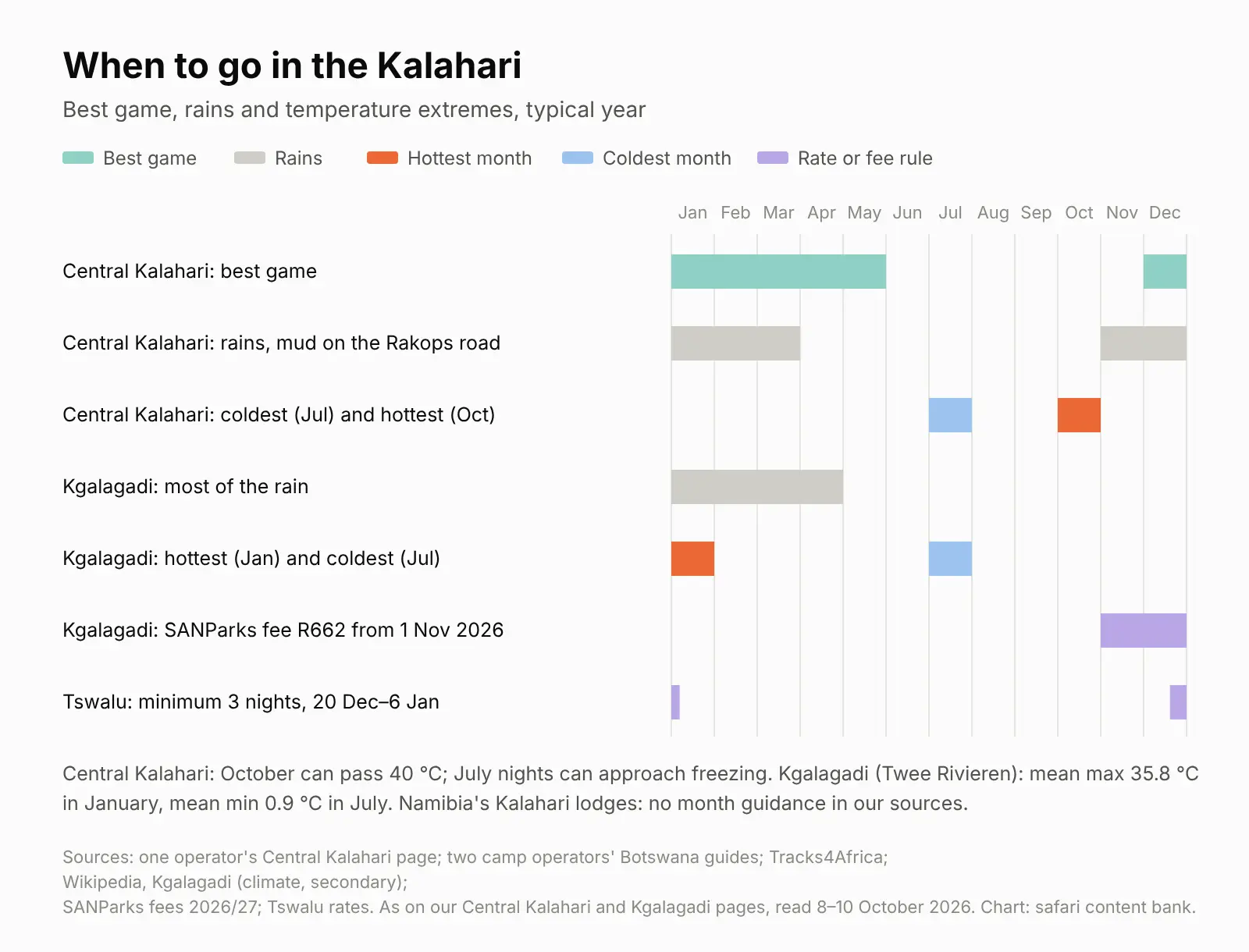 Sources: one operator’s Central Kalahari page; two camp operators’ Botswana guides; Tracks4Africa; Wikipedia, Kgalagadi (climate, secondary); SANParks fees 2026/27; Tswalu rates. As on our Central Kalahari and Kgalagadi pages, read 8–10 October 2026. Chart: safari content bank.
| Months | Central Kalahari | Kgalagadi | Namibia’s Kalahari and Tswalu |
|---|---|---|---|
| December–February | Best game; rains; Rakops approach muddy | Rainy season; January mean maximum 35.8 °C at Twee Rivieren | No month guidance in our sources; Tswalu’s 3-night minimum from 20 December to 6 January |
| March–May | Best game continues; rains end in March | Most of the rain falls January–April | Not in our sources |
| June–August | Drier, quieter, game dispersed; July the coldest month, nights can approach freezing | July mean minimum 0.9 °C; record −10.3 °C | Not in our sources |
| September–November | Dispersed game; October the hottest month, can pass 40 °C; rains from November | Fee rose from R576 to R662 on 1 November 2026 | Kalahari Anib’s 2026–27 rate starts 1 November 2026 |
As on our Central Kalahari and Kgalagadi pages. Kgalagadi climate: Wikipedia (secondary; no official normals in our sources). More: green-season safaris and best time for a safari.
Malaria: which Kalahari is malaria-free?
The South African Kalahari is outside the malaria-risk areas, the Botswana side of the Kgalagadi is very low risk, and Namibia’s Hardap region is not on WHO’s list; nobody in our sources calls the Central Kalahari malaria-free.
| Kalahari | What the official sources say | Source |
|---|---|---|
| Tswalu and the Kgalagadi’s South African side (Northern Cape) | “There is no risk in the rest of South Africa” outside the north-east; bite avoidance only | TravelHealthPro, as on malaria-free safaris; SANParks names Kruger and Mapungubwe as its only parks in risk areas |
| Kgalagadi, Botswana side | Southern half of Botswana very low risk all year; bite avoidance only | TravelHealthPro, Botswana, as on Kgalagadi |
| Central Kalahari | No health authority in our sources calls it malaria-free; the northern half of Botswana is high risk October–May, the southern half very low | same, as on Central Kalahari |
| Namibia’s Kalahari (Mariental) | WHO lists six northern regions and the river areas; it does not list the south. Mariental is in Hardap, which is not on the list | WHO list, as on safari malaria risk |
Official pages read 8–10 October 2026. Ask a travel-health clinic which band your route falls in.
Combining the Kalahari with the rest of a trip
Each Kalahari connects to a different trip: Namibia’s to Sossusvlei, the Kgalagadi to southern Namibia through Mata-Mata, the Central Kalahari to Maun and the Okavango, and Tswalu to a South African itinerary by air.
| Kalahari | Usually combined with | The link | Source |
|---|---|---|---|
| Namibia’s Kalahari | Sossusvlei, the Fish River Canyon, Windhoek | B1 tar from Windhoek; C19 to the Sossusvlei side | Namibia self-drive distances |
| Kgalagadi | Southern Namibia | Exit through Mata-Mata after at least two nights in the park; a foreign-registered car pays Namibia’s N$534 Cross-Border Charge (since 1 August 2026) | Kgalagadi |
| Central Kalahari | Maun and the Okavango Delta; Windhoek by road | Fly from Maun; or Maun–Ghanzi 280 km of tar and the A2’s 165 km to the Mamuno/Buitepos border | Central Kalahari |
| Tswalu | A South African trip | Flights to the reserve airstrip, not in the rate | malaria-free safaris |
Our sources hold no road distance from Windhoek, Upington or Johannesburg to the Kgalagadi, and none between Tswalu and the Kgalagadi.
- A rental car across a border needs the company’s letter: Namibian rental car across borders.
- Whole-country choices: Namibia vs Botswana, Namibia vs South Africa and Botswana vs South Africa.
Which Kalahari to choose
Choose the Kgalagadi to self-drive for predators on a budget, the Central Kalahari for remoteness and the green season, Tswalu for a private, malaria-free trip with everything included, and Namibia’s Kalahari only as a night of red dunes on the way somewhere else.
| If you… | Pick | Why |
|---|---|---|
| Want a scenic night between Windhoek and Sossusvlei | Namibia’s Kalahari | 261 km on tar from Windhoek; Kalahari Anib Lodge N$2,572 B&B |
| Want to self-drive for lion and cheetah in an ordinary vehicle | Kgalagadi, South African side | SANParks rest camps; R662 a day from 1 November 2026 |
| Have two 4x4s and want empty country | Central Kalahari or the Kgalagadi’s Botswana side | Two vehicles advised in the first, compulsory in the second |
| Are travelling December–May | Central Kalahari | Its best game months, the reverse of the Okavango |
| Want malaria-free with children | Tswalu or the Kgalagadi’s South African side | Northern Cape: no risk; Tswalu’s 0–11s sharing stay free |
| Want meerkats close up | Tswalu, or Botswana’s salt pans | Tswalu’s habituated colonies are in the rate; see where to see meerkats |
| Want everything arranged, at the top price | Tswalu | Private vehicle, guide and tracker, meals and drinks included |
| Are on a tight budget | Kgalagadi camping or a Namibian Kalahari campsite | Twee Rivieren cottage from R2,017 per unit; Kalahari Anib campsite N$341 per person |
Common mistakes about the Kalahari
| What you’ll often read | What is correct |
|---|---|
| “The Kalahari lodges near Windhoek are a safari” | They are a dune stop. Forum regulars say “no big-game density”. For Kalahari predators go to the Kgalagadi, the Central Kalahari or Tswalu. |
| “The Kalahari is malaria-free” | Depends which. The South African side and Tswalu are outside risk areas; no source in ours calls the Central Kalahari malaria-free. |
| “The best time is June to October” | Not in the Central Kalahari: its best game is December–May. |
| “Mata-Mata is a one-night shortcut to Namibia” | You must stay at least two nights in the Kgalagadi first. |
| “The Kgalagadi costs R576 a day” (no date) | That was the 2025/26 rate, which ended on 31 October 2026. Since 1 November 2026: R662 per international adult per day. |
| “The Central Kalahari fee is P500 from April 2026” | Reported postponed. P190 is the last published fee; confirm with DWNP. |
| “Tswalu is a Big Five reserve” | No elephant. |
| “One 4x4 is fine anywhere in the Kalahari” | Not on the Kgalagadi’s Botswana side, where two vehicles are compulsory. |
Frequently asked questions
What is the difference between the Kalahari in Namibia, Botswana and South Africa? Namibia’s Kalahari, near Mariental, is lodges on private land with red dunes and little big game. South Africa and Botswana share the Kgalagadi Transfrontier Park, a self-drive predator park. Botswana also has the Central Kalahari and Khutse reserves, remote and best December–May. South Africa adds Tswalu, a private, all-inclusive reserve.
Is the Kalahari malaria-free? The South African side of the Kgalagadi and Tswalu, in the Northern Cape, are outside the malaria-risk areas (TravelHealthPro). The Kgalagadi’s Botswana side is very low risk. Namibia’s Hardap region, around Mariental, is not on WHO’s list. No health authority in our sources calls the Central Kalahari malaria-free; ask a travel clinic.
Can I see big game in Namibia’s Kalahari? Not much. Forum regulars call it a first- or last-night stop near Windhoek with “no big-game density”. One ranch, Bagatelle, is listed with cheetah and meerkat encounters. For Kalahari lion, go to the Kgalagadi, the Central Kalahari or Tswalu.
Which Kalahari park is best for lions? The Central Kalahari has the only published figure in our sources: 89% of one operator’s traveller groups saw lion. Botswana Tourism names the black-maned Kalahari lion first among the Kgalagadi’s wildlife. Tswalu lists Kalahari lion but publishes no sighting rate. More: where to see lions.
How much does Tswalu cost? Motse costs R46,400 per adult sharing a night and Loapi R55,800 in 2026, with a private vehicle, guide and tracker, meals and drinks. Children aged 0–11 sharing stay free. Flights to the reserve are extra, and the minimum stay is two nights (three over Christmas and New Year).
Do I need a 4x4 for the Kalahari? Not for Namibia’s Kalahari lodges, on the tarred B1. Not on the Kgalagadi’s South African side, where our sources hold no convoy rule. Yes, with a second vehicle, on the Kgalagadi’s Botswana side, and yes, with low range, in the Central Kalahari, where two vehicles are advised.
When is the best time to visit the Kalahari? For the Central Kalahari, December–May, when game gathers on the short grass after the rains (one operator). In the Kgalagadi, January is the hottest month and July the coldest, with frost possible; our sources name no best month. They give none for Namibia’s Kalahari lodges or for Tswalu.
Sources
- Fees: SANParks daily conservation fees 2025/26 (PDF) and 2026/27 (PDF); Tourism Update, 23 Feb 2022 (DWNP schedule, 1 April 2022); Botswana Daily News (BOPA), 24 Feb 2026; Gabz FM, 5 May 2026; Road Fund Administration; all as on our Kgalagadi and Central Kalahari pages, checked 8–10 Oct 2026
- Parks: SANParks, Kgalagadi, border crossings and transfrontier park; Botswana Tourism, Kgalagadi; Wikipedia, Central Kalahari and Kgalagadi (secondary); Tracks4Africa; one operator’s Central Kalahari page and traveller sighting reports, read September 2026 (name in our editor notes)
- Rates: Tswalu rates, read 8 Oct 2026; Kwando 2024 rate card (PDF); Gondwana Collection, Kalahari Anib Lodge and campsite; a booking site’s Bagatelle listing and a campsite information sheet (names in our editor notes)
- Health: UK TravelHealthPro, South Africa and Botswana; WHO country list 2022, rev. 3 Jan 2023; as on our safari malaria risk and malaria-free safaris pages
- Roads: a travel booking site’s distance table and Wikipedia, C19, as on Namibia self-drive distances; Wikipedia, A3 and A2
- Traveller reports (forum posts, not fact): TripAdvisor Namibia forum, “Kalahari lodges – Suggestions Please”
- European escorted-tour brochures for Namibia, read 8 Oct 2026 (unnamed; listed in our editor notes)
More: Kgalagadi, Central Kalahari, Makgadikgadi, where to see meerkats, where to see cheetahs, Namibia, Botswana and South Africa.
Fees, rates and rules checked 8–10 October 2026 on our Kgalagadi, Central Kalahari, meerkat, pangolin and malaria pages and in our content bank; this page was compiled on 31 October 2026. We will update it when DWNP publishes a current fee schedule, when SANParks publishes its 2027/28 fees, when Tswalu’s 2027 rates apply, and when we have a destination source for Namibia’s Kalahari.
Ask for a quote
Tell us your dates and we send you a priced itinerary. Free, no obligation.
- Free quote, no obligation
- Trips run by licensed local operators