 Experience

Last verified · Next check due
On this page
- July and August at a glance, destination by destination
- The Mara River crossings: July or August, Kenya or Tanzania
- Botswana: the Okavango at its peak flood
- Kruger and South Africa: the dry winter
- Gorillas in the dry season
- Namibia: dry, cold dawns, and Namibians on holiday too
- Peak-season prices: what July and August cost
- Crowds in July and August
- How far ahead to book a July–August safari
- Malaria-free options for a summer holiday
- Family rules: minimum ages and child prices
- What changes in late August
- Park fees in July and August
- Common mistakes about a summer-holiday safari
- Frequently asked questions
- Sources
Short answer: Go to the Mara River, from the Masai Mara or the northern Serengeti, for the crossings (July–October, busiest August–September); to Botswana for the Okavango’s high water; or to Kruger, Namibia and the gorilla parks for dry-season game. It is peak price: the Mara fee is US$200 a day and Governors’ Camp US$998 a night. Book 6–18 months ahead. Gorilla trekking is 15+. Most July–August camp rates run on into September; Natural Selection’s peak ends 31 August.
Key facts
- The European and North American summer holidays fall in the dry season almost everywhere. July and August are dry in Kenya, Tanzania, Botswana, Namibia, Zambia, Zimbabwe, Uganda and Rwanda, and in Kruger, whose dry season runs April–September. Month detail: safari in July and safari in August.
- The Mara River crossings run July–October, busiest in August–September, seen from the Masai Mara in Kenya or Kogatende and Lamai in the northern Serengeti. In early and mid-July most of the herds are usually still in Tanzania, and no one can date a crossing (Great Migration river crossings).
- Peak rates start on 1 July at most Kenyan, northern Serengeti, Zambian and Namibian camps we checked: Governors’ Camp goes from US$623 to US$998 a night, Lemala Mara Tented Camp from US$330 to US$825. Botswana’s top camps switch earlier, in May or June (2024–2026 rate cards).
- Book 6–18 months ahead: 12–18 months on the migration route (one safari operator), about a year for Botswana park campsites (Tracks4Africa) and 6 months or more for Uganda’s gorilla permits (one Uganda-based operator). None of these is an official rule.
- The youngest child decides where you can go. Gorilla trekking is 15+ in Uganda and Rwanda; Natural Selection’s Okavango camps, Kwando and Great Plains take no children under 6; Machaba Camp, Governors’ Camp and Tswalu take all ages (family safari).
- The malaria-free reserves are in South Africa, and winter is their cheap season. Kruger is not one of them; Madikwe, Pilanesberg, the Waterberg and the Eastern Cape are. Amakhala charges from R5,290 per person sharing to 31 July 2027 and R6,970 from 1 August 2027 (malaria-free safari).
July and August at a glance, destination by destination
Every classic safari region is in its dry season in July and August, so the choice comes down to what you want to see, how old the children are and how much malaria risk you accept. This table is the summer summary; the month pages hold the full camp lists, rain figures and fees by country.
| Destination | Why go in July–August | Example summer rate | Main fee per adult | Malaria in July–August | More |
|---|---|---|---|---|---|
| Kenya (Masai Mara) | Herds arrive from mid or late July; most are in the Mara in August, crossing the river mostly south to north | Governors’ US$998, Kicheche Mara North US$995 (July–October) | Mara reserve US$200 a day (1 July–31 December) | Risk all year in the entire country, low only in Nairobi and above 2,500 m (WHO) | Kenya, Masai Mara |
| Tanzania (northern Serengeti) | Lead herds at Kogatende in July; crossings from the Tanzanian bank in July–October | Lemala Mara Tented Camp US$825 (1 July–30 September 2026) | Serengeti US$153.40 a night inside (July–September) | Risk all year below 1,800 m (WHO) | Tanzania, Serengeti |
| Botswana (Okavango, Chobe) | Delta near its flood peak; flooded area largest July–September; game at the remaining water | Machaba US$1,315; Mombo US$5,345 | Chobe, Moremi P270 a day (last published, 2022); P380 and P500 reported since | North: low risk June–September, bite avoidance only (TravelHealthPro) | Botswana, Okavango Delta |
| South Africa (Kruger) | Dry season, “the easiest time to see animals” (SANParks) | Singita Ebony, Sabi Sand, R60,470 (1 June–31 August) | R692 (R602 until 31 October 2026) | Outside SANParks’ November–April peak; TravelHealthPro recommends tablets September–May | South Africa, Kruger |
| South Africa (malaria-free reserves) | Eastern Cape, Madikwe, Pilanesberg, Waterberg; winter is the cheap season in the Eastern Cape | Amakhala Leeuwenbosch R5,290 (1 May–31 July 2027), R6,970 from 1 August 2027 | Pilanesberg R748 a day + R168 per vehicle | No risk; bite avoidance only (TravelHealthPro) | Malaria-free safari, Addo |
| Namibia (Etosha, Sossusvlei) | Dry and cold at night; game at Etosha’s waterholes, “very good” in July–August | Sossus Dune Lodge N$7,000 (NWR high season, July–October) | N$280, no seasons | Etosha at the edge of the seasonal zone, 2026 advice extended to June–August; Sossusvlei and the coast not listed (WHO) | Namibia, Etosha, Sossusvlei |
| Uganda (Bwindi) | Dry season, about June–September; rated “Excellent” in July and “Good” in August (a safari booking site) | Buhoma Lodge US$535 (July–September) | Gorilla permit US$800 | No official source read | Uganda, Bwindi |
| Rwanda (Volcanoes) | Dry season, June–September | Singita Kwitonda US$3,630 (1 June–31 October 2026) | Gorilla permit US$1,500; no discount until November | Risk all year in the whole country (WHO) | Rwanda, Volcanoes |
| Zambia, Zimbabwe (South Luangwa, Hwange) | All bush camps open; August is South Luangwa’s busiest month and Hwange’s “very best” (one operator) | Chinzombo US$1,840; Camp Hwange US$1,080 (a safari agent’s listing) | South Luangwa US$25; Hwange US$24 day visitor, US$12 staying inside | Operators’ guides only; no official source read | South Luangwa, Hwange |
Typical year, not a forecast; camp rates per person sharing per night, 2024–2027 cards and agent listings, read September–October 2026, as on our July and August pages. Malaria: WHO ITH country list 2022 (PDF), TravelHealthPro, HealthyTravel / Swiss TPH. Fees: Narok County FY2025/26, the last published; TANAPA, last published tariff, 2023/24; DWNP via Tourism Update; SANParks; Government Notice 115 of 2026; DNPW 2025; ZimParks 2026; UWA; RDB; Pilanesberg as quoted on our South Africa safari cost page.
Which summer safari suits your family
| If you want | Go to | Why | Watch out for |
|---|---|---|---|
| A river crossing | The Mara reserve or Mara Triangle, or Kogatende and Lamai, in August | August is the one month every Mara River calendar agrees on | No one can date a crossing; forum regulars advise families with children to skip long waits at the river (traveller reports) |
| Water, boats and big herds | The Okavango Delta and Chobe | Highest water to about August; boats at seasonal-floodplain camps to about September | Most fly-in camps take no children under 6; a 20 kg soft bag per seat on light aircraft |
| Young children and no malaria | The Eastern Cape (Addo, Amakhala), Pilanesberg, Madikwe | No-risk areas; winter rates | June–August “is cold and can be wet and windy” in the Eastern Cape; Pilanesberg fills in school holidays |
| A self-drive | Kruger, Etosha, Pilanesberg, Addo | Dry season, game at water | Kruger is a malaria risk area; South African school holidays fill southern Kruger; NWR’s Etosha camps book 6–12 months out |
| Gorillas and the savanna, with teenagers | Masai Mara or Serengeti plus Bwindi or Volcanoes | Dry season in both; at least 7 days | Everyone must be 15+; permits are full price and go months ahead |
| Walking, mokoro or canoe trips | South Luangwa, the Okavango | All bush camps open | Usually 12+ (Kwando, Time + Tide, The Bushcamp Company); 8+ for Great Plains’ mokoro and canoe trips |
Ages and rules as on our family safari page; seasons as on the July and August pages; Eastern Cape weather from our Addo page. Read 8–10 October 2026.
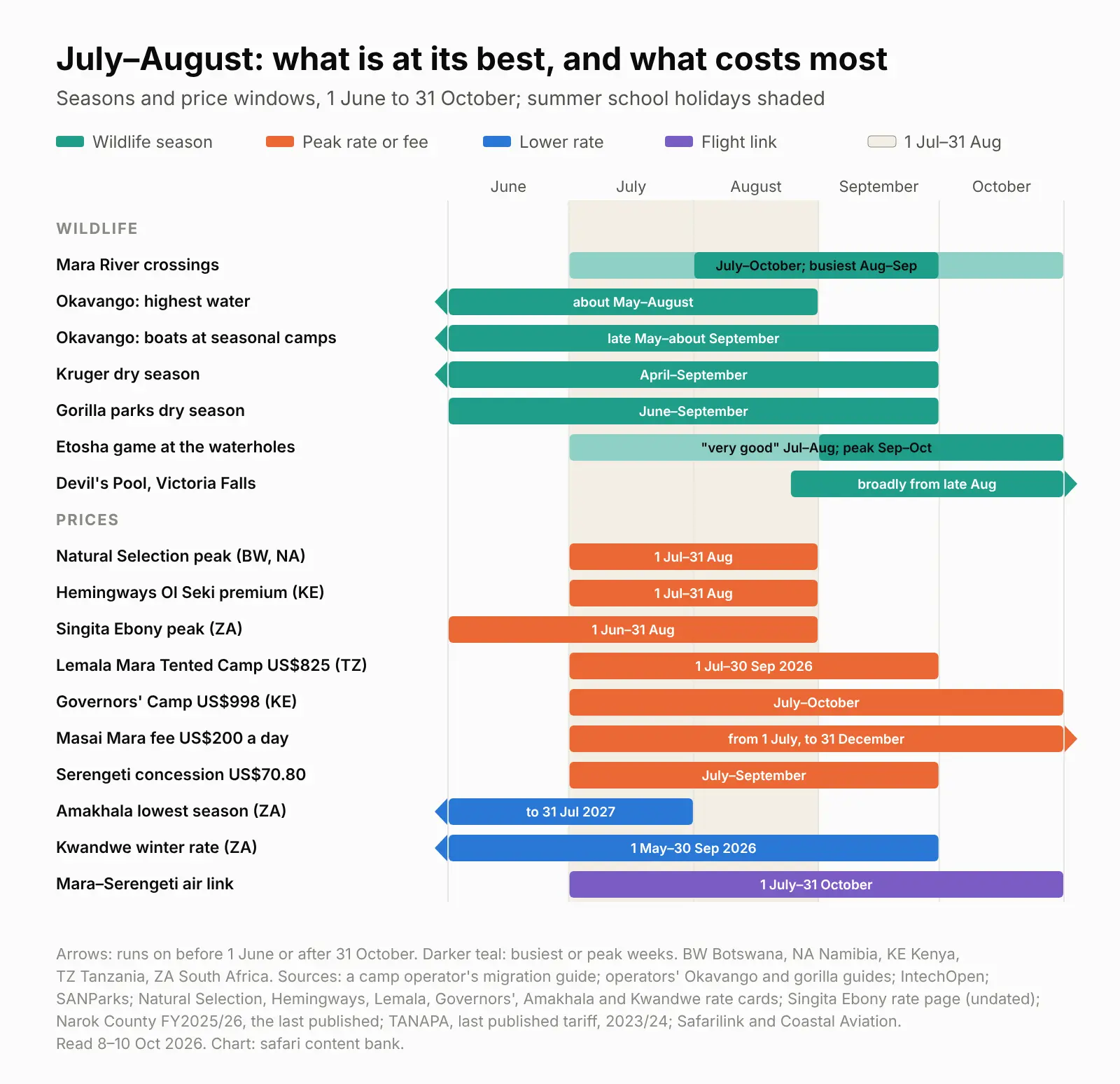 Sources: a camp operator’s migration guide; IntechOpen review and operators’ Okavango guides; SANParks; UWA and operators’ gorilla guides; our Etosha and Victoria Falls pages; Natural Selection, Hemingways, Lemala, Governors’, Amakhala and Kwandwe rate cards; Singita Ebony rate page (undated); Narok County FY2025/26; TANAPA, last published tariff, 2023/24; Safarilink and Coastal Aviation via our Mara to Serengeti page. Read 8–10 October 2026. Chart: safari content bank.
The Mara River crossings: July or August, Kenya or Tanzania
For a crossing, August is the safer month and either bank works; in early and mid-July the herds are usually still in the northern Serengeti, so a July-only trip is better based in Tanzania. Neither park publishes odds, and nobody can date a crossing.
- When: a camp operator’s calendar has the lead herds at Kogatende in July, with the Mara River crossings beginning, and the herds in the northern Serengeti (Lamai Wedge, Kogatende) and the Masai Mara in August, crossing mostly from south to north (Great Migration month by month). In 2026 the first crossings were reported in the second week of July (TripAdvisor Masai Mara forum, traveller reports). The Mara Conservancy says crossings “happen frequently during the migration but are difficult to predict” (Great Migration river crossings).
- The Mara fee doubles as the holidays start: US$100 per non-resident adult per day from 1 January to 30 June and US$200 from 1 July to 31 December; children 9–17 US$50, under 9 free (Narok County FY2025/26, the last published schedule). That schedule expired on 30 June 2026 and no 2026/27 schedule had been published by 9 October 2026; for July–December 2026, The Kenya Times (6 August 2026, a secondary source) reports US$200 still applies. Check the fee for July 2027 before you book (Masai Mara park fees).
- Serengeti fees rise on 1 July too: a night inside the park costs US$153.40 per adult in July–September, entry US$82.60 plus concession US$70.80, against US$141.60 in June (last published tariff, 2023/24; Serengeti park fees).
- A conservancy saves on fees, not always on the total: a Mara conservancy night costs US$130 per adult in fees, and a conservancy guest pays the reserve fee only for a day spent in the reserve, such as a crossing day. Three August nights cost US$3,575 at Kicheche Mara North with one reserve day and US$3,744 at Governors’ Camp, before flights (our sums, Masai Mara safari cost).
- Switching banks means flying: the road border between the parks has been closed since 1977, and the Safarilink and Coastal Aviation link via Migori and Tarime runs from 1 July to 31 October (Masai Mara to the Serengeti).
- With children: on the TripAdvisor Kenya forum, regulars advise families to skip waiting at the river for a crossing (TripAdvisor, Family safari Kenya, traveller reports). Nairobi to the Mara is 5.5–6.5 hours by road or about 1 hour by scheduled flight from Wilson (Masai Mara: getting there).
Full costs: Great Migration safari cost, Kenya safari cost, Tanzania safari cost; which bank: Serengeti vs Masai Mara.
Botswana: the Okavango at its peak flood
July and August are the Okavango’s high-water months: the flood is near its peak, the flooded area is largest from July to September, and every Botswana camp we checked is at its top rate. Most fly-in camps set a minimum age of 6.
- The water: it is highest in most of the Delta from about May to August (a UK safari operator’s guide), UNESCO puts the peak around June–July, and August is the last month of highest water in most areas; in Moremi the water falls from August (Okavango flood calendar). Boats run at seasonal-floodplain camps from about late May to September (a Botswana camp operator’s seasonal guide; Okavango water vs land camps).
- Game: June to October is best “because animals gather at the remaining water” (a camp operator’s best-time guide); more than 20,000 zebra spend June to early November on the Chobe and Zambezi floodplains (Africa Geographic; Chobe), and a Botswana camp operator lists painted dogs denning in August–September.
- Top rates: Mombo US$5,345 from June to October, Duba Plains US$3,950 from 15 June (2025 card), Machaba Camp US$1,315 from 1 May to 31 October 2026, and Natural Selection’s peak, 1 July–31 August, at US$3,895 at Jack’s Camp and US$1,995 at Sable Alley (Okavango Delta safari cost; Natural Selection 2026, PDF). Fly-in rates usually include park fees.
- Children: Natural Selection’s Okavango camps, Kwando and Great Plains take children from 6; Natural Selection’s Makgadikgadi and Boteti camps, including Jack’s Camp, and Machaba Camp take all ages. Natural Selection charges children 6–18 half the adult sharing rate, with under-6s free, and requires a private vehicle for children 9 or younger at US$725–935 a night (single supplements and child rates).
- Malaria: TravelHealthPro rates the north, including the Okavango and Chobe, low risk from June to September, with bite avoidance only (Botswana safari questions). That is not malaria-free; ask a travel clinic about children.
- Park fees: no official current tariff. The last published DWNP schedule (1 April 2022) charges P270 per non-resident adult a day in Chobe and Moremi; in February 2026 the government news agency BOPA called the existing non-resident fee P380, and a P500 rise was announced, then reported postponed (Botswana park fees).
Hubs: Botswana, Okavango Delta, Moremi; full costs: Botswana safari cost.
Kruger and South Africa: the dry winter
Kruger in July and August is in its dry season and cold at dawn, and South Africa’s own mid-year school holidays fill the far south; a July or August 2027 visit costs R692 a day at the gate. The malaria-free reserves are covered in their own section below.
- Season: April to September is Kruger’s dry season and “the easiest time to see animals” (SANParks climate). Entrance gates close at 17:30 from May to July and at 18:00 in August and September (Kruger self-drive).
- The fee: Kruger’s fee is R692 (R602 until 31 October 2026); the 2026/27 schedule runs to 31 October 2027, so July and August 2027 cost R692 per international adult a day. Children aged 2–11 pay R345 on that schedule, under-2s nothing, and from 12 a child pays the adult fee (Kruger park fees).
- Book the rest camps now: SANParks opens bookings in tranches, and stays to 31 October 2027 have been bookable since 13 October 2026 at SANParks offices and 14 October online (SANParks booking periods).
- Cold: a July 2026 TripAdvisor thread reports safari tents at about 5 °C on winter nights, and forum regulars warn that morning drives in open vehicles are very cold (South Africa safari questions, traveller reports).
- Private reserves: in the Sabi Sand, Singita Ebony charges R60,470 per person from 1 June to 31 August against R51,665 off-peak (rate page undated; Kruger safari cost). Several Greater Kruger lodges take no young children on shared drives: under-6s at Thornybush Game Lodge, for example, and Londolozi’s private vehicle does not admit under-6s (family safari).
- Malaria: SANParks puts Kruger’s peak in November–April, and TravelHealthPro recommends tablets there from September to May; no source in our bank calls Kruger malaria-free in winter (safari malaria risk).
Full costs: South Africa safari cost, Kruger safari cost; hubs: South Africa, Kruger.
Gorillas in the dry season
July and August are in the gorilla parks’ main dry season, with drier trails, but they are full price and the permits go first; nobody under 15 may trek. The dry season lines up with the Mara River crossings, so the two pair well for families with teenagers.
- Permits: Uganda’s costs US$800 per foreign non-resident (US$600 only in April, May and November) and Rwanda’s US$1,500, whose 30% discount runs only from November to May (UWA letter TDO 93/04, PDF; gorilla permit prices). Four Uganda permits for a family of four aged 15 and over cost US$3,200 (our sum).
- Minimum age 15, in both countries. Each permit buys one hour with a habituated family, at most eight visitors. Chimp tracking in Kibale needs 12 or 16, depending on which UWA document you read; Rwanda’s golden monkey trek needs 12 (family safari).
- Book six months or more ahead for July and August, as one Uganda-based operator advises. A traveller who tried four months before an August 2026 trip was told peak permits were probably gone (Uganda safari questions, traveller report). Since 1 March 2026 a Uganda permit is held only against full payment (Bwindi).
- Weather: the drier months in Uganda are about June–September (one operator’s guide); Bwindi’s temperatures range from about 7 °C to 20 °C, and June–July are its coldest months (UWA Bwindi brochure, PDF). In Rwanda, June–September is the dry season (Volcanoes).
- Pairing with a safari: 3–4 days in the Mara or Serengeti and 3 at Bwindi or Volcanoes need at least 7 days, and July to September pairs the herds with the drier gorilla months. The US$100 East Africa Tourist Visa covers Kenya, Uganda and Rwanda, not Tanzania (safari and gorilla trekking).
- Lodges in high season: Buhoma Lodge charges US$535 per person a night in July–September (a safari agent’s listing), Rwanda’s park-run lodges are in high season from 1 June to 30 September, and Singita Kwitonda charges US$3,630 per adult a night from 1 June to 31 October 2026 (Rwanda safari cost).
Hubs: Uganda, Rwanda, Bwindi, Volcanoes; costs: gorilla trekking trip cost, Uganda or Rwanda for gorillas.
Namibia: dry, cold dawns, and Namibians on holiday too
Namibia in July and August is dry and cold at night, Etosha’s game is at the waterholes, and both NWR’s high season and Natural Selection’s peak are on. Namibians travel in their own winter school holidays, so book NWR camps early.
- Weather: Tsumeb, near Etosha, records 0 mm of rain from June to September; Windhoek averages 7.2 °C on July nights and 9.6 °C in August (Climates to Travel, an aggregator). Pre-dawn temperatures at altitude and in the desert approach freezing (Namibia safari questions).
- Game: July–August is “very good” at Etosha as game concentrates on the waterholes; September and October are the peak (Etosha).
- Rates: NWR’s high season runs July–October (Sossus Dune Lodge N$7,000 per person, dinner, bed and breakfast, against N$4,030 from November to June; a booking agent). Natural Selection’s peak is 1 July–31 August: Kwessi Dunes, near Sossusvlei, charges N$20,495 per person a night then, against N$10,845 in January–March (Natural Selection Namibia 2026, PDF).
- Local demand: the environment ministry and tourism board’s 2015 domestic survey found that school holidays at Easter, in winter and at Christmas drove the seasonal peaks in Namibians’ own trips (MET/NTB Domestic Tourism Expenditure Survey 2015, PDF). Forum regulars advise booking NWR’s Etosha camps 6–12 months ahead for July–September (traveller reports).
- Children: Namibia’s visa costs N$1,600 for travellers over 11, N$800 for children aged 6–11 and nothing under 6, and under-18s need a full (unabridged) birth certificate (FCDO; family safari). Wolwedans Dune Camp takes children from 7. Windhoek to Etosha is 4–6 hours by road (Namibia self-drive distances).
- Fees and malaria: N$280 per foreign adult at Etosha, Sossusvlei and the other Tier 1 parks, with no seasons (Government Notice 115 of 2026; Namibia park fees). In 2026 prophylaxis advice was extended to cover June–August in the seasonal-risk regions; Etosha is at the edge of that zone, and the WHO list does not include the coast, Sossusvlei or the south.
Full costs: Namibia safari cost; hubs: Namibia, Etosha, Sossusvlei.
Peak-season prices: what July and August cost
July and August are the top rate, or close to it, at every camp we checked outside South Africa’s Eastern Cape; the same night costs 17–150% more than in the camp’s cheapest open season at 14 of 15 camps on our August page (our sums). Published package prices for July–September run 13–46% above June.
| Camp (country) | July–August rate | Peak dates | Lowest rate in our sources | Rate card |
|---|---|---|---|---|
| Governors’ Camp, Masai Mara (Kenya) | US$998 | July–October | US$453 (April–May) | Governors’ 2026 (PDF) |
| Hemingways Ol Seki, Naboisho (Kenya) | US$1,305 | 1 July–31 August | US$810 | Hemingways 2026 (PDF) |
| Lemala Mara Tented Camp (Tanzania) | US$825 | 1 July–30 September 2026 | US$330 (June) | Lemala |
| Jack’s Camp, Natural Selection (Botswana) | US$3,895 | 1 July–31 August | US$2,095 (green) | NS 2026 (PDF) |
| Machaba Camp, Khwai (Botswana) | US$1,315 | 1 May–31 October 2026 | US$718 (11 January–31 March) | Machaba 2026 |
| Kwessi Dunes, Natural Selection (Namibia) | N$20,495 | 1 July–31 August | N$10,845 (10 January–31 March) | NS Namibia 2026 (PDF) |
| Chinzombo, South Luangwa (Zambia) | US$1,840 | July–October | US$1,330 | Time + Tide |
| Buhoma Lodge, Bwindi (Uganda) | US$535 | July–September | US$380 | A safari agent’s listing (2026) |
| Singita Ebony Lodge, Sabi Sand (South Africa) | R60,470 | 1 June–31 August | R51,665 (off-peak) | Kruger safari cost (rate page undated) |
| Amakhala Leeuwenbosch, Eastern Cape (South Africa) | R5,290 in July 2027; R6,970 from 1 August 2027 | Lowest season 1 May–31 July 2027 | R5,290 | Amakhala rates |
Per person sharing per night. What a rate includes differs: Kenyan and Tanzanian rates exclude park fees; Botswana’s fly-in rates include them; Lemala’s exclude guide and vehicle. Read September–October 2026. Rates for July–August 2027 were not yet listed for most camps on 10 October 2026.
- Packages: one Kenya-based safari company’s fly-in conservancy safaris of 4–10 nights cost US$5,065–9,590 per person sharing in July–September 2026, against US$3,655–6,820 in June, and its 10-day Kenya and Tanzania trip US$9,890 against US$8,770 (our sums: about 13–46% more; safari in July). Operators are not named here.
- Some offers skip the peak: Natural Selection’s stay-6-pay-4 offer at four of its Botswana camps excludes 1 July–31 August (2026 card).
Worked example: one day of park fees for a family of four (our sums)
Two adults and children aged 12 and 8 pay a different fee in every park, because each authority draws its age bands differently: a 12-year-old is a child in the Mara and the Serengeti but an adult in Kruger. Camp rates, conservancy and concession fees are left out.
| Park, one summer day | Sum | Total |
|---|---|---|
| Masai Mara reserve, July–December | 2 × US$200 + US$50 (age 12) + US$0 (age 8, under 9) | US$450 |
| Serengeti entry, 16 May–14 March | 2 × US$82.60 + 2 × US$23.60 (child fee with VAT) | US$212.40 |
| Kruger, July–August 2027 | 3 × R692 (the 12-year-old pays the adult fee) + R345 | R2,421 |
| Uganda gorilla permits | Not possible: both children are under 15 | — |
Our sums, as printed on our family safari page. Mara fee: Narok County FY2025/26, the last published schedule. Serengeti: last published tariff, 2023/24 (child fee US$20 before VAT, ages 5–15). Kruger: SANParks 2026/27 schedule.
Full family costs: family safari cost; per day by country: safari cost per day by country.
Crowds in July and August
The summer holidays are the busiest weeks at the Mara River, in South Luangwa and, because of South Africa’s own school holidays, in southern Kruger; no authority publishes vehicle counts at sightings, so the evidence is a few written rules and many traveller reports. A safari agent’s when-to-go guide calls August “the most popular month” for a safari.
| Where | What our sources say | Source |
|---|---|---|
| Masai Mara reserve | Five vehicles at a sighting, others wait at least 100 m away; reviewers describe being “surrounded by 20–30 vehicles” (August 2025) | Business Daily on Narok County’s plan; a safari booking site’s reviews (traveller reports) |
| Mara conservancies | No published per-sighting cap; quieter, with off-road driving, night drives and walking | Mara reserve vs conservancies |
| Northern Serengeti crossing points | “Not uncommon for fifty or more trucks to be parked” at a crossing point | TripAdvisor Serengeti forum regular (traveller report) |
| Ngorongoro Crater | “Too many vehicles no bush vibe” (August 2025) | A safari booking site’s reviews (traveller report) |
| Southern Kruger | Sightings traffic heaviest in the far south in South Africa’s mid-year school holidays; a forum poster cited 26 June–20 July 2027 for them | Kruger; TripAdvisor (a poster’s dates, not an official calendar) |
| Pilanesberg | Small and busy; fills at weekends and in school holidays | Malaria-free safari |
| South Luangwa | August is the busiest month; remote sectors nearly vehicle-free | One operator’s guide; TripAdvisor posters |
| Chobe riverfront | Most vehicles nearest Kasane, partly from Victoria Falls day trips | One operator’s Chobe guide |
Read 8–10 October 2026. Forum and review lines are travellers’ reports, not fact.
- What helps: a Mara conservancy or the Mara Triangle, more days near the river rather than a single crossing day, camps away from Kruger’s far south, and remote sectors in South Luangwa (safari in August).
How far ahead to book a July–August safari
For July or August 2027, the advice in our sources means booking now for the migration route, Botswana and Kruger, and by about January 2027 for Uganda’s gorilla permits. None of these is an official rule except SANParks’ booking periods.
| What you are booking | Advice | Source |
|---|---|---|
| Migration route, July–October | 12–18 months ahead | One safari operator (page modified 6 October 2026) |
| Masai Mara reserve camps near the river, mid-July to early September | Up to a year | TripAdvisor Mara forum regulars (traveller reports) |
| Northern Serengeti, mid-July | “Most accommodations have already filled up their spots”, a Tanzanian operator wrote in April 2026 | Tanzania safari questions |
| Tanzania safari in August | At least 6 months | Routard forum regulars (traveller reports) |
| Botswana park campsites and mid-range camps | About a year | Tracks4Africa; TripAdvisor forum, July 2026 |
| Kruger rest camps (SANParks) | Bookable for stays to 31 October 2027 since 13 October 2026 (offices) and 14 October (online) | SANParks booking periods |
| Etosha NWR camps, July–September | 6–12 months | TripAdvisor Etosha forum regulars |
| Uganda gorilla permits, July–August | 6 months or more; held only against full payment | One Uganda-based operator; a traveller report; UWA |
Read 8–17 October 2026. Forum lines are travellers’ reports, not fact. General lead times: how to book a safari.
- Flights: our sources hold no international airfares or seat counts for July–August, so we cannot say how early long-haul seats sell out.
Malaria-free options for a summer holiday
The malaria-free Big Five reserves in our sources are all in South Africa, outside the Kruger area, and July–August is their winter low season; northern Botswana is low risk in June–September but not malaria-free. Whether your children need tablets, and which, is for a travel clinic, not this page.
| Area | Malaria status | Summer price (example) | Children | Source |
|---|---|---|---|---|
| Eastern Cape (Addo, Amakhala, Kwandwe, Shamwari) | No risk (TravelHealthPro) | Amakhala Leeuwenbosch R5,290 (1 May–31 July 2027), R6,970 from 1 August 2027, + R460 levy; Kwandwe R17,930 (1 May–30 September 2026), + R1,500 levy | Amakhala lists “kids under 12 stay free” offers in its 1 May–31 July 2027 season; Kwandwe 12+ at Great Fish River Lodge, all ages in its villas | Amakhala rates; Kwandwe 2026–27 (PDF) |
| North West (Pilanesberg, Madikwe) | No risk (TravelHealthPro) | Pilanesberg R748 per adult a day + R168 per vehicle; Madikwe River Lodge from US$291 per person sharing (2026, a safari travel agent’s listing) | Pilanesberg is self-drive, about 220 km from O.R. Tambo; Madikwe is lodge-only | Malaria-free safari |
| Waterberg (Welgevonden, Marakele) | No risk (TravelHealthPro) | Welgevonden’s lodges set their own rates; none in our sources | Welgevonden takes no day visitors; 2.5–3.5 hours from Johannesburg | Malaria-free safari |
| Tswalu Kalahari (Northern Cape) | Malaria-free on one tour operator’s list | Motse R46,400 per adult sharing (2026) | All ages; children 0–11 sharing stay free; no elephant, so not Big Five | Tswalu rates |
| Sossusvlei and Namibia’s south | Not listed by the WHO; Etosha at the edge of the seasonal zone | Kwessi Dunes N$20,495 (1 July–31 August) | Namibia visa N$800 for ages 6–11, free under 6 | WHO country list 2022 (PDF) |
| For comparison: Kruger, northern Botswana | Kruger a risk area (tablets September–May, TravelHealthPro); northern Botswana low risk June–September | Kruger R692 a day in July–August 2027 | — | TravelHealthPro |
Read 8–10 October 2026. South African reserves from our malaria-free safari and Addo pages; Kwandwe’s 2026/27 card ends on 30 April 2027, so its winter 2027 rate is not yet in our sources.
- Winter here is cold and can be wet: June to August in the Eastern Cape “is cold and can be wet and windy” (Addo). Kwandwe took 20% off stays of 4+ nights from 1 May to 30 September 2026 (2026–27 card).
- Malaria-free is not cheaper at the gate: a foreign couple in one car pays R1,664 a day in Pilanesberg against R1,384 in Kruger from 1 November 2026 (our sums, malaria-free safari).
Family rules: minimum ages and child prices
No law sets a minimum age for a game drive; each camp sets its own, from all ages to 16, while the park authorities set 15 for gorillas and 12 or 16 for Kibale’s chimps. Confirm every age in writing before you book; camps change them.
| Activity or camp | Minimum age | Set by | Source |
|---|---|---|---|
| Gorilla trek, Uganda and Rwanda | 15 | UWA, RDB | UWA tariff 2024–26; Visit Rwanda |
| Chimp trek, Kibale (Uganda) | 12 or 16, depending on the UWA document | UWA | Family safari |
| Natural Selection Okavango camps, Kwando, Great Plains (Botswana) | 6 | Each camp | 2024–2026 rate cards |
| Machaba Camp (Botswana), Governors’ Camp (Kenya), Tswalu (South Africa) | All ages (Machaba: private vehicle for under-6s, US$550 a night) | Each camp | Machaba, Governors’ and Tswalu 2026 |
| Kicheche Bush and Valley (Kenya); Wolwedans Dune Camp (Namibia) | 7 | Each camp | Rate cards |
| Walking safari | 12 at Kwando, Time + Tide and The Bushcamp Company | Each camp | Kwando 2024; Time + Tide 2027; Bushcamp Company 2026 |
| Mokoro or canoe | 8 at Great Plains; 12 at Kwando and Time + Tide | Each camp | Great Plains 2025; Kwando 2024; Time + Tide 2027 |
| Hot-air balloon, Masai Mara | About 6–7 | Balloon operator | A safari agent’s age-limits guide |
Read 8–10 October 2026, as on our family safari page, which lists more camps.
- Private vehicles: Natural Selection requires one for children 9 or younger (US$725–935 a night), Kwando for children under 12 (US$150–210 per empty seat, 2024), and Governors’ Camp’s optional exclusive vehicle costs US$512 a day from July to October (single supplements and child rates).
- Child prices at the gate: the Mara charges US$50 for ages 9–17 and nothing under 9; Kruger R345 for ages 2–11 from 1 November 2026; the Serengeti US$20 before VAT for ages 5–15; KWS parks such as Amboseli US$45 for under-18s (family safari).
- Documents: Botswana asks under-18s for an original or certified full birth certificate and Namibia for a full (unabridged) one, plus a consent affidavit if a parent is not travelling (FCDO); every child needs their own Kenya eTA at US$30 (Kenya safari cost).
- Luggage: Botswana’s light aircraft take 20 kg per person, hand luggage included, in a soft bag (Botswana bush flights).
What changes in late August
Late August is the end of the price peak at a handful of camps, the start of Kruger’s tablet window under TravelHealthPro’s advice, and the point from which Devil’s Pool at Victoria Falls can open; most camps keep their July–August rate into September. Of 14 camps we compared, 10 charge the same in the first week of September as in August, and 4 charge 8–15% less (our sums).
| Date | What changes | Source |
|---|---|---|
| 31 August | Natural Selection’s peak ends in Botswana and Namibia: Jack’s Camp US$3,895 → US$3,495, Sable Alley US$1,995 → US$1,795 from 1 September | NS 2026 (PDF) |
| 31 August | Hemingways Ol Seki’s premium rate ends: US$1,305 → US$1,195 (high season, 1 September–31 October) | Hemingways 2026 (PDF) |
| 31 August | Singita Ebony’s peak ends: R60,470 → R51,665 off-peak | Kruger safari cost (rate page undated) |
| August | The Okavango’s highest water ends in most areas; in Moremi the water falls from August; boats run at seasonal camps to about September | Okavango flood calendar |
| Late August–September | Painted dogs denning in Botswana (one operator); carmine bee-eaters arrive in South Luangwa | Safari in August |
| Broadly late August | Devil’s Pool at Victoria Falls opens at low water; the dates move with the river | Victoria Falls |
| 1 September | Kruger enters the September–May window in which TravelHealthPro recommends antimalarial tablets | TravelHealthPro |
| Unchanged | Mara fee US$200 to 31 December; Serengeti US$153.40 a night to 30 September; Lemala Mara Tented Camp US$825 to 30 September 2026; Governors’ US$998 to October; Uganda’s permit US$800 | Narok County FY2025/26, the last published; last published tariff, 2023/24; rate cards |
Rate cards read September–October 2026; Natural Selection’s and Hemingways’ are 2026 cards, so the 2027 dates may differ. Mara herds: most are in the Mara in August and September (a camp operator’s pattern).
- The game does not get worse: September and October are the peak months at Etosha, September is Hwange’s most popular month (one operator), and the Mara River crossings run to October (safari in August).
- Malaria advice changes in Namibia too: the 2026 extension of prophylaxis advice covers June–August in the seasonal-risk regions (Namibia safari questions). Ask a travel clinic about the exact dates of your trip.
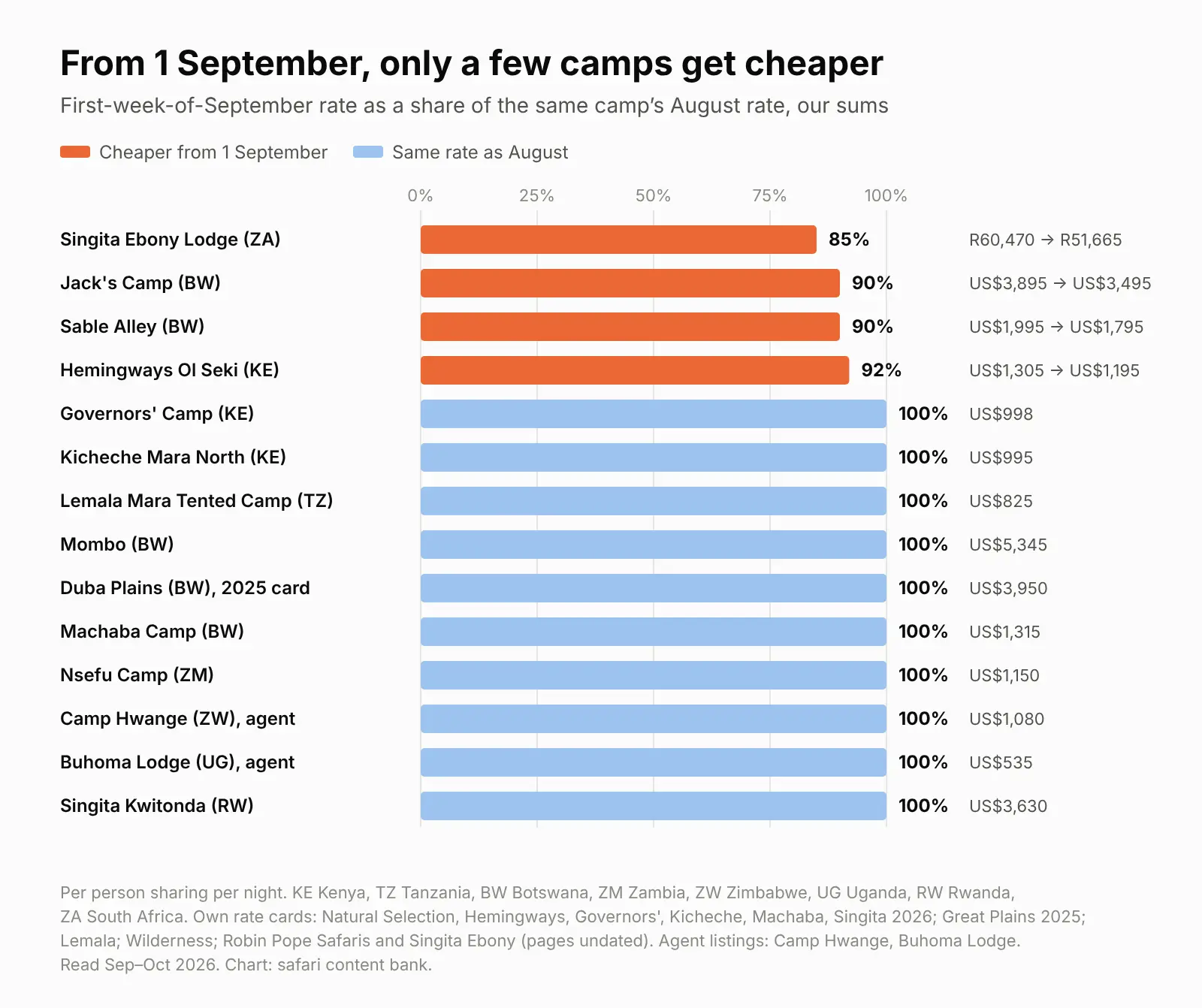 Our sums from camps’ own rate cards (Natural Selection, Hemingways, Governors’, Kicheche, Machaba, Singita 2026; Great Plains 2025; Lemala; Wilderness; Robin Pope Safaris, page undated; Singita Ebony rate page, undated) and agent listings (Camp Hwange, Buhoma Lodge), read September–October 2026. Chart: safari content bank.
Worked example: four nights for a couple, end of August or start of September (our sums)
Moving four nights from the last week of August to the first week of September saves a couple US$3,200 at Jack’s Camp and US$1,600 at Sable Alley, and nothing at Governors’ Camp. Flights, tips and drinks outside the rate are left out.
| Trip | Four nights to 31 August | Four nights from 1 September | Difference |
|---|---|---|---|
| Jack’s Camp, with the US$60 fee a night | 2 × 4 × (US$3,895 + US$60) = US$31,640 | 2 × 4 × (US$3,495 + US$60) = US$28,440 | US$3,200 |
| Sable Alley, with the US$60 fee a night | 2 × 4 × (US$1,995 + US$60) = US$16,440 | 2 × 4 × (US$1,795 + US$60) = US$14,840 | US$1,600 |
| Governors’ Camp, with the Mara fee and the US$50 community fee a night | 2 × 4 × (US$998 + US$200 + US$50) = US$9,984 | US$9,984 | None |
Natural Selection 2026 Botswana card (park fees included in the rate; US$60 community, conservation and reserve fee extra); Governors’ 2026 card (rates exclude park and community fees). Mara fee: Narok County FY2025/26, the last published schedule.
Park fees in July and August
Two government fees are at their high level for the whole summer holiday: the Masai Mara reserve fee (from 1 July) and the Serengeti concession fee (July–September); the gorilla permits are full price. Fees are copied from our cost pages.
| Park or permit | Fee per adult in July–August | Season | Source |
|---|---|---|---|
| Maasai Mara National Reserve (Kenya), per day | US$200; child 9–17 US$50, under 9 free | US$100 from 1 January to 30 June on the last published schedule | Narok County FY2025/26, the last published; expired 30 June 2026 |
| Serengeti (Tanzania), a night inside the park | US$153.40 (entry US$82.60 + concession US$70.80) | US$141.60 from 1 October | Last published tariff, 2023/24 |
| Kruger National Park (South Africa), per day | R692 in July–August 2027 | R692 (R602 until 31 October 2026) | SANParks 2025/26 and 2026/27 schedules |
| Chobe, Moremi (Botswana), per day | P270 (last published, 2022) | In February 2026 BOPA called the existing non-resident fee P380; a P500 rise was announced, then reported postponed | DWNP via Tourism Update; no official current tariff |
| Etosha, Sossusvlei (Namibia) | N$280 | No seasons | Government Notice 115 of 2026 |
| Uganda gorilla permit | US$800 | US$600 only in April, May and November | UWA letter TDO 93/04, 26 February 2026 |
| Rwanda gorilla permit | US$1,500 | Discount (US$1,050, our sum) only November–May | RDB, checked 9 October 2026 |
Fees copied from our Kenya, Tanzania, Botswana, Namibia, South Africa, Uganda and Rwanda cost pages. Zambian and Zimbabwean fees have no seasons: see safari in July.
The official fee lines, with the date each took effect and the authority’s own source:
| Fee | Amount | In force from | Source |
|---|---|---|---|
| Maasai Mara National Reserve, non-resident adult, per day (12-hour ticket, 06:00–18:00), 1 Jul–31 Dec | USD 200 | Since 1 Jul 2024; Narok County FY2025/26 schedule, the last published, expired 30 Jun 2026 (no 2026/27 schedule as of 9 Oct 2026); The Kenya Times (6 Aug 2026, secondary) reports US$200 still applies for Jul–Dec 2026 | Narok County fee schedule FY2025/26 |
| Maasai Mara National Reserve, non-resident child 9–17 or student, per day (under 9 free) | USD 50, all year | Narok County FY2025/26 schedule, the last published | Narok County fee schedule FY2025/26 |
| Serengeti and Nyerere National Parks, non-East African adult, entry per day, 16 May–14 Mar | USD 70 + 18% VAT = USD 82.60 | 1 Jul 2023 (2023/24 tariff, last published) | TANAPA Tariffs 2023/24 |
| Serengeti and Nyerere, concession fee per person per night inside the park | Jul–Sep USD 60 + VAT = USD 70.80; Oct–Jun USD 50 + VAT = USD 59 | 1 Jul 2023 (2023/24 tariff, last published) | TANAPA Tariffs 2023/24 |
| Chobe National Park and Moremi Game Reserve (DWNP), non-resident adult, per person per day | BWP 270 (SADC residents BWP 205; Botswana citizens and residents BWP 30) | Last published DWNP schedule, 1 April 2022 (via Tourism Update). In Feb 2026 the government news agency BOPA called the existing non-resident fee P380; a P500 rise was announced, then reported postponed. No official current tariff: confirm with DWNP or your operator | Tourism Update, 23 Feb 2022 (DWNP fee schedule) |
| Tier 1 parks (Etosha, Namib-Naukluft including Sossusvlei, Skeleton Coast, Ai-Ais/Fish River Canyon, Waterberg Plateau, Cape Cross, Dorob, Tsau //Khaeb), foreign adult 16+, per person | NAD 280 (NAD 140 park entrance + NAD 140 conservation fee) | 1 Apr 2026 (Government Notice 115 of 2026; the notice prices fees per person with no period; MEFT's 2021 schedule made fees valid for 24 hours from entry); was NAD 150 under the 2021 schedule | Government Gazette 8877 (Government Notice 115 of 2026), hosted by the Legal Assistance Centre |
| Kruger National Park daily conservation fee, international adult (12+), per day | ZAR 602 | 1 Nov 2025 to 31 Oct 2026 (SANParks 2025/26 schedule) | SANParks daily conservation fees 2025/26 |
| Kruger National Park daily conservation fee, international adult (12+), per day | ZAR 692 | 1 Nov 2026 to 31 Oct 2027 (SANParks 2026/27 schedule, already published) | SANParks daily conservation fees 2026/27 |
| Uganda: gorilla tracking permit, Bwindi Impenetrable and Mgahinga Gorilla NPs, foreign non-resident, per person per trek (guide and that day's park entry included) | USD 800 (foreign resident USD 700; rest of Africa USD 500; East African citizens UGX 300,000) | Since 1 Jul 2024 (UWA tariff 2024–26); confirmed unchanged from 1 Jan 2027 by UWA letter TDO 93/04 of 26 Feb 2026 | UWA letter TDO 93/04, 26 Feb 2026 |
| Rwanda: mountain gorilla tracking permit, Volcanoes NP, international visitor, per person per day | USD 1,500 | Current RDB price, checked 9 Oct 2026 | Visit Rwanda (Rwanda Development Board) |
Common mistakes about a summer-holiday safari
| What you’ll often read | What is correct |
|---|---|
| “The migration is in the Masai Mara all summer” | In early and mid-July most of the herds are usually still in the northern Serengeti; they reach the Mara from mid or late July, and most are there in August–September. |
| “A crossing is guaranteed in August” | No source guarantees a crossing or publishes odds. August is the month every calendar agrees on; the Mara Conservancy calls crossings “difficult to predict”. |
| “Summer means hot weather” | It is winter in southern Africa: Windhoek averages 7.2 °C on July nights, and Kruger safari tents get down to about 5 °C (traveller report). |
| “Kruger is malaria-free in winter” | No source says so. TravelHealthPro recommends tablets there from September to May, and Kruger is a risk area; the malaria-free reserves are Madikwe, Pilanesberg, the Waterberg and the Eastern Cape. |
| “Children can come gorilla trekking with a parent” | Not under 15, in Uganda or Rwanda, with or without a parent. |
| “Any camp will take young children” | Many Botswana fly-in camps take no children under 6, and some South African lodges only from 12 or 16; Machaba, Governors’ and Tswalu take all ages. |
| “Gorilla permits can be bought a few months out” | One operator advises 6 months or more for July–August, and a traveller who tried four months out was told peak permits were probably gone (traveller report). |
| “Prices drop as soon as the school holidays end” | At most camps they do not: 10 of the 14 camps we compared charge their August rate in early September; Natural Selection, Hemingways Ol Seki and Singita Ebony are the exceptions. |
Frequently asked questions
Where is the best place for a safari in July and August? Almost anywhere in the classic safari countries, because it is the dry season: the Mara River for the wildebeest crossings, the Okavango for its high water, Kruger and Namibia for game at the waterholes, and Bwindi or Volcanoes for gorillas. Choose by the children’s ages and malaria: gorillas need everyone 15+, and the malaria-free reserves are in South Africa. Month detail: safari in July, safari in August.
Will we see a river crossing in the summer holidays? Nobody can promise one. The Mara River crossings run July–October and are busiest in August–September; in 2026 the first were reported in the second week of July (traveller reports). August, with several days near the river on either bank, gives the best chance. See Great Migration river crossings.
How much more does a safari cost in July and August? Most camps charge their top rate. Governors’ Camp in the Masai Mara charges US$998 a night against US$453 in April–May, Lemala Mara Tented Camp US$825 against US$330 in June, and the Mara reserve fee doubles to US$200 a day on 1 July (last published schedule). One company’s packages cost 13–46% more than in June (our sums).
How far ahead should we book a summer-holiday safari? For July or August 2027, now: one safari operator advises 12–18 months for the migration route, Botswana park campsites need about a year (Tracks4Africa), and Kruger’s rest camps for those months have been bookable since 13–14 October 2026. Uganda’s gorilla permits need 6 months or more (one Uganda-based operator).
What is the minimum age for a family safari? There is no legal minimum for game drives; camps set their own. Many Botswana fly-in camps take children from 6, while Machaba Camp, Governors’ Camp and Tswalu take all ages. Walking and mokoro trips usually start at 12, and gorilla trekking is 15+ in Uganda and Rwanda. See family safari.
Where can we go on a malaria-free safari in July or August? South Africa’s reserves outside the Kruger area: Madikwe and Pilanesberg near Johannesburg, the Waterberg, and the Eastern Cape around Addo. Winter is their cheap season: Amakhala charges R5,290 per person sharing to 31 July 2027. Kruger is a malaria risk area. See malaria-free safari.
Is it crowded on safari in July and August? At the main sightings, yes: reviewers describe 20–30 vehicles in the Mara reserve (August 2025), and a Serengeti forum regular reports fifty or more trucks at a crossing point. South Africa’s own school holidays fill southern Kruger. Conservancies, the Mara Triangle and remote South Luangwa sectors are quieter.
Is late August cheaper than early August? Rarely. Most camps keep their July–August rate into September or October. Natural Selection’s peak ends on 31 August (Jack’s Camp US$3,895 to US$3,495), Hemingways Ol Seki’s premium rate too (US$1,305 to US$1,195), and Singita Ebony’s (R60,470 to R51,665). In the Eastern Cape, Amakhala gets dearer from 1 August 2027.
Sources
- Rate sheets and rate pages (camps’ own): Governors’ 2026 (PDF); Kicheche 2026 (PDF); Hemingways 2026 (PDF); Lemala rates; Natural Selection 2026 Botswana (PDF) and Namibia (PDF); Wilderness, Mombo; Great Plains 2025 (PDF); Machaba 2026; Kwando 2024 rate card (PDF); Robin Pope Safaris, Nsefu Camp (undated); Time + Tide; Singita 2026 (PDF); Amakhala; Kwandwe 2026–27 (PDF); Tswalu; NWR via NWR rates from a booking agent’s listing; all read September–October 2026
- Agent listings and package prices (names and links in our editor notes): a safari agent’s listings (Camp Hwange, Buhoma Lodge); a safari travel agent’s listing (Madikwe River Lodge); one Kenya-based safari company’s 2026 published packages; read 8 October 2026
- Seasons and herds: a camp operator’s migration guide; Mara Conservancy, wildebeest migration; UNESCO, Okavango Delta; IntechOpen review; Africa Geographic, zebra migrations; safari operators’ guides (Okavango flood, Botswana seasons, Hwange, South Luangwa, Chobe, Uganda gorillas, migration-route booking); a safari booking site (Bwindi ratings, Mara and Ngorongoro reviews); names in our editor notes
- Climate and health: Climates to Travel, Namibia (an aggregator); SANParks climate and malaria; TravelHealthPro, South Africa and Botswana; HealthyTravel / Swiss TPH, Namibia; WHO ITH country list 2022 (PDF); UWA Bwindi brochure (PDF)
- Fees and permits: Narok County, Maasai Mara fee schedule FY2025/26 (PDF), the last published; TANAPA, Tariffs 2023/24 (PDF), the last published tariff; SANParks daily conservation fees 2025/26 (PDF) and 2026/27 (PDF); SANParks booking periods (checked 17 October 2026); Tourism Update, DWNP fees (1 April 2022); Government Gazette 8877 (Government Notice 115 of 2026); UWA letter TDO 93/04 (PDF); Visit Rwanda; RDB low-season discount
- Official statistics: MET/NTB, Namibia Domestic Tourism Expenditure Survey 2015 (PDF)
- Traveller reports: TripAdvisor Masai Mara, Kenya, Serengeti, Kruger, Etosha, Botswana and Uganda forums and the Routard Tanzania forum, linked in the text or on the pages linked
- More on this site: safari in July, safari in August, Great Migration river crossings, Great Migration month by month, family safari, family safari cost, malaria-free safari, safari and gorilla trekking, Okavango flood calendar, how to book a safari, Easter safari, Christmas safari, best time for a safari
Rates, fees and seasons checked 8–10 October 2026 (SANParks booking periods 17 October 2026); SANParks fees checked 1 November 2026. We will update this page by 21 November 2026, and again when camps publish their July–August 2027 rates and when Narok County, TANAPA, SANParks or DWNP publish a new fee schedule.