 Experience

Last verified · Next check due
On this page
- Where to see each zebra: parks, numbers, status and fees (2026)
- Plains zebra and the Great Migration: the Serengeti and the Masai Mara
- Botswana’s zebra migration, and plains zebra in southern Africa
- Grévy’s zebra: Samburu and Laikipia in northern Kenya
- Mountain zebra: western Namibia and South Africa’s Eastern Cape
- Which zebra to choose for your trip
- When is the best time to see zebras?
- Common mistakes about seeing zebras
- Frequently asked questions
- Sources
Short answer: Africa has three zebra species. Plains zebra are on almost every safari: about 300,000 travel with the Serengeti–Mara migration (UNESCO), and Botswana’s herds graze Nxai Pan and the Makgadikgadi from December to March. Grévy’s zebra live in northern Kenya, in Samburu and Laikipia; Kenya counted 2,465 in 2024–25. Mountain zebra live in western Etosha, Naukluft and the Kaokoveld (Hartmann’s) and in South Africa’s Mountain Zebra National Park (Cape).
Key facts
- Three species, three Red List categories: plains zebra Near Threatened, Grévy’s zebra Endangered, mountain zebra Vulnerable (Wikipedia, Zebra, secondary, citing the IUCN Red List). The mountain zebra’s Vulnerable listing is the 2019 assessment by Gosling and others; South Africa’s 2016 regional assessment also lists Hartmann’s mountain zebra as Vulnerable, with numbers increasing (Endangered Wildlife Trust, PDF).
- Grévy’s zebra is the rare one. Kenya counted 2,465 in its 2024–25 national wildlife census, a species in decline (Citizen Digital, 11 Dec 2025); the Red List figure quoted on Wikipedia is fewer than 2,000 mature animals. A smaller population lives in Ethiopia (Wikipedia, secondary).
- The biggest herds are in the Serengeti–Mara: UNESCO’s World Heritage text gives about 300,000 zebra with the wildebeest (UNESCO); a 2023 paper says more than 250,000 zebra and other ungulates travel with them (Nature Communications, 2023).
- Botswana has two zebra migrations, not one: more than 20,000 zebra move from the Chobe floodplains to Nxai Pan, and about 15,000 from the Okavango to the Makgadikgadi (Africa Geographic, 20 November 2025). The full story, camps and rates are on our Botswana zebra migration page.
- Plains zebra are close to a sure thing in southern Africa’s big parks: 94% of one safari operator’s Botswana travellers saw zebra, 96% in South Luangwa and 98% in Mana Pools (read September–October 2026).
- We print no world total for plains zebra: our sources disagree. The Red List figure quoted on Wikipedia counts 150,000–250,000 mature animals; older figures in our bank are about twice that.
Where to see each zebra: parks, numbers, status and fees (2026)
Plains zebra are in nearly every big savanna park from Kenya to South Africa; for Grévy’s zebra you need northern Kenya, and for mountain zebra western Namibia or South Africa’s Eastern Cape. Numbers below are the figures our sources give for each place; none of them is a single continent-wide census.
| Zebra | Where to see it | Red List status | Numbers in our sources | Fee to be there, per adult | Source |
|---|---|---|---|---|---|
| Plains zebra: Serengeti–Mara migration | Serengeti (Tanzania); Masai Mara (Kenya) | Near Threatened (species) | About 300,000 with the migration (UNESCO) | Serengeti US$82.60 a day (last published tariff, 2023/24); Mara reserve US$100 a day January–June, US$200 July–December | UNESCO; Great Migration month by month |
| Plains zebra: Botswana’s migrations | Chobe riverfront, Nxai Pan and the Makgadikgadi | Near Threatened | More than 20,000 (Chobe herd) and about 15,000 (Okavango herd) | P190 a day at Nxai Pan and Makgadikgadi, P270 in Chobe (last published DWNP schedule, 1 April 2022) | Africa Geographic; Botswana zebra migration |
| Plains zebra: resident | Okavango Delta, Moremi, Kruger, Etosha, Hwange, Mana Pools, Tarangire, Lake Mburo | Near Threatened | No park count in our sources; seen by 91–98% of one operator’s travellers in northern Botswana | Kruger R692 (R602 until 31 Oct 2026); Etosha N$280 + N$60 per vehicle; Hwange US$12–24 a day | One operator; our park pages |
| Crawshay’s zebra (the Luangwa Valley’s own form) | South Luangwa (Zambia) | Not assessed separately in our sources | No count; zebra seen by 96% of one operator’s travellers | US$25 a day (DNPW 2025 schedule, the last published) | South Luangwa; one operator |
| Grévy’s zebra | Samburu, Buffalo Springs, Shaba; Laikipia conservancies (Lewa, Borana) | Endangered | 2,465 in Kenya (2024–25 census) | Samburu US$85 a day (county); Buffalo Springs, Shaba and Lewa publish no fee we could find | Citizen Digital; Samburu County; Lewa |
| Hartmann’s mountain zebra | Western Etosha; Naukluft; NamibRand; the Kaokoveld (Skeleton Coast) | Vulnerable (species, 2019) | Etosha 857–1,136, NamibRand about 428 (2017 counts) | Etosha and Namib-Naukluft N$280 per foreign adult + N$60 per vehicle (Government Notice 115 of 2026) | Mountain Zebra Project report, 2018; Etosha |
| Cape mountain zebra | Mountain Zebra National Park, Eastern Cape (South Africa); also Karoo and Goegap (Wikipedia) | Vulnerable (species) | About 2,600 in all by the 2010s, from fewer than 50 in the 1950s | Not on our fee pages: check SANParks | Wikipedia (secondary); SANParks |
Red List categories from Wikipedia, Zebra (secondary, citing the IUCN Red List; the Red List pages themselves were not readable when our bank was compiled); mountain zebra 2019 assessment as cited in our Namibia science file. “One operator”: a safari operator’s traveller reports, share of groups who saw zebra at least once on their trip; Botswana pages read September 2026, Zambia and Zimbabwe 8 October 2026. Fees per non-resident or international adult, copied from our Serengeti, Masai Mara, Kenya, Botswana, Kruger, Etosha, Zambia and Zimbabwe fee and cost pages, read 8–10 October 2026.
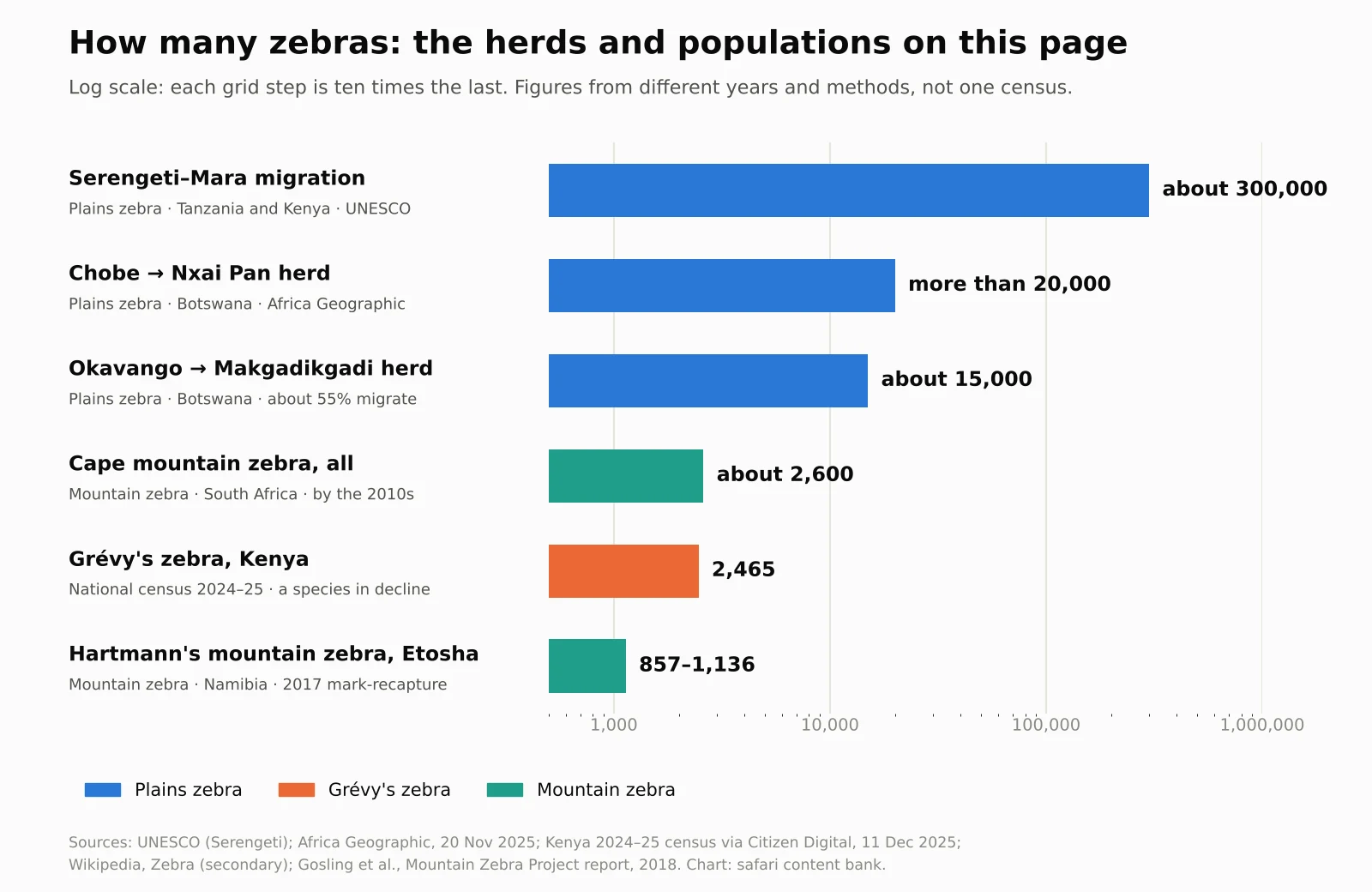 Sources: UNESCO; Africa Geographic, 20 Nov 2025; Kenya’s 2024–25 census via Citizen Digital, 11 Dec 2025; Wikipedia, Zebra (secondary); Gosling et al., Mountain Zebra Project 8th progress report, 24 July 2018. Figures from different years and methods. Chart: safari content bank.
- How to tell them apart: plains zebra have broad stripes that run on under the belly and a black snout; Grévy’s zebra, the largest wild horse at 125–160 cm and 352–450 kg, have many narrow stripes and a clean white belly; mountain zebra have medium stripes, a white belly and a chestnut-orange patch on the muzzle (Wikipedia, secondary).
- Subspecies: mountain zebra has two, Cape and Hartmann’s; plains zebra has six or none, depending on the author; Grévy’s has none (Wikipedia, secondary). The quagga, a half-striped southern form of plains zebra, is extinct: the last one died in Amsterdam zoo on 12 August 1883.
- For the other big animals, see where to see giraffes and where to see elephants.
Plains zebra and the Great Migration: the Serengeti and the Masai Mara
The Serengeti–Mara has the largest zebra herds in Africa: about 300,000 move with some 1.3 million wildebeest on a year-round circuit between Tanzania and Kenya (UNESCO; TAWIRI counted 1,366,109 wildebeest at the end of March 2023, ± 231,741 SE, as on our Botswana zebra migration page).
- Where the herds are by month: in a typical year they calve around Ndutu in the southern Serengeti from late January to mid-March, move north in April–May, reach the Grumeti in June and cross the Mara River from July to October, before heading south in November–December. Rains shift every date. Month by month, with the camps: Great Migration month by month; crossings: river crossings; calving: Serengeti calving season.
- Zebra walk a long way: in a 2019 study, plains zebra covered just under 3,500 km of total movement a year, and Botswana’s zebra moved more than the Serengeti’s (Scientific Reports, 2019).
- Tarangire’s zebra are up: zebra in Tarangire National Park increased from 2011 to 2019, and the community wildlife management areas beside it (Burunge, Randilen) held zebra at densities comparable to the park (Scientific Reports, 2024; Tarangire).
- Fees: Serengeti US$82.60 per adult per day (US$70.80 from 15 March to 15 May); Tarangire US$59 (US$53.10 from 15 March to 15 May), both last published tariff, 2023/24. The Mara reserve charges US$100 a day January–June and US$200 July–December (Narok County FY2025/26 schedule, the last published).
See also: Serengeti vs Masai Mara and Great Migration safari cost.
Botswana’s zebra migration, and plains zebra in southern Africa
Botswana’s herds are smaller than the Serengeti’s but you share them with far fewer vehicles: they reach Nxai Pan and the Makgadikgadi from December, mass in March and head back from March to May (Botswana zebra migration, with routes, camps, rates and a month-by-month table).
- Two herds, two routes: the Chobe herd moves between the Chobe and Zambezi floodplains and Nxai Pan; the Okavango herd between the south-eastern Delta and the Makgadikgadi, and only about 55% of it migrates (Africa Geographic). A third movement, between the Chobe–Linyanti system and the Mababe Depression near Savuti, is separate.
- The rest of the year the Chobe herd is on the riverfront: more than 20,000 zebra spend June to early November on the Chobe and Zambezi floodplains (Chobe), which suits a dry-season trip.
- Fees: P190 per non-resident adult per day at Nxai Pan and the Makgadikgadi, P270 in Chobe and Moremi (last published DWNP schedule, 1 April 2022). In Feb 2026 the government news agency BOPA called the existing non-resident fee P380; a P500 rise was announced, then reported postponed. Confirm with DWNP or your operator (Botswana park fees).
| Area | Zebra seen by (one operator’s travellers, per trip) | Fee per adult | Source |
|---|---|---|---|
| Moremi Game Reserve (Botswana) | 98% | P270 a day (last published DWNP schedule, 1 April 2022) | one operator’s Moremi page; Moremi |
| Mana Pools (Zimbabwe) | 98% | US$24 a day, day visitor or staying overnight (ZimParks Tariff 2026) | one operator’s Mana Pools page; Mana Pools |
| Okavango Delta reserves (private concessions) | 97% | In the camp rate at many camps | one operator’s Okavango Delta page; Okavango Delta |
| Kwando-Linyanti (private concessions, Botswana) | 96% | Camp rate plus levy | one operator’s Kwando-Linyanti page |
| South Luangwa (Zambia) | 96% | US$25 a day (DNPW 2025 schedule, the last published) | one operator’s South Luangwa page; South Luangwa |
| Makgadikgadi and Nxai Pan | 95% | P190 a day (last published DWNP schedule, 1 April 2022) | one operator’s salt pans page; Makgadikgadi |
| Botswana, all areas | 94% | – | one operator’s Botswana wildlife page |
| Chobe National Park | 91% | P270 a day (same DWNP line as Moremi) | one operator’s Chobe page; Chobe |
| Lower Zambezi (Zambia) | 79% | US$25 a day (same DNPW line as South Luangwa) | one operator’s Lower Zambezi page; Lower Zambezi |
| Kafue (Zambia) | 66% | Not on our fee pages | one operator’s Kafue page; Kafue |
| Central Kalahari Game Reserve | 50% | P190 a day (same DWNP line as Nxai Pan) | one operator’s Central Kalahari page; Central Kalahari |
| Okavango Panhandle | 0% | – | one operator’s Panhandle page |
| Kruger National Park | Not published | R692 (R602 until 31 Oct 2026) | Kruger |
| Etosha National Park | Not published; “Abundant” on a safari booking site | N$280 per foreign adult + N$60 per vehicle | Etosha |
| Hwange National Park | Not published | US$12 a day staying inside, US$24 as a day visitor (ZimParks Tariff 2026) | Hwange |
Botswana pages read September 2026; Zambia and Zimbabwe pages 8 October 2026. Our sources list plains zebra in Kruger, Etosha and Hwange (Wikipedia, Zebra, secondary). Botswana’s fee lines are the last published DWNP schedule; no official current tariff is published.
- Etosha: zebra are “Abundant” on a safari booking site’s wildlife ratings, and the park’s dry season, May–October, pulls game to a few waterholes (Etosha). The park is fully fenced, so there is no migration.
- Kruger: a self-drive park; stay in your vehicle except at designated spots (Kruger self-drive).
- Kafue is being restocked: African Parks released 1,567 wildebeest and 172 zebra in August 2025 (African Parks, Kafue). Compare it with the Luangwa on Kafue vs South Luangwa.
- Uganda: only Lake Mburo and Kidepo Valley have zebra (UWA). At Lake Mburo, UWA rangers lead walks among zebra and impala for US$25 per foreign adult; entry is US$40 per 24 hours (last published UWA tariff, July 2024–June 2026).
Grévy’s zebra: Samburu and Laikipia in northern Kenya
Grévy’s zebra, often spelled Grevy’s, is the largest and rarest zebra on a safari circuit: Kenya counted 2,465 in 2024–25 and the species is in decline (Citizen Digital). It lives in arid northern Kenya and, in smaller numbers, Ethiopia (Wikipedia, secondary).
- Samburu: Samburu County lists Grévy’s zebra among the “Samburu Five”, with reticulated giraffe, Beisa oryx, gerenuk and Somali ostrich (Samburu). The reserve fee is US$85 per adult in every month (Samburu County Finance Act 2025). Buffalo Springs, across the Ewaso Ng’iro, and Shaba are Isiolo County reserves in the same range (Wikipedia, secondary); we found no official fee for them.
- Laikipia: Lewa says it is home to “the world’s largest population of endangered Grevy’s zebras” (Laikipia), and Borana says the landscape it shares with Lewa holds 14% of Kenya’s Grévy’s zebra (Borana, Your Impact). Lewa publishes no conservancy fee.
- Why they stay near the rivers: Grévy’s zebra can go almost a week without drinking, and stallions defend territories marked with dung piles, the best of them near water (Wikipedia, secondary). In Samburu, the dry seasons concentrate animals on the Ewaso Ng’iro.
- Not in the Mara: none of our Masai Mara sources lists Grévy’s zebra (Samburu vs Masai Mara), so a Kenya trip that wants both needs a northern leg.
- How to fit it in: Samburu is about 350 km, 6–8 hours by road, from Nairobi (traveller reports), and Safarilink and AirKenya fly from Wilson Airport (Samburu). Laikipia pairs with the Mara on Laikipia vs Masai Mara; the fees are on Kenya park fees.
Mountain zebra: western Namibia and South Africa’s Eastern Cape
There are two mountain zebras: Hartmann’s in Namibia and Cape mountain zebra in South Africa. The species is Vulnerable on the Red List (2019 assessment), and you see it in hills and on escarpments rather than on open plains. Wikipedia (secondary) puts its range up to 2,000 m.
Hartmann’s mountain zebra: Etosha’s west, Naukluft and the Kaokoveld
- Etosha: Hartmann’s mountain zebra live in the west of the park (Etosha), where Dolomite Camp needs a 4x4 approach all year and Olifantsrus has a two-storey hide over its waterhole. A 2017 mark-recapture count put Etosha’s at 857–1,136 (Gosling et al., Mountain Zebra Project, 2018).
- Naukluft and NamibRand: the same project counted 1,824 known alive in Naukluft, with incomplete sampling, and about 428 on NamibRand Nature Reserve. Namib-Naukluft is a Tier 1 park: N$280 per foreign adult plus N$60 per vehicle (Government Notice 115 of 2026; Namibia park fees).
- The Kaokoveld: Wilderness lists Hartmann’s mountain zebra among the desert-adapted animals around Hoanib Skeleton Coast Camp (Wilderness; Skeleton Coast). In Damaraland, a safari booking site rates zebra only “Rare”.
- National numbers are uncertain. Namibia holds most of the world’s Hartmann’s mountain zebra, most of them on private farmland; national estimates vary widely and the most-cited figure traces to unpublished data. In the north-west, Hartmann’s mountain zebra declined steeply on road and aerial counts from 1982 to 2021, with drought the main driver (MEFT and NACSO, State of Community Conservation 2021).
Cape mountain zebra: Mountain Zebra National Park
- The park was made for it: Mountain Zebra National Park, near Cradock in the Eastern Cape, was founded on 2 July 1937 to save the Cape mountain zebra and now covers 284 km² (Wikipedia, secondary). Only two stallions were left in 1950; Wikipedia gives more than 700 by 2015, with about 20 moved out each year, while SANParks’ park page says 300. Our sources disagree.
- Recovery: Cape mountain zebra went from fewer than 50 in the 1950s to about 2,600 by the 2010s (Wikipedia, Zebra, secondary). Karoo and Goegap are among the other parks that hold mountain zebra.
- What else: the park is malaria-free (malaria-free safaris), and SANParks sells cheetah tracking on foot with a ranger there (SANParks, Mountain Zebra; where to see cheetahs). Its conservation fee is not on our fee pages; check SANParks before you go.
Which zebra to choose for your trip
Pick the zebra by the trip you are already planning: any East or southern African circuit has plains zebra, a northern Kenya leg adds Grévy’s, and Namibia or the Eastern Cape adds mountain zebra.
| If you want | Go to | Why |
|---|---|---|
| The biggest zebra herds | Serengeti or Masai Mara | About 300,000 zebra move with the wildebeest (UNESCO) |
| A zebra migration with few vehicles | Nxai Pan or the Makgadikgadi, December–March | More than 20,000 and about 15,000 zebra on the pans; details on Botswana zebra migration |
| Zebra on a dry-season Botswana trip | Chobe riverfront or Moremi | Chobe herd on the floodplains June–early November; Moremi 98% |
| The rarest zebra | Samburu or Laikipia | Grévy’s zebra, Endangered; 2,465 in Kenya |
| Mountain zebra on a self-drive | Western Etosha | Hartmann’s mountain zebra; 857–1,136 in 2017 |
| Mountain zebra without malaria | Mountain Zebra National Park, Eastern Cape | Cape mountain zebra; malaria-free; cheetah tracking on foot |
| The Luangwa Valley’s own zebra | South Luangwa | Crawshay’s zebra; zebra seen by 96% |
| Zebra on foot | Lake Mburo | UWA ranger-led walks among zebra and impala, US$25 |
| Zebra on a Big Five self-drive | Kruger | Plains zebra; R692 (R602 until 31 Oct 2026) |
When is the best time to see zebras?
Migrating zebra are in a different place each month: the southern Serengeti around Ndutu from late January to mid-March, the Mara from July to October, and Botswana’s pans from December to March. Resident zebra are there all year, and the dry months make them easier to find. No source in our bank gives zebra-specific months for the resident herds, so the table uses each park’s general dry season.
| Where | Zebra | Best months in our sources | Source |
|---|---|---|---|
| Southern Serengeti (Ndutu) | Plains, migration | Late January–mid-March, calving season | Great Migration month by month |
| Northern Serengeti and Masai Mara | Plains, migration | July–October, river crossings | Great Migration month by month |
| Chobe riverfront | Plains, Chobe herd | June–early November | Chobe |
| Nxai Pan | Plains, Chobe herd | December–February; some stay into April | Botswana zebra migration |
| Makgadikgadi | Plains, Okavango herd | December or January to March; massing in March | Botswana zebra migration |
| Samburu | Grévy’s | June–October and January–February, when animals gather on the Ewaso Ng’iro | Samburu |
| Laikipia | Grévy’s | January–February and June–October (Ol Pejeta) | Laikipia |
| Etosha | Plains; Hartmann’s in the west | May–October, when water is limited to a few waterholes | Etosha |
| South Luangwa | Crawshay’s | June–October, when every camp is open | South Luangwa |
| Kruger | Plains | April–September, the dry season | Kruger |
| Mountain Zebra National Park | Cape mountain | No month in our sources | – |
Read 8–10 October 2026. Migration months are a typical year, not a forecast. More: best time for a safari.
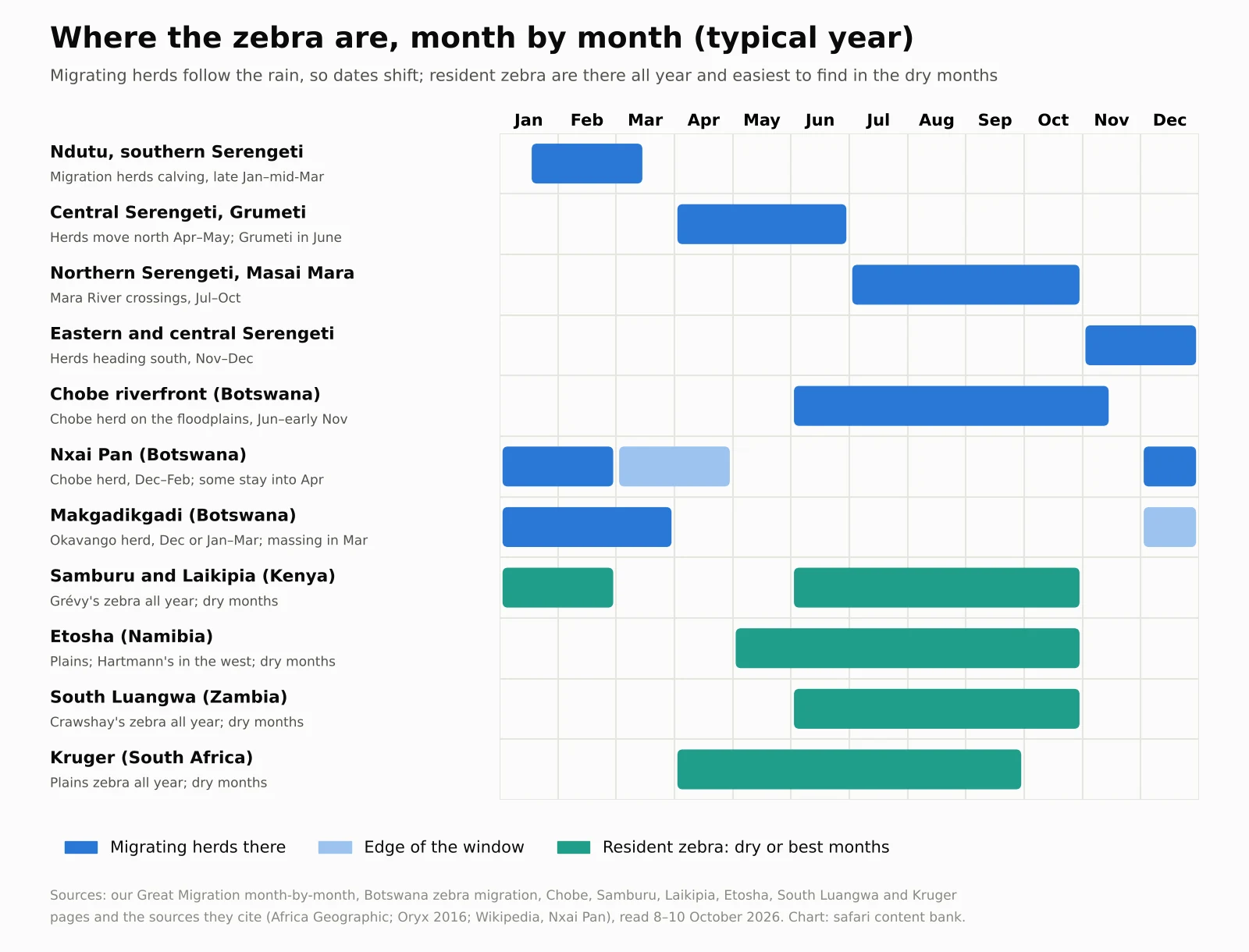 Sources: our Great Migration month-by-month, Botswana zebra migration, Chobe, Samburu, Laikipia, Etosha, South Luangwa and Kruger pages and the sources they cite, read 8–10 October 2026. Chart: safari content bank.
- The Botswana zebra months are green-season months. Botswana’s rains fall from about November to March, when most camps charge their lowest rates (green-season safari).
- The Mara’s zebra months are its expensive months: the reserve fee is US$100 a day January–June and US$200 July–December.
The official fee lines, with the date each took effect and the authority’s own source:
| Fee | Amount | In force from | Source |
|---|---|---|---|
| Maasai Mara National Reserve, non-resident adult, per day (12-hour ticket, 06:00–18:00), 1 Jan–30 Jun | USD 100 | Since 1 Jan 2024; Narok County FY2025/26 schedule, the last published | Narok County fee schedule FY2025/26 |
| Maasai Mara National Reserve, non-resident adult, per day (12-hour ticket, 06:00–18:00), 1 Jul–31 Dec | USD 200 | Since 1 Jul 2024; Narok County FY2025/26 schedule, the last published, expired 30 Jun 2026 (no 2026/27 schedule as of 9 Oct 2026); The Kenya Times (6 Aug 2026, secondary) reports US$200 still applies for Jul–Dec 2026 | Narok County fee schedule FY2025/26 |
| Serengeti and Nyerere National Parks, non-East African adult, entry per day, 16 May–14 Mar | USD 70 + 18% VAT = USD 82.60 | 1 Jul 2023 (2023/24 tariff, last published) | TANAPA Tariffs 2023/24 |
| Serengeti and Nyerere National Parks, non-East African adult, entry per day, 15 Mar–15 May | USD 60 + 18% VAT = USD 70.80 | 1 Jul 2023 (2023/24 tariff, last published) | TANAPA Tariffs 2023/24 |
| Tarangire, Lake Manyara and Arusha National Parks, non-East African adult, entry per day | Peak USD 50 + VAT = USD 59; low USD 45 + VAT = USD 53.10 | 1 Jul 2023 (2023/24 tariff, last published) | TANAPA Tariffs 2023/24 |
| Samburu National Reserve (Samburu County), non-resident adult, per day (basis not stated by the county) | USD 85 (child USD 50) | Samburu County Finance Act 2025, published 22 Dec 2025 | Samburu County Finance Act 2025 |
| Uganda: park entry, Queen Elizabeth, Bwindi, Mgahinga, Kibale, Kidepo Valley and Lake Mburo NPs, foreign non-resident adult, per 24 hours | USD 40 (child USD 20) | 1 Jul 2024 (UWA Conservation Tariff July 2024–June 2026, the last published park-entry rates; the 2026/27 letter does not cover park entry) | UWA Conservation Tariff July 2024–June 2026 |
| Uganda: guided nature or birding walk, Lake Mburo NP (UWA rate for savanna parks), foreign non-resident, per person | USD 25 (foreign resident USD 20; East African citizens UGX 20,000) | 1 Jul 2024 (UWA Conservation Tariff July 2024–June 2026, the last published rates) | UWA Conservation Tariff July 2024–June 2026 |
| South Luangwa and Lower Zambezi National Parks (DNPW Category A), international adult, entry per day (06:00–18:00) | USD 25 (SADC and resident USD 20; Zambian citizen ZMW 55.60); child 5–13 half price, under 5 free | DNPW 2025 schedule ("official 2025 rates"), the last published; page last modified 8 May 2025, still shown 9 Oct 2026 | DNPW 2025 fee schedule, as shown on a Zambia travel portal |
| Chobe National Park and Moremi Game Reserve (DWNP), non-resident adult, per person per day | BWP 270 (SADC residents BWP 205; Botswana citizens and residents BWP 30) | Last published DWNP schedule, 1 April 2022 (via Tourism Update). In Feb 2026 the government news agency BOPA called the existing non-resident fee P380; a P500 rise was announced, then reported postponed. No official current tariff: confirm with DWNP or your operator | Tourism Update, 23 Feb 2022 (DWNP fee schedule) |
| Other DWNP parks and reserves (Central Kalahari Game Reserve, Khutse, Nxai Pan, Makgadikgadi Pans), non-resident adult, per person per day | BWP 190 (SADC residents BWP 145; Botswana citizens and residents BWP 20) | Last published DWNP schedule, 1 April 2022 (via Tourism Update). In Feb 2026 the government news agency BOPA called the existing non-resident fee P380; a P500 rise was announced, then reported postponed. No official current tariff: confirm with DWNP or your operator | Tourism Update, 23 Feb 2022 (DWNP fee schedule) |
| Kruger National Park daily conservation fee, international adult (12+), per day | ZAR 602 | 1 Nov 2025 to 31 Oct 2026 (SANParks 2025/26 schedule) | SANParks daily conservation fees 2025/26 |
| Kruger National Park daily conservation fee, international adult (12+), per day | ZAR 692 | 1 Nov 2026 to 31 Oct 2027 (SANParks 2026/27 schedule, already published) | SANParks daily conservation fees 2026/27 |
| Tier 1 parks (Etosha, Namib-Naukluft including Sossusvlei, Skeleton Coast, Ai-Ais/Fish River Canyon, Waterberg Plateau, Cape Cross, Dorob, Tsau //Khaeb), foreign adult 16+, per person | NAD 280 (NAD 140 park entrance + NAD 140 conservation fee) | 1 Apr 2026 (Government Notice 115 of 2026; the notice prices fees per person with no period; MEFT's 2021 schedule made fees valid for 24 hours from entry); was NAD 150 under the 2021 schedule | Government Gazette 8877 (Government Notice 115 of 2026), hosted by the Legal Assistance Centre |
| Vehicle up to 10 seats, most national parks (N$50 at Sandwich Harbour), per vehicle | NAD 60 | 1 Apr 2026 (Government Notice 115 of 2026; the notice states no period; MEFT's 2021 schedule made fees valid for 24 hours from entry); was NAD 50 | Government Gazette 8877 (Government Notice 115 of 2026), hosted by the Legal Assistance Centre |
| Hwange National Park, Main Camp (row as labelled in the ZimParks 2026 tariff), international adult, conservation fee per day | USD 24 day visitor; USD 12 if staying overnight in the park (SADC USD 18 / 10; local USD 5 / 3) | ZimParks Tariff 2026 (tariff year 2026, published February 2026); the conservation-fee table does not say whether VAT is included; Robins, Sinamatella and Kazuma Pan are not listed separately in our sources | ZimParks De-Gazetted Tariff 2026 |
| Mana Pools National Park, Sapi and Chewore, international adult, conservation fee per day | USD 24, day visitor or staying overnight (SADC USD 18; local USD 8) | ZimParks Tariff 2026 (tariff year 2026, published February 2026); the conservation-fee table does not say whether VAT is included | ZimParks De-Gazetted Tariff 2026 |
Before paying an agent, check the operator’s licence.
Common mistakes about seeing zebras
| What you’ll often read | What is correct |
|---|---|
| “Botswana’s zebra migration is one herd” | Two herds on two routes: Chobe to Nxai Pan (more than 20,000) and Okavango to the Makgadikgadi (about 15,000), plus a separate Savuti–Mababe movement. |
| “Botswana’s zebra migration is Africa’s longest” | Contested. The 2016 Oryx paper called it the longest recorded large-mammal migration in Africa; Africa Geographic now calls it the second-longest, after the Great Nile Migration. |
| “You can see Grévy’s zebra in the Masai Mara” | Not in our Mara sources. Grévy’s zebra live in Samburu, Buffalo Springs, Shaba and Laikipia. |
| “All zebras are plains zebras” | There are three species. Grévy’s zebra (Endangered) and mountain zebra (Vulnerable) are separate species from the plains zebra (Near Threatened). |
| “Namibia has 132,000 Hartmann’s mountain zebra” | That figure traces to unpublished data. Counts in four key Namibian areas total under 6,000; most of the rest are said to be on farmland. |
| “Every Okavango camp has zebra” | Not the Panhandle: 0% of one operator’s travellers saw zebra there, against 97% in the Delta reserves. |
| “Mountain Zebra National Park has 300 zebra” | SANParks’ page says 300; Wikipedia says more than 700 by 2015. Our sources disagree. |
| “The quagga was a separate zebra species” | It was a half-striped southern form of the plains zebra, extinct since 1883 (Wikipedia, secondary). |
| “Kruger costs R602 a day” | That was the 2025/26 rate, which ended on 31 October 2026. Since 1 November 2026: R692 per international adult per day. |
Frequently asked questions
Where is the best place to see zebras on safari? For numbers, the Serengeti–Mara, where about 300,000 zebra travel with the wildebeest (UNESCO). For near-certain sightings, northern Botswana, South Luangwa and Mana Pools: 91–98% of one operator’s travellers saw zebra there (read September–October 2026). For the rarer species, go to Samburu or Laikipia for Grévy’s zebra and western Etosha for Hartmann’s mountain zebra.
How many species of zebra are there? Three: the plains zebra, Grévy’s zebra and the mountain zebra. The mountain zebra has two subspecies, Cape and Hartmann’s; the plains zebra has six or none, depending on the author; Grévy’s zebra has none (Wikipedia, secondary). Zambia’s Luangwa Valley has its own form, Crawshay’s zebra (South Luangwa).
Where can I see Grévy’s zebra? In northern Kenya: Samburu, Buffalo Springs and Shaba reserves, and the Laikipia conservancies, where Lewa claims the world’s largest population. Kenya counted 2,465 Grévy’s zebra in 2024–25. Samburu charges US$85 per non-resident adult (Samburu County Finance Act 2025); Lewa publishes no fee.
Where can I see mountain zebra? Hartmann’s mountain zebra: western Etosha (857–1,136 in a 2017 count), Naukluft, NamibRand and the Kaokoveld in Namibia. Cape mountain zebra: Mountain Zebra National Park near Cradock in South Africa’s Eastern Cape, founded in 1937 to save it. Etosha charges N$280 per foreign adult plus N$60 per vehicle (Government Notice 115 of 2026).
Are zebras endangered? Grévy’s zebra is Endangered, the mountain zebra Vulnerable and the plains zebra Near Threatened on the IUCN Red List (Wikipedia, secondary, citing the Red List; the mountain zebra listing is the 2019 assessment). Kenya’s 2024–25 census found 2,465 Grévy’s zebra, a species in decline (Citizen Digital).
How many zebras are in the Great Migration? About 300,000, according to UNESCO’s World Heritage text for the Serengeti; a 2023 paper says more than 250,000 zebra and other ungulates travel with the wildebeest. The herds calve around Ndutu from late January to mid-March and cross the Mara River from July to October in a typical year.
When is Botswana’s zebra migration? The zebra reach Nxai Pan and the Makgadikgadi in December, graze there through January and February, mass in March and head back from March to May (Africa Geographic). Nxai Pan and the Makgadikgadi charge P190 per non-resident adult per day (last published DWNP schedule, 1 April 2022). Camps, routes and rates are on our Botswana zebra migration page.
When is the best time to see zebras? It depends on the herd: Ndutu from late January to mid-March, the Mara from July to October, Botswana’s pans from December to March, and the Chobe riverfront from June to early November. Resident zebra are easiest to find in the dry season: June–October in Samburu and South Luangwa, May–October in Etosha and April–September in Kruger.
Sources
- Species, status and numbers: Wikipedia, Zebra (secondary, citing the IUCN Red List; identification, subspecies, range, Cape mountain zebra recovery, quagga), read 9 Oct 2026; Endangered Wildlife Trust, Hartmann’s mountain zebra regional assessment, 2016 (PDF); IUCN Red List, mountain zebra assessment 2019 (Gosling et al.), as cited in our Namibia science file; Citizen Digital, 11 Dec 2025 (Kenya’s 2024–25 census)
- Migrations: UNESCO, Serengeti National Park; Nature Communications, 2023; Scientific Reports, 2019 (zebra movement); Africa Geographic, Botswana’s zebra migrations, 20 Nov 2025; Naidoo et al., Oryx, 2016; Scientific Reports, 2024 (Tarangire)
- Mountain zebra: Gosling et al., Mountain Zebra Project 8th progress report, 24 July 2018 (2017 counts), and MEFT/NACSO, State of Community Conservation 2021, both as held in our Namibia science file; Wikipedia, Mountain Zebra National Park (secondary); SANParks, Mountain Zebra, read 8 Oct 2026; Wilderness, Hoanib Skeleton Coast Camp
- Grévy’s zebra: Samburu County, as cited on our Samburu page; Lewa, as cited on our Laikipia page; Borana, Your Impact
- Sighting rates: one operator’s pages on Botswana wildlife, Chobe, Moremi, the Okavango Delta reserves, Kwando-Linyanti, the Central Kalahari, the salt pans and the Okavango Panhandle (read September 2026), and on South Luangwa, Lower Zambezi, Kafue and Mana Pools (read 8 October 2026); a safari booking site’s wildlife ratings for Etosha and Damaraland (names and links kept in our editor notes); African Parks, Kafue; UWA, as cited on our Lake Mburo page
- Fees: Narok County FY2025/26 schedule (PDF); TANAPA Tariffs 2023/24 (PDF), the last published tariff; Samburu County Finance Act 2025; UWA Conservation Tariff July 2024–June 2026 (PDF); DNPW 2025 schedule, the last published, from a safari agent’s guide read 9 Oct 2026; DWNP schedule effective 1 April 2022 via Tourism Update, 23 Feb 2022; SANParks daily conservation fees 2025/26 and 2026/27; Government Notice 115 of 2026 (PDF); ZimParks Tariff 2026 (PDF)
More on where to see the other animals: lions, leopards, cheetahs, wild dogs and the Big Five.
Figures, rates and fees checked 10 October 2026; SANParks fees checked 1 November 2026. We will update this page when the IUCN Red List publishes new zebra assessments, when Kenya publishes its next wildlife census, when SANParks’ 2026/27 fees take effect on 1 November 2026, when DNPW publishes a 2026 Zambia schedule or Botswana an official tariff, when TANAPA publishes a new tariff, and when UWA publishes park-entry rates after June 2026.