 Experience

Last verified · Next check due
On this page
- The safari day at a glance, hour by hour
- How many hours a day are you in the vehicle?
- How the place changes the day: parks, reserves and private land
- Lodge, road safari or self-drive: how the day differs
- Night drives, walks, mokoro and gorilla mornings
- Is there downtime, and can you skip a drive?
- Which kind of safari day suits you?
- Common mistakes about the safari day
- Frequently asked questions
- Sources
Short answer: At most camps the day runs on two activities: a game drive from first light to mid-morning, brunch and a midday rest, then tea and an afternoon drive from about 15:30–16:00 that ends with a sundowner at dusk, then dinner. Lodges publish drives of 2–4 hours. In public parks the gates set the hours: a Masai Mara ticket covers 06:00–18:00, so East African road trips often run full-day drives with a picnic.
Key facts
- Two activities a day are in the rate at most fully inclusive camps. Time + Tide and The Bushcamp Company in Zambia include “2 activities/day” (2026–27 rate sheets), Singita’s Kruger and Sabi Sand lodges include “twice-daily drives” (2025 rates), and Governors’ Camp in the Masai Mara includes 2–3 game drives a day (2026 rate sheet).
- A published game drive lasts 2–4 hours. Wolwedans in Namibia prints 3 hours for its morning and afternoon drives and 1.5 hours for sunrise and sundowner drives; Onguma’s drive into Etosha lasts 4 hours (2025–27 activity sheet; 2026 rack rates).
- Park gates, not camps, set the day in public parks. The Masai Mara ticket covers one calendar day, 06:00–18:00; Ngorongoro allows driving 06:00–18:00 and closes the crater descent at 16:00; Kruger’s entrance gates open at 05:30 or 06:00 and close at 17:30–18:30, by month.
- Not every rate includes drives. Onguma’s “Dinner, Bed & Breakfast” rate includes no activities, and at many big East African lodges the bed and meals come from the lodge while the vehicle and guide come from your operator.
- Expect early alarms and real tiredness. An experienced poster on TripAdvisor’s Botswana forum warned a first-timer of 4:45 am alarms and real fatigue; a writer in Botswana in winter reported wake-ups at about 05:30 near freezing.
- Night drives are not part of the day in many national parks. No night drives are sold in the Serengeti or the Masai Mara reserve, and Botswana’s parks forbid night driving; private concessions, conservancies and a few parks sell them.
The safari day at a glance, hour by hour
The usual day at a lodge or camp is wake-up, coffee, morning drive, brunch, rest, tea, afternoon drive with a sundowner, and dinner. Camps on private land set their own clock times and rarely publish them; the times below are the ones our sources hold.
| When | What happens | What to know | Source |
|---|---|---|---|
| Before first light | Wake-up call, coffee or tea | Guides prepare the vehicles in the dark; camp staff on one guide course were up at 04:00–04:30 to pack the hot boxes | A private-reserve lodge’s ranger blog, 20 May 2025; Bushwise, 24 Feb 2023 |
| First light to mid-morning | Morning game drive | The coolest hours, when predators are active; at Kapama an optional bush walk can follow | Our sources’ drive-types guide; Kapama |
| Late morning | Brunch or a late breakfast | At Wolwedans the morning drive leaves after breakfast instead and returns for lunch | The Points Guy, 13 Sep 2022; Wolwedans activity sheet 2025–27 |
| Midday | Rest: a siesta, or time on your tent deck | Guides use it to service vehicles and log sightings | A private-reserve lodge’s ranger blog |
| Mid-afternoon | Afternoon tea | The meal before the second drive | Drive-types guide |
| About 15:30–16:00 to dusk | Afternoon drive, with a sundowner stop | In public parks you must be off the roads by the gate time | Drive-types guide |
| After dark | Spotlit drive back to camp, on private land | Guides look for porcupine, bushbaby and owls on the way back | A private-reserve lodge’s ranger blog |
| Evening | Dinner | Kruger’s park rules set quiet hours from 21:30 to 06:00 | Kruger self-drive |
Read 9–10 October 2026. The “drive-types guide” is the game-drive table in our content bank, compiled from two safari operators’ vehicle guides and camp rate sheets; the operators are named in our editor notes.
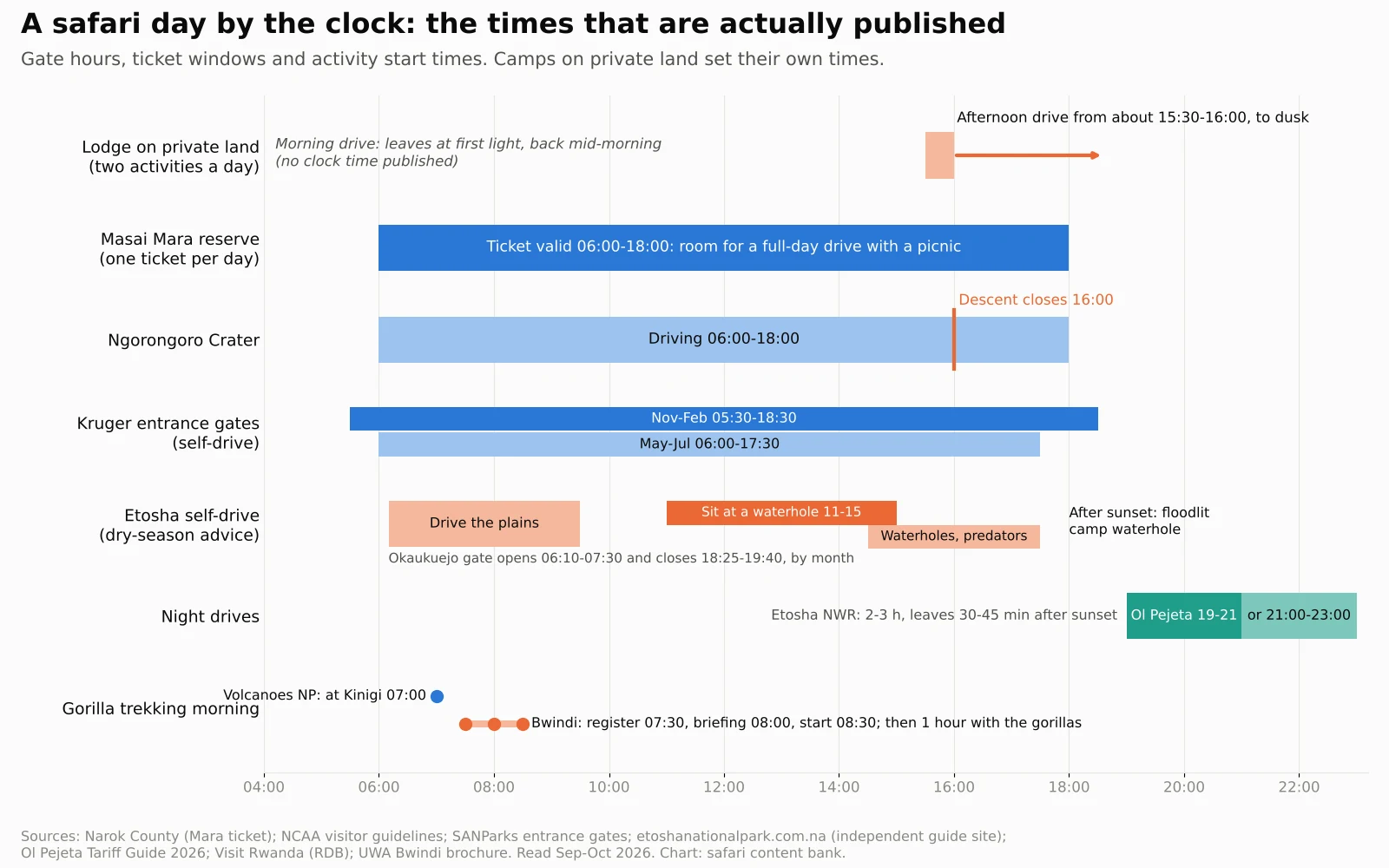 Sources: Narok County (Mara ticket); NCAA visitor guidelines; SANParks entrance gates; a safari agent’s guide; Ol Pejeta Tariff Guide 2026; Visit Rwanda (RDB); UWA Bwindi brochure. Read September–October 2026. Chart: safari content bank.
- The day is built around the animals, not the guests. The pre-dawn drive, late breakfast, siesta and afternoon drive are set by when animals are active (The Points Guy, 13 Sep 2022).
- The forum version starts at 4:45 am. An experienced poster on TripAdvisor’s Botswana forum warned a first-timer of 4:45 am alarms and real fatigue (TripAdvisor, traveller report).
- Southern African winter dawns are cold in an open vehicle. A writer on a US safari company’s blog reported wake-ups at about 05:30 near freezing in Botswana, with camps handing out fleece-lined ponchos (30 Jun 2023). What to wear is on what to wear on safari.
How many hours a day are you in the vehicle?
On a two-drive day, usually 4–8 hours (our sums from published drive lengths); on an East African full-day drive, up to the 12 hours of a Masai Mara ticket. One safari operator’s vehicle guide puts it at six to eight hours a day.
| Activity | Length | Where | Source |
|---|---|---|---|
| Morning or afternoon drive | 3 hours (2–3 hours in the description) | Wolwedans, NamibRand (Namibia) | Wolwedans activity sheet 2025–27 (PDF) |
| Sunrise or sundowner drive | 1.5 hours | Wolwedans | Same |
| Full-day drive with picnic lunch | 6 hours | Wolwedans | Same |
| Game drive into Etosha, morning or afternoon | 4 hours, N$1,750 per person | Onguma (Namibia) | Onguma 2026 rack rates (PDF), which ran to 31 October 2026 |
| Sunrise drive or sundowner drive on the reserve | 3 hours, N$890 per person | Onguma | Same |
| Private full-day drive | 8 hours, N$15,500 per vehicle | Onguma | Same |
| Masai Mara reserve ticket | 12 hours, 06:00–18:00 | Kenya | Masai Mara park fees |
Read 8–10 October 2026. Onguma’s prices are from its 2026 rate sheet, which ran to 31 October 2026; we have not confirmed 2027 activity prices. They include drinks; its conservation levy is extra.
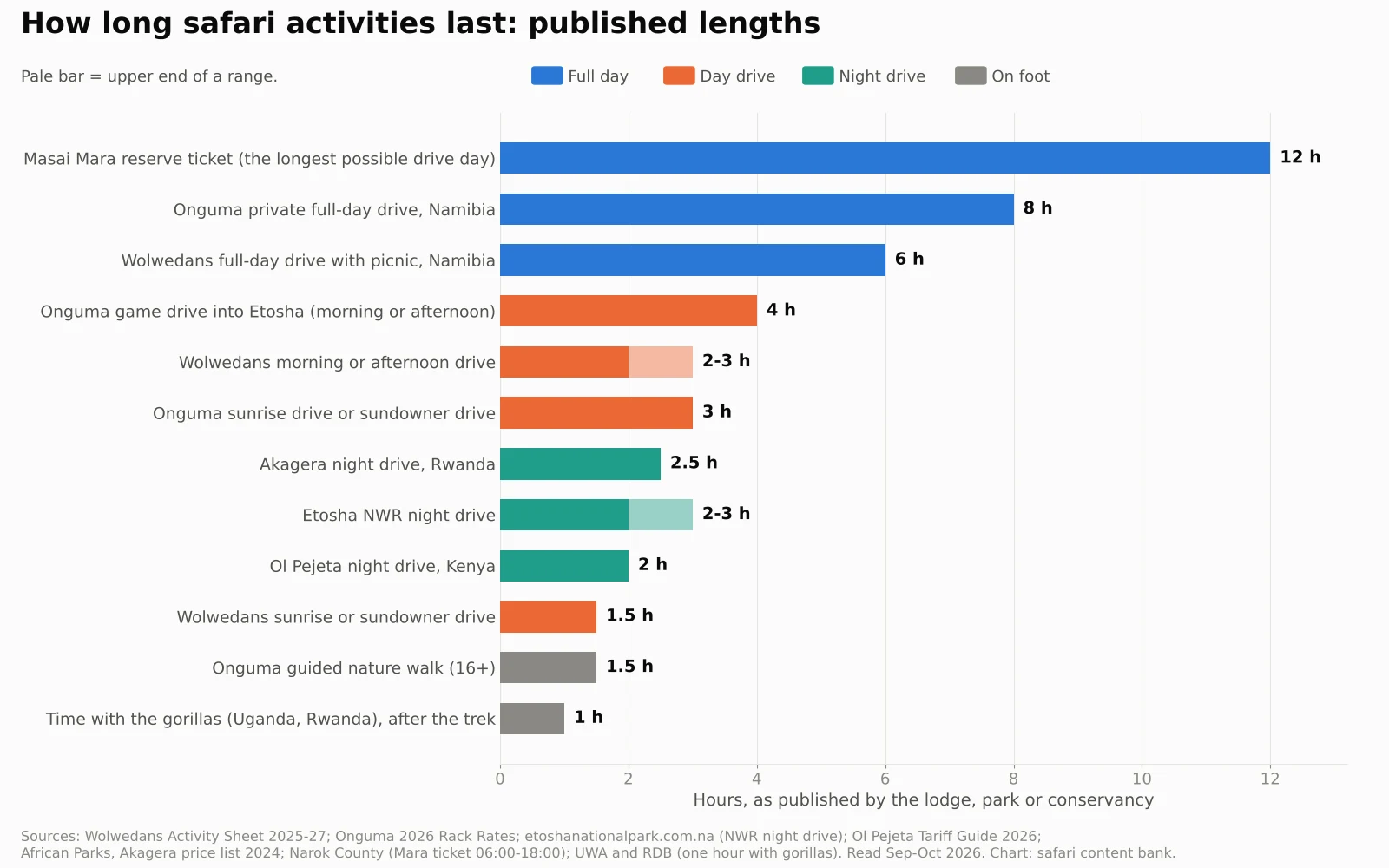 Sources: Wolwedans Activity Sheet 2025–27; Onguma 2026 Rack Rates; a safari agent’s guide (NWR night drive); Ol Pejeta Tariff Guide 2026; African Parks, Akagera price list 2024; Narok County (Mara ticket); UWA and RDB (one hour with the gorillas). Read September–October 2026. Chart: safari content bank.
- Two 3-hour drives make 6 hours in the vehicle; two 4-hour Onguma drives make 8 (our sums). Add the spotlit return or a night drive on private land and the day is longer.
- A full-day drive replaces the midday rest. It is how East African trips reach river crossings or the Ngorongoro Crater floor, and the Masai Mara ticket “will not carry overnight”, so the day ends at 18:00 (Masai Mara park fees).
- The vehicle decides how those hours feel. Open vehicles, pop-tops and seat counts are on safari vehicles.
How the place changes the day: parks, reserves and private land
Inside a public park or reserve, gate times and the ticket bound the day and there are no night drives; on private concessions and conservancies, the camp sets the times and can drive at night and off-road.
| Place | Hours | Night drives | What it does to the day | Read more |
|---|---|---|---|---|
| Maasai Mara National Reserve (Kenya) | Ticket covers one calendar day, 06:00–18:00 | Not sold | Full-day drives with a picnic; US$100 per adult per day from 1 January to 30 June and US$200 from 1 July to 31 December (Narok County FY2025/26, the last published schedule) | Masai Mara park fees |
| Mara conservancies (Kenya) | Set by the camp | Sold, for example at Kicheche Valley and Porini Lion Camp | Off-road driving, night drives and walks are part of the stay | Mara reserve vs conservancies |
| Serengeti National Park (Tanzania) | The day permit covers “twelve daylight hours” (TANAPA, last published tariff, 2023/24) | Not inside the park | Long drives between areas; concessions on the edge, such as Grumeti, sell night drives | Serengeti |
| Ngorongoro Crater (Tanzania) | Driving 06:00–18:00; descent closes 16:00 | No | The crater is a day of its own; rim lodges give the earliest descent | Ngorongoro |
| KWS parks (Kenya) | Gates 06:00–18:00 | KWS sells them “in selected Parks and Reserves” | Sleep inside to drive from gate opening to closing | Safari etiquette |
| Kruger National Park (South Africa) | Entrance gates open 05:30 or 06:00, close 17:30–18:30, by month | Not in private vehicles; SANParks sells guided drives | Self-drivers are on the road at gate opening; SANParks’ sunrise drive was R424 per adult (2024/25 tariff) | Kruger self-drive |
| Sabi Sand and Timbavati (South Africa) | Gates open 05:00, last entry 22:00 | Yes, on lodge drives | The lodge sets the drive times | Kruger vs private reserves |
| Etosha National Park (Namibia) | Sunrise to sunset; Okaukuejo opens 06:10–07:30 and closes 18:25–19:40, by month | Only NWR’s guided drives, about N$620 per person | Be in a camp or out of the park by sunset | Etosha |
| Botswana’s parks and reserves (Chobe, Moremi, Central Kalahari) | Park hours | No: “off-roading and night driving [are] prohibited” (Botswana Tourism) | Camps on private and community concessions drive at night “in moderation” | Botswana night drives and walking |
| South Luangwa (Zambia) | DNPW park day 06:00–18:00 | Yes, inside the park | One camp’s guests are covered until 20:00 for night drives (Flatdogs rates, as on our photography page) | South Luangwa |
As printed on our hub, fee and guide pages, read 8–10 October 2026. Etosha gate times are from a safari agent’s guide.
- Sleeping outside a park costs you its first and last hours. Regulars on TripAdvisor’s Kruger forum make this point to first-timers; it is a traveller report, not a SANParks rule (Kruger self-drive).
- The rule follows the land, not the price of the camp. A camp inside a park works under park rules; one on a concession can drive at night (safari etiquette; private concession vs national park).
- Light for photography sits in the same first and last hours; gate hours for nine parks are charted on photography safari.
Lodge, road safari or self-drive: how the day differs
At a camp the day is two set activities in a shared vehicle; on an East African road safari your own vehicle and guide let you leave at sunrise and stay out all day; self-driving puts you on the park’s clock and your own plan.
| Trip type | Shape of the day | Who sets the times | Typical inclusions | Read more |
|---|---|---|---|---|
| Fly-in camp or private-reserve lodge | Morning and afternoon activity, rest between; night drive where the land allows | The camp | Two activities a day, meals and house drinks in a “fully inclusive” rate (Time + Tide, The Bushcamp Company, Singita’s Kruger and Sabi Sand lodges) | How to choose a safari camp |
| East African road safari with a driver-guide | Sunrise departures, long or full-day drives with a picnic, drives between parks | You and your guide, within gate hours | The vehicle is yours for the trip; at a big lodge the bed and meals are the lodge’s | Big lodges vs small camps |
| Lodge ground package (East Africa) | Two game drives a day from the lodge | The lodge | Ol Tukai Lodge’s Amboseli package: full board, airstrip transfers and two game drives a day; park fee extra (2026 rack) | Big lodges vs small camps |
| Mobile camp | As a camp day, but the camp moves; bucket showers | The camp | Varies; a mobile-camp bucket shower holds about 40 litres of heated water | Mobile safari |
| Self-drive, Etosha | Plains early, waterholes at midday, waterholes and predators late, floodlit waterhole at night | The gates | Park fee and your camp; NWR night drives booked at reception | Etosha |
| Self-drive, Kruger | Out at gate opening, back by gate closing; add SANParks drives | The gates | Park fee and your camp | Kruger self-drive |
Rate inclusions from each camp’s own rate sheet, read 8 October 2026; Ol Tukai as on our big lodges vs small camps page. The mobile-camp bucket shower is from a US safari company’s blog (30 Jun 2023).
- With your own vehicle you can stay at a sighting. A couple on a privately guided first safari in the Serengeti (May 2018) left at sunrise and stayed at sightings as long as they wished (a guest report on the operator’s blog).
- “Fully inclusive” is not the same everywhere. At Onguma the “All Inclusive” rate covers 2 scheduled activities a day but “Dinner, Bed & Breakfast” covers none; at Okonjima the fully inclusive Bush Camp rate excludes night drives and specialised tracking (2026 rack rates). See Erindi, Okonjima or Etosha.
- The self-drive or guided choice changes every hour of the day; costs and rules are compared on self-drive vs guided safari.
Self-drive in Etosha: the waterhole day
In the dry season, drive early, sit at a waterhole through the midday heat, and go back to the waterholes in the late afternoon. Etosha’s water points are mostly borehole-fed, and its management plan provides water for tourism, so the animals come to fixed points (MEFT, Etosha Management Plan, 2007 (PDF)).
| Time | What to do | Why |
|---|---|---|
| Gate opening to about 09:30 | Drive the plains and pan edges | Animals are grazing, not drinking; you cover ground and may find cats moving |
| About 11:00–15:00 | Sit at one waterhole, engine off | The heat brings elephants and predators to drink, and tour vehicles are back at camp |
| 14:30–17:30 | Waterholes again, then look for predators | Lions and hyenas become active in the late afternoon |
| After sunset | The floodlit waterhole at Okaukuejo or Halali, or a booked NWR night drive | Visitors may not drive after dark |
Slot times from a safari agent’s self-drive guide; read September–October 2026.
- Give a waterhole time. A tour seller’s Etosha waterhole guide says wildlife typically arrives after 20–40 minutes and that leaving after ten is the commonest self-drive mistake; the self-drive guide advises picking one with fresh tracks and committing to an hour.
- Everybody leaves camp at gate opening. Leave last for a waterhole nobody else is at, or leave first and commit to distance.
- The floodlit waterholes are for guests sleeping inside the park. Night drives are about N$620 per person for 2–3 hours, leave 30–45 minutes after sunset and are booked at reception on arrival (Etosha).
Night drives, walks, mokoro and gorilla mornings
Extra activities replace or extend one of the two daily slots: walks and mokoro trips go in the morning or daytime, night drives follow the afternoon drive, and a gorilla trek takes the whole morning.
| Activity | When in the day | Length | Where | Read more |
|---|---|---|---|---|
| Night drive | After dark, often straight on from the afternoon drive | Ol Pejeta 19:00–21:00 or 21:00–23:00; Akagera 2.5 hours; Etosha NWR 2–3 hours | Private reserves, conservancies, concessions and a few parks | Night drive safari |
| Walking safari | Early morning | Onguma’s interpretive walk 1.5 hours; TANAPA prices walks of 1–4 hours and longer | Zambia, Zimbabwe, private reserves, conservancies, some Tanzanian parks; with an armed guide | Walking safari |
| Mokoro | Daytime | Not stated | Okavango Delta: two guests and a poler in a dugout | Mokoro safari |
| Hot-air balloon | Dawn | Wolwedans: pre-dawn wake-up and a 1–1.5-hour drive to the launch site; a full morning | Serengeti, Masai Mara, NamibRand | Hot-air balloon safari |
| Gorilla trek | The whole morning | At Kinigi by 07:00 (Rwanda); Bwindi registration 07:30, start 08:30; 1 hour with the gorillas | Volcanoes, Bwindi, Mgahinga | Gorilla trekking day |
| Sleep-out | Overnight | One night | Private land; Time + Tide charges US$275 per person (2027 rack) | Zambia safari cost |
As printed on our activity pages and in the camps’ own sheets, read 8–10 October 2026.
- Age limits apply to walks. Time + Tide and The Bushcamp Company take walkers from age 12, and Onguma’s walk is for 16 and over; the full list is on safari age limits.
- Walks are in the rate at many walking camps. The Bushcamp Company’s two daily activities are walks at its bushcamps (2026 rates).
- A gorilla day has no afternoon drive to speak of: the trek can take “a few hours to a full day” in Bwindi (UWA), so leave the rest of that day free.
Is there downtime, and can you skip a drive?
Yes on both: the middle of the day is free at a camp, and you can stay in camp for a drive, but every rate sheet we read prices the night, not the drive. With a private vehicle you set the pace and the hours, as one safari operator’s vehicle guide puts it, so you can also start later or come back early.
- The midday hours are for rest. A writer on a Botswana trip came to value the midday hours on the tent deck over more driving (a US safari company’s blog, 30 Jun 2023).
- Camps adapt to slow or older guests, and only a minority walk. That is the view of experienced posters on TripAdvisor’s Zambia forum (traveller reports, TripAdvisor). Longer days and steps into vehicles are covered on safari for seniors and accessible safari.
- Two nights in a camp can be too short straight off a long-haul flight. A traveller who did six camps in fifteen nights (Botswana and Zambia, August 2013) advised three nights minimum per camp because of jet lag (a traveller review on an operator’s site). Nights per camp are on how many days for a safari.
- Staying connected in the free hours: what camps and vehicles offer is on safari Wi-Fi and charging.
Which kind of safari day suits you?
Choose a camp’s two-drive day for rest between drives, a road safari for long or full days in the vehicle, and self-drive for setting your own pace within the gates.
| If you want | Choose | Why | Watch for |
|---|---|---|---|
| Rest between drives | A fly-in camp or private-reserve lodge | Two set activities and a free middle of the day | Shared vehicles: you keep the group’s times |
| Night drives and walks | A conservancy or private concession | The parks we cover sell few or none | Check what the rate includes; see night drive safari |
| River crossings or the Ngorongoro floor | An East African road safari with full-day drives | Full days reach places a half-day drive cannot | The Mara ticket ends at 18:00; Ngorongoro’s descent closes at 16:00 |
| To set your own pace | Self-drive in Etosha or Kruger | You choose the waterhole and how long to stay | Gate times by month; no driving after dark |
| Short days for children or older travellers | A camp with a private vehicle, or a road safari | You decide when to turn back | See safari age limits and safari for seniors |
| The gorillas | One trek day per permit, with nothing else planned | The trek takes the morning or more | See gorilla trekking day |
From the tables above, read 8–10 October 2026.
Common mistakes about the safari day
| What you’ll often read | What is correct |
|---|---|
| “You drive all day on safari” | At most camps, no: two activities a day of about 2–4 hours each, with the middle of the day free. Full-day drives are an East African road-safari choice. |
| “A Mara ticket lasts 24 hours” | 12 hours, 06:00–18:00, one calendar day; it “will not carry overnight” (Masai Mara park fees). |
| “Every safari has night drives” | Not in the Serengeti, the Masai Mara reserve or Botswana’s parks; only on private land and in a few parks, such as South Luangwa and Etosha’s NWR drives. |
| “Fully inclusive means every activity” | Usually two a day. Okonjima’s fully inclusive Bush Camp rate excludes night drives and specialised tracking; Onguma’s DBB rate includes no activities. |
| “Midday is wasted time” | Not when you self-drive in Etosha: the midday waterhole sit is when heat brings animals to drink and tour vehicles are back in camp. |
| “You can arrive at the gate any time” | Gates close: Kruger’s entrance gates at 17:30 from May to July; Etosha’s at sunset. Plan the last drive back to camp before closing. |
Frequently asked questions
What time does a safari day start? Before first light. An experienced poster on TripAdvisor’s Botswana forum warned of 4:45 am alarms, and a Botswana winter visitor reported wake-ups at about 05:30. In public parks the gates set the earliest start: the Masai Mara ticket runs from 06:00, and Kruger’s entrance gates open at 05:30 or 06:00, by month.
How long is a game drive? Usually 2–4 hours. Wolwedans in Namibia publishes 3 hours for a morning or afternoon drive and 1.5 hours for a sunrise or sundowner drive; Onguma’s drive into Etosha is 4 hours. Full-day drives last 6–8 hours at those lodges, and up to the 12 hours of a Masai Mara ticket.
How many game drives a day are included? Two at most fully inclusive camps: Time + Tide and The Bushcamp Company in Zambia include “2 activities/day”, and Governors’ Camp in the Masai Mara includes 2–3 game drives a day (2026–27 rate sheets). Bed-and-breakfast or dinner-bed-and-breakfast rates, such as Onguma’s DBB, include none.
Is there free time on safari? Yes, the middle of the day, between brunch and afternoon tea, at most camps. Guests use it for a siesta or time on the tent deck. On a full-day drive in East Africa or a self-drive day in Etosha, the midday hours are spent out in the park instead.
Can I skip a game drive? Yes; you can stay in camp. Every rate sheet we read prices the night, not the drive, so a skipped drive does not lower the bill. Experienced posters on TripAdvisor’s Zambia forum say camps adapt to slow or older guests.
When do night drives happen? After dark, often straight on from the afternoon drive, and only where they are allowed: private concessions, conservancies, private reserves and a few parks. Ol Pejeta runs them at 19:00–21:00 or 21:00–23:00; Etosha’s NWR drives leave 30–45 minutes after sunset and last 2–3 hours. There are none in the Serengeti or the Masai Mara reserve.
What does a self-drive day in Etosha look like? Drive the plains from gate opening to about 09:30, sit at a waterhole from about 11:00 to 15:00, return to the waterholes from 14:30 to 17:30, and be in camp by sunset. At night, guests sleeping inside watch the floodlit waterholes at Okaukuejo and Halali.
Sources
- Camp and lodge rate sheets: Wolwedans Activity Sheet 2025–27 (PDF), valid 11 January 2026–31 March 2027; Onguma 2026 rack rates (PDF), valid 1 November 2025 to 31 October 2026; Okonjima 2026 rack rates (PDF); Time + Tide 2027 rack (PDF); The Bushcamp Company 2026 (PDF); Governors’ Camp Collection 2026 (PDF); Singita Kruger and Sabi Sand 2025 rack rates (an agent-hosted copy); all read 8 October 2026
- Park hours and rules: Narok County, Maasai Mara fee schedule FY2025/26 (PDF), the last published; TANAPA, Tariffs 2023/24 (PDF), the last published tariff; NCAA visitor guidelines; SANParks entrance gates; Sabi Sand access; Botswana Tourism, game drives; a safari agent’s guide to park entry fees (DNPW); Ol Pejeta Tariff Guide 2026 (PDF); African Parks, Akagera price list 2024 (PDF); read 8–10 October 2026
- Etosha: a safari agent’s guide: gate times, self-drive guide, night drive guide, read September–October 2026; MEFT, Etosha Management Plan, August 2007 (PDF)
- Gorilla trekking: Visit Rwanda (RDB), gorilla tracking; UWA Bwindi brochure (PDF); checked 9 October 2026
- A guide’s and a camp’s day: Kapama, a day in the life of a safari guide, 20 May 2025; Bushwise, “Thuma mina”, 24 Feb 2023; The Points Guy, walking safaris, 13 Sep 2022; all opened 9 October 2026
- Traveller reports (opinion, not fact): TripAdvisor Botswana forum, itinerary feedback; Zambia forum, first safari; a US safari company’s Botswana blog post (30 Jun 2023); a guest report on a Tanzanian operator’s blog (15 Aug 2018); a traveller review on an operator’s site (trip of August 2013); read October 2026
- Two safari operators’ vehicle guides (game-drive types and times, hours in the vehicle), opened 9 October 2026; names in our editor notes
- More: safari vehicles, night drive safari, photography safari, safari etiquette, gorilla trekking day, first safari, how many days for a safari
Times and rates checked 8–10 October 2026. We will update this page when Narok County, TANAPA or SANParks publish new schedules, and when the camps above issue 2027 rate sheets.