 Experience

Last verified · Next check due
On this page
- Where are sightings most crowded, and what is quieter nearby?
- Which parks are busiest? Visitors per km²
- The rules that limit vehicles and visitors
- Bed limits on private land: why conservancies are quieter
- Which months are quietest?
- What you give up for fewer vehicles
- Which option is right for you?
- Common mistakes about avoiding safari crowds
- Frequently asked questions
- Sources
Short answer: Sleep on private land or pick a remote park. Conservancies and concessions admit only their camps’ guests, while the Masai Mara reserve’s five-vehicle rule sits beside reviews of 20 to 40 vehicles at one sighting. Per km², Amboseli and the Mara reserve are the busiest parks in our sources; Nyerere, Ruaha, Katavi and Kafue see far fewer people. The busiest times are July–October, South African school holidays and calving at Ndutu.
Key facts
- No park authority in our sources counts vehicles at sightings. The evidence is visitor totals, a few written rules and traveller reports, and this page labels each one.
- Small parks crowd fastest. Amboseli had 295,000 visitors in 2025 on 392 km², about 750 per km²; the Serengeti had 491,398 in 2024/25 on 14,763 km², about 33 per km² (our sums; Kenya Economic Survey 2026 via Business Daily; The Citizen).
- Only three sighting caps are published: five vehicles in the Mara reserve, six at Ol Pejeta for 10 minutes each, two at Lewa. Caps against traveller reports are compared on how to choose a safari camp.
- What keeps private land quiet is who may enter: Botswana’s private concessions and Sabi Sand take no day visitors or self-drivers, and Olare Motorogi’s five camps each have 24 beds or fewer.
- Quiet costs money or time. A Kruger day costs R692 (R602 until 31 Oct 2026), against R7,300 per person sharing at the cheapest Sabi Sand lodge we found (2026); Katavi has scheduled flights only twice a week.
Where are sightings most crowded, and what is quieter nearby?
The crowds gather where a famous event meets public access: the Mara River crossings, Ndutu in calving season, the Ngorongoro Crater floor, southern Kruger and Chobe’s riverfront near Kasane. Each has a quieter option within reach.
| Busy place | Who can drive there | Crowd evidence | Quieter option | Detail |
|---|---|---|---|---|
| Masai Mara reserve (Kenya), July–October | Anyone with a day ticket, on operators’ vehicles | 20 to 40 vehicles at one sighting (reviews on a safari booking site, 2019–2026) | A Mara conservancy; forum travellers found the Mara Triangle and the Keekorok area quieter | Mara reserve vs conservancies |
| Mara River crossings (northern Serengeti) | Anyone with a park ticket | “Fifty or more trucks” at a crossing point (a TripAdvisor forum regular) | No quiet crossing: they happen in the reserve and the national park, not on private land | Great Migration river crossings |
| Ndutu in calving season (Ngorongoro Conservation Area), February–March | Anyone with an NCAA ticket | “15–20 vehicles at a single sighting” (TripAdvisor, March 2026) | No quieter calving ground in our sources | Serengeti calving season |
| Ngorongoro Crater floor | 4×4 vehicles with a licensed or NCAA guide | “Too many vehicles no bush vibe” (a review on a safari booking site, August 2025) | None in the crater; other parks on the route are below | Ngorongoro |
| Amboseli (Kenya) | Anyone with a KWS ticket; self-drive allowed | “Surchargé de véhicules” (overloaded with vehicles), a Routard forum trip report, October 2025 | None named in our sources; Laikipia’s conservancies publish vehicle caps | Amboseli |
| Southern Kruger (South Africa) | Self-drivers, day visitors, SANParks drives | Sighting traffic heaviest in the far south in South African school holidays and December | Kruger’s north, or a private reserve such as Sabi Sand or Timbavati | Kruger vs private reserves |
| Chobe riverfront near Kasane (Botswana) | Self-drivers, mobile safaris, lodge vehicles, day trips from Victoria Falls | 7 vehicles around one lion with a kill; “too many people” in low-scoring reviews (a safari booking site) | Lodges towards Ngoma in the west (one safari operator); Savuti; private concessions | Moremi vs Chobe |
| South Luangwa near the Mfuwe gate (Zambia) | Camp vehicles and short-stay visitors | August is the busiest month (one safari operator) | Remote sectors, “nearly vehicle-free” (TripAdvisor posters) | South Luangwa vs Ruaha |
| Lower Zambezi (Zambia) | Camp vehicles | 12 vehicles at one lion sighting (TripAdvisor trip report, June 2026) | No quieter area named in our sources | South Luangwa vs Lower Zambezi |
Read 8–10 October 2026. Vehicle counts are single travellers’ reports, not surveys. Sources: TripAdvisor forums (Mara crowds, Serengeti crossings, Tanzania, March 2026, Zambia, June 2026, South Luangwa); Routard forum; reviews on a safari booking site; our Kruger and Chobe hubs.
- The quiet option is often next door, not in another country. Mara conservancies border the reserve, Sabi Sand and Timbavati share Kruger’s unfenced western edge, and Botswana’s concessions border Moremi with no fences between them.
- The crowd follows the event. Crossings and calving pull vehicles to a few points on the map; the same parks are far emptier away from them.
Which parks are busiest? Visitors per km²
Amboseli and the Mara reserve carry the most visitors for their size; Kruger and the Serengeti take the most visitors in total but spread them over far more land. These are park entries, not counts of vehicles at sightings.
| Park | Visitors | Period | Area | Visitors per km² (our sum) | Source |
|---|---|---|---|---|---|
| Amboseli (Kenya) | 295,000 | 2025 | 392 km² | about 750 | Kenya Economic Survey 2026, via Business Daily |
| Masai Mara reserve (Kenya) | 213,000 | 2025 | about 1,500 km² | about 142 | Same; area from the Mara Conservancy |
| Kruger (South Africa) | 1.7 million, a record | 2025 | nearly 2 million hectares | about 85 | EB News Daily, 3 Apr 2026 |
| Akagera (Rwanda) | 67,661 | 2025 | 1,122 km² | about 60 | Wikipedia, as on our Akagera hub |
| Serengeti (Tanzania) | 491,398 | 2024/25 financial year | 14,763 km² | about 33 | The Citizen, 18 Dec 2025 |
| Katavi (Tanzania) | about 1,500 foreign visitors a year | 2012/13, the last count we found | — | — | Wikipedia, as on our Katavi and Mahale page |
| Nyerere, Ruaha (Tanzania) | No count in our sources | — | — | — | Each in 9% of published Tanzania itineraries, the Serengeti in 87% (our count of 150) |
Visitors per km² are our sums: visitors ÷ area. The counts cover different years and count visitors in different ways (Kruger’s includes day visitors), so read them as orders of size, not a ranking to one decimal. Itinerary counts: operators’ published Tanzania itineraries with a stated route, captured 8 October 2026, as on our Tanzania northern vs southern circuit page.
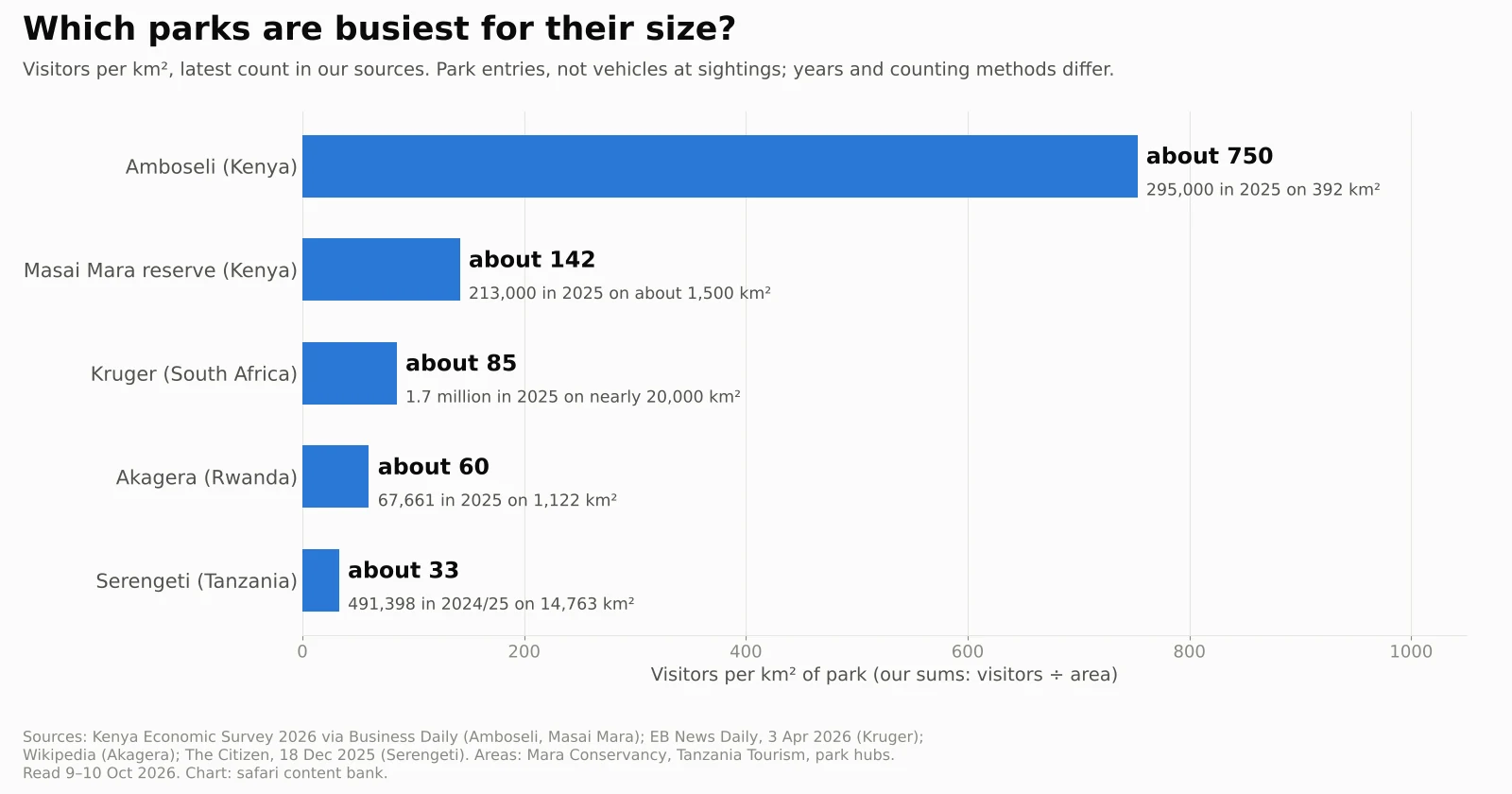 Our sums from Kenya Economic Survey 2026 (via Business Daily), EB News Daily, Wikipedia (Akagera) and The Citizen; areas from the Mara Conservancy, a safari agent’s guide and our park hubs. Read 9–10 October 2026. Chart: safari content bank.
- Kenya’s crowds moved from the Mara to Amboseli. Mara reserve visitors fell from 420,000 in 2023 to 343,000 in 2024 and 213,000 in 2025, while Amboseli rose from 222,000 to 266,000 and 295,000 (Kenya Economic Survey 2026, via Business Daily). Operators quoted in that report blame the Mara’s fee rise. Reviews still describe crowded Mara sightings, so a smaller total has not emptied the river.
- Kenya’s parks as a whole are busier than ever: KWS parks, reserves and sanctuaries recorded 3.38 million visitors in 2024/25, against 3.18 million in 2023/24 (State Department for Wildlife figures, reported by Eastleigh Voice, 5 Dec 2025).
- In Tanzania, Ngorongoro and the Serengeti lead: 14.2% and 13.1% of surveyed international visitors went to each in 2025, Tarangire 9.0% (Bank of Tanzania, 2025 exit survey (PDF)). The south is compared on Nyerere vs Serengeti.
- The Okavango has no park count in our sources. Maun, its gateway, took 42,112 tourist air arrivals in 2024 (Statistics Botswana); the Kazungula Bridge border by Kasane took 183,371 tourists, many of them heading for Chobe’s riverfront.
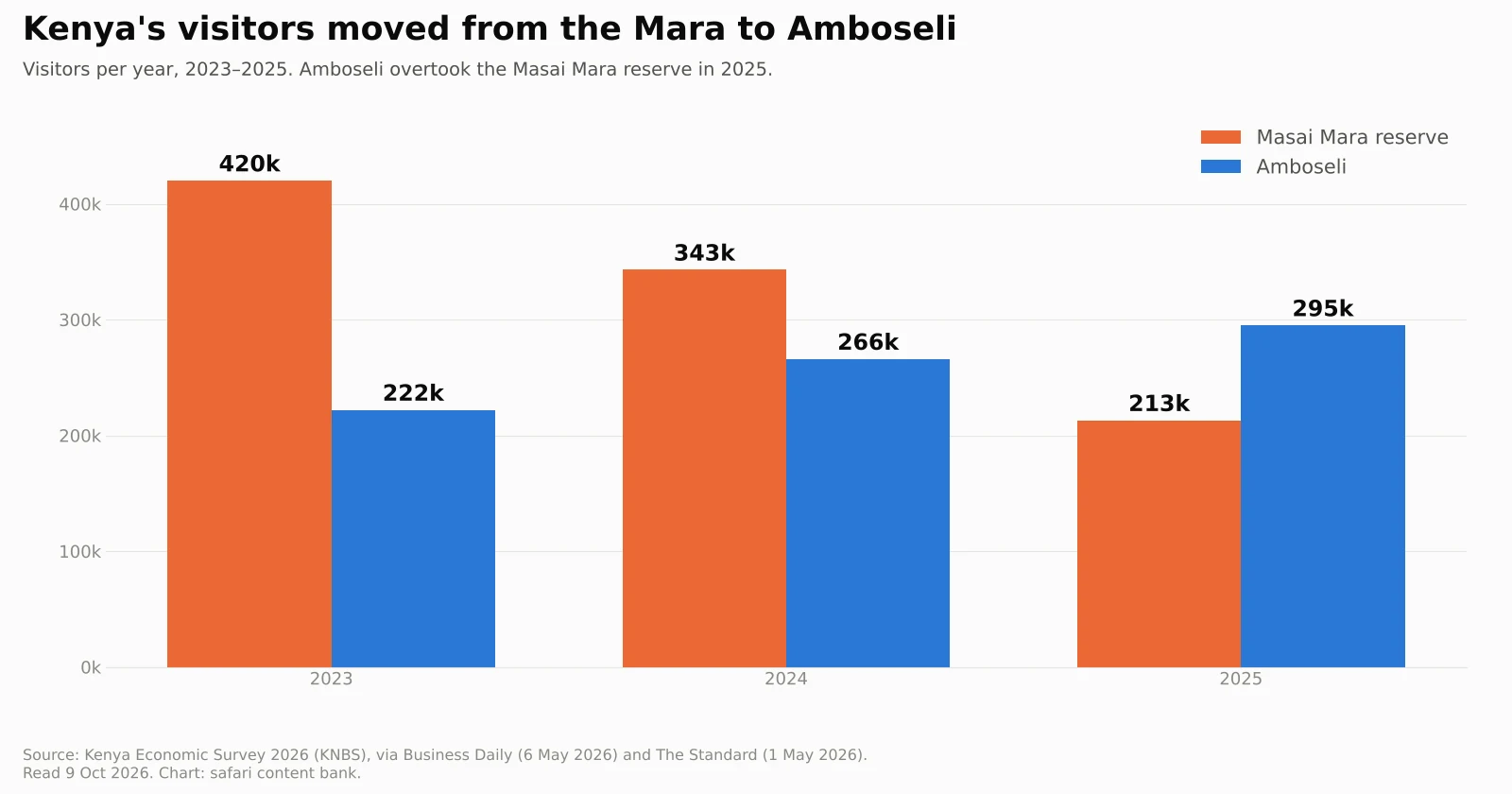 Kenya Economic Survey 2026 (KNBS), via Business Daily, 6 May 2026, and The Standard, 1 May 2026. Read 9 October 2026. Chart: safari content bank.
The rules that limit vehicles and visitors
Two kinds of rule keep numbers down: a cap on vehicles at a sighting, which only three land managers publish, and a rule on who may enter at all, which is what most private land relies on. The full caps-against-reports comparison is on how to choose a safari camp.
| Area | Written rule | Whose rule |
|---|---|---|
| Masai Mara reserve (Kenya) | Five vehicles at a sighting; the next stops and waits at least 100 m away. Off the track only to approach big cats on nearby open ground, no nearer than 25 m | Narok County’s management plan, via Business Daily |
| Mara Triangle (western reserve) | Viewing time is limited once more than five vehicles are waiting | Mara Conservancy park rules |
| Ol Pejeta (Laikipia) | “Maximum of 6 vehicles … around wildlife sighting for a maximum of 10 minutes per vehicle” | Ol Pejeta Tariff Guide 2026 (PDF) |
| Lewa (Laikipia) | “Strictly a maximum of two vehicles viewing an animal at any one time” | Lewa Code of Conduct |
| Mara conservancies | No published cap; camp guests only | Mara reserve vs conservancies |
| Botswana private concessions | No published cap; “No self-drivers or day visitors are permitted” (Khwai Private Reserve) | Botswana night drives and walking |
| Sabi Sand (Greater Kruger) | No day visitors; entry only through its gates to named lodges | Sabi Sand access |
| Kruger National Park | No published cap; on public holidays and long weekends it can stop admitting day visitors once a daily threshold is reached (SANParks publishes no number) | SANParks day visits |
| Ngorongoro Crater | No time limit on the floor; descent closes at 16:00; only 4×4 vehicles up to 3,500 kg tare | NCAA guidelines, as on our Ngorongoro hub |
| Serengeti, Chobe, Moremi, Lower Zambezi | No published cap found | — |
Read 8–10 October 2026. Ol Pejeta charges US$110 per non-resident adult per day (24 hours for overnight guests), VAT included (Tariff Guide 2026); see Laikipia.
- A rule on paper is not the view from the vehicle. The Mara reserve’s cap is five, yet reviewers report 20 to 40 vehicles at one sighting; nobody publishes how the rule is enforced.
- A strict rule cuts both ways. In May 2026 a guest in Zambia complained that his guide left sightings early under a camp’s vehicle limit; the camp’s owners replied that they trust their guides (TripAdvisor Zambia forum, traveller report). Photographers should ask how long a vehicle may stay. Viewing manners are on safari etiquette.
Bed limits on private land: why conservancies are quieter
On private land the number of vehicles is set by the number of beds, because only guests drive there. No land manager in our sources publishes a beds-per-acre rule, so the useful question to a camp is how many beds share its traversing area.
| Private land | What limits numbers | Published figures | Source |
|---|---|---|---|
| Olare Motorogi (Mara conservancy) | Five partner camps; “None of these camps is larger than 24 beds” | Kicheche Bush Camp 6 tents, Mara Plains 7, Porini Lion Camp 10, Mahali Mzuri 12, Olare Mara Kempinski 12: 47 tents in all (our sum) | Olare Motorogi Conservancy |
| Other Mara conservancies | Camp guests only; each conservancy sets its own rules | No bed or vehicle limit published | Mara reserve vs conservancies |
| Botswana concessions | Each lease carries a capped bed allocation; only guests of camps on the lease drive there | No schedule of the caps is published in our sources | A safari agent’s guide to public vs private concessions, read 8–10 October 2026 |
| Sabi Sand, Timbavati (Greater Kruger) | Lodge guests only; each lodge has its own traversing area (Timbavati also takes self-catering guests) | No bed limit published | Kruger vs private reserves |
Read 8–10 October 2026.
- Guests-only land is the point, and shared land costs less. On Botswana’s concessions, one site summarises the difference as “fewer vehicles at sightings and there is more control over the length of time spent at sightings” (a safari agent’s guide, read 10 October 2026). Kwando’s Moremi Crossing (US$530–850, 2024) sits on NG 27B, a concession shared by several operators, and has the lowest fly-in rate on our Botswana safari cost page.
- Small land means fewer animals, not just fewer vehicles. Forum posters warn about small traversing areas at budget private lodges in the Greater Kruger (TripAdvisor Kruger forum, traveller reports). Ask for the traversing area and the number of lodges that share it.
- The rules on private land also change what you can do: night drives, walks and off-road driving. That is covered on private concession vs national park.
Which months are quietest?
No park publishes vehicle counts by month, so the quiet months are the ones outside the big events and school holidays: in East Africa, roughly November–June away from Ndutu; in southern Africa, outside July–October and South Africa’s school holidays. Each quieter month has its own trade-off.
| Area | Busiest | Quieter | The catch | Month guide |
|---|---|---|---|---|
| Masai Mara reserve | July–October (crossings; “surrounded by 20–30 vehicles”, August 2025 review) | January–February (forum travellers); June | Herds may not be in the Mara; the reserve fee is US$100 per adult per day from January to June and US$200 from July to December (Narok County FY2025/26, the last published schedule) | Safari in January, June |
| Northern Serengeti | July–October (crossings) | Outside the crossing months | The herds are elsewhere in the ecosystem | Great Migration month by month |
| Ndutu and the southern Serengeti | February–March (calving) | Not in our sources | Ngorongoro Conservation Area entry is US$70.80 per adult per 24 hours all year (NCAA’s page does not say whether VAT is included) | Serengeti calving season |
| Ngorongoro Crater | Crowding reviews from June and August | Not in our sources | No low-season fee | Ngorongoro |
| Kruger | December–January holidays; South Africa’s mid-year school holidays; long weekends | Outside school holidays; the north all year | SANParks opens bookings 11–12 months ahead; holidays fill the southern camps first | Kruger self-drive |
| South Luangwa | August | June; the remote sectors all season | Seasonal bush camps open only from late May to mid-November | Safari in June |
| Okavango and Botswana concessions | Guests only, all year | Green season, January–March | Rains; lower camp rates | Green-season safari |
Read 8–10 October 2026. Busy and quiet months from our month pages and the traveller reports cited above; none is a vehicle count.
- Green season is quieter in most places, but not at Ndutu. Fewer camps are open in the rainy months, and our green-season page has the rates; the calving crowd at Ndutu is the exception.
- Shoulder months trade a little quiet for a lower rate. June in the Mara and April or November in Botswana are covered on shoulder-season safari.
- Peak months have their own crowd pages: safari in August and summer holiday safari.
- The Serengeti’s long rains bring a lower fee: entry is US$70.80 instead of US$82.60 from 15 March to 15 May (last published tariff, 2023/24), but a March 2026 traveller wrote “We were stuck 11 times in 7 days” on the southern plains (TripAdvisor forum, traveller report).
What you give up for fewer vehicles
Fewer vehicles usually cost more per night, take longer to reach, or rule out the famous event. In the Mara, the private option can be the cheaper fee.
| Trade-off | Example | Figures |
|---|---|---|
| A higher bed price | Kruger self-drive against a Sabi Sand lodge | Kruger R692 (R602 until 31 Oct 2026) per international adult per day, campsite from R484 per site (Punda Maria, October 2026; SANParks had not published its 2026/27 accommodation tariff when we checked on 1 November 2026); Sabi Sand from R7,300 per person sharing (Elephant Plains, 2026) |
| A higher bed price | Botswana: shared concession against a single-operator one | Moremi Crossing, shared NG 27B, US$530–850 (2024); published Botswana camp rates reach US$5,345 a night (Mombo, peak) |
| Not always a higher fee | Mara conservancy against the reserve | Conservancies charge US$130 per adult per night (camps’ 2026 rate sheets) against the reserve’s US$200 a day from July to December; you also pay the reserve fee on days you drive in |
| No river crossings | Mara conservancies | Crossings happen in the reserve and the national park, not in the conservancies |
| No self-drive and no day trips | Botswana concessions, Sabi Sand, Mara conservancies | Camp guests only, on camp vehicles |
| Fewer flights and longer journeys | Katavi and Mahale | Scheduled flights only on Mondays and Thursdays from 1 June to 31 October, so stays fall into 3- or 4-night blocks |
| Paying peak rates for the event | Crossings, calving | The busiest places in July–October and February–March are also where camps charge their top rates |
Fees as on our Kruger park fees, Masai Mara park fees and Mara reserve vs conservancies pages; camp rates as on Kruger vs private reserves and Botswana safari cost; flights as on Katavi and Mahale. Read 8–10 October 2026; SANParks fees checked 1 November 2026.
- The dearest camp is not always the quietest land. Mombo sits inside Moremi Game Reserve, where park rules apply and anyone with a park ticket may drive; a cheaper camp on a private concession has guests-only land.
- A private vehicle buys control, not emptiness. It lets you stay at a sighting or leave early, but other vehicles still arrive. Prices are on single supplements and child rates.
Which option is right for you?
If crowds are what you most want to avoid, choose private land or a remote park first, and the month second.
| If you want | Go | Why | Watch for |
|---|---|---|---|
| The Mara with fewer vehicles | A Mara conservancy, or the Mara Triangle | Camp guests only; forum travellers found the Triangle quieter | Crossings are in the reserve; reserve fee on days you drive in |
| The migration herds without the crossings crowd | November–June in Tanzania, away from Ndutu in February–March | The herds spread over a larger park | Rain and roads from March to May |
| Big Five in South Africa without traffic | Sabi Sand or Timbavati, or northern Kruger | Lodge guests only; the north has fewer cars | Lodge rates from R7,300 pp sharing; small traversing areas at cheaper lodges |
| Botswana without the Chobe riverfront crowd | A private concession, Savuti, or lodges towards Ngoma | Guests only on concessions | Concession camps are fly-in and priced accordingly; see Botswana safari cost |
| A Tanzanian park with few other visitors | Nyerere, Ruaha, or Katavi and Mahale | 9% of published itineraries each for Nyerere and Ruaha; about 1,500 foreign visitors a year at Katavi (2012/13) | Longer flights; Katavi’s twice-weekly schedule |
| Zambia’s walking parks, quietly | South Luangwa’s remote sectors, or Kafue | Remote sectors “nearly vehicle-free” (forum posters); Kafue covers 22,400 km² with 21 camps on Visit Kafue’s lists | August is South Luangwa’s busiest month; see Kafue vs South Luangwa |
| A small Kenyan park without the queues | Laikipia’s conservancies rather than Amboseli | Ol Pejeta and Lewa publish caps of six and two vehicles | Ol Pejeta’s fee is US$110 per adult per day; see Laikipia |
From the tables above. Read 8–10 October 2026.
Common mistakes about avoiding safari crowds
| What you’ll often read | What is correct |
|---|---|
| “Conservancies allow only two or three vehicles at a sighting” | No Mara conservancy, Botswana concession or Greater Kruger reserve publishes a number in our sources. Only the Mara reserve (five), Ol Pejeta (six) and Lewa (two) do. |
| “The Mara is quieter now that visitor numbers have halved” | Fewer visitors, same complaints. Visitors fell from 420,000 in 2023 to 213,000 in 2025, yet reviews still describe 20 to 40 vehicles at one sighting. |
| “Calving season is the quiet season” | Not at Ndutu: a traveller reported 15–20 vehicles at a single sighting in March 2026, and Ngorongoro Conservation Area fees have no low season. |
| “A more expensive camp means fewer vehicles” | The land decides, not the rate. Mombo, at up to US$5,345 a night, sits inside Moremi under park rules; a guests-only concession can cost far less. |
| “Kruger is too busy for a quiet safari” | The crowds are in the far south in school holidays and December; the north and the private reserves on the western edge are quieter. |
| “A private conservancy also gives you the river crossings” | Crossings happen in the reserve and the national park, so conservancy guests drive in and pay the reserve fee for that day. |
Frequently asked questions
Where can I go on safari without crowds? On private land: Mara conservancies, Laikipia’s conservancies, Botswana’s private concessions and the Greater Kruger reserves admit only their camps’ guests. Among parks, Nyerere, Ruaha, Katavi, Kafue and South Luangwa’s remote sectors see far fewer visitors than the Mara reserve, the Serengeti’s crossing points, Amboseli or southern Kruger.
Which safari park is the most crowded? For its size, Amboseli: 295,000 visitors in 2025 on 392 km², about 750 per km² (our sum). The Mara reserve follows at about 142 per km². Kruger had the most visitors in total, a record 1.7 million in 2025, on nearly 2 million hectares. No authority counts vehicles at sightings.
How many vehicles are allowed at a sighting? Five in the Masai Mara reserve, with the next waiting at least 100 m away; six at Ol Pejeta for 10 minutes each; two at Lewa. No Mara conservancy, Botswana concession or Kruger rule in our sources publishes a number. Travellers report 20 to 40 vehicles at some Mara reserve sightings.
Is the Masai Mara too crowded? At the river and at big-cat sightings in July–October, travellers say yes: reviewers describe 20 to 40 vehicles. The conservancies, the Mara Triangle and January–February are the quieter options forum travellers name. Conservancies charge US$130 per adult per night, less than the reserve’s US$200 a day from July to December.
What is the quietest month for a safari? No park publishes vehicle counts by month. In East Africa, the months outside July–October are quieter, except at Ndutu in February–March; in southern Africa, avoid South Africa’s school holidays and December in Kruger and August in South Luangwa. Green season is the emptiest but brings rain and closed camps.
Is a private concession worth it just to avoid crowds? If vehicles at sightings would spoil the trip, it is the most reliable fix, because only the camps’ guests drive there. It costs more in Botswana and South Africa, rules out self-drive and day trips, and in the Mara means leaving the conservancy for the crossings.
Is Chobe too crowded? The riverfront nearest Kasane is the busiest wildlife area in Botswana, partly from Victoria Falls day trips; one review describes 7 vehicles around a lion with a kill. Lodges towards Ngoma in the west, Savuti and the private concessions are quieter. See Moremi vs Chobe.
Sources
- Visitor numbers: Kenya Economic Survey 2026 via Business Daily, 6 May 2026 and The Standard, 1 May 2026; Eastleigh Voice, 5 Dec 2025 (KWS parks); The Citizen, 18 Dec 2025 (Serengeti); EB News Daily, 3 Apr 2026 (Kruger); Bank of Tanzania, 2025 International Visitors Exit Survey (PDF); Statistics Botswana, Tourism Statistics Annual Report 2024 (PDF); Wikipedia, Akagera and Katavi; all read 9–10 October 2026
- Areas: Mara Conservancy, history; a safari agent’s guide to Serengeti; our Amboseli, Kruger and Akagera hubs; read 9 October 2026
- Rules: Narok County’s Greater Maasai Mara Ecosystem Management Plan 2023–2032, via Business Daily; Mara Conservancy park rules; Ol Pejeta Tariff Guide 2026 (PDF); Lewa Code of Conduct; Sabi Sand access; SANParks day visits; a safari agent’s guide to public vs private concessions; Olare Motorogi Conservancy, where to stay; all read 8–10 October 2026
- Fees: Narok County, Maasai Mara fee schedule FY2025/26 (PDF), the last published; SANParks daily conservation fees 2025/26 (PDF) and 2026/27 (PDF); TANAPA, Tariffs 2023/24 (PDF), the last published tariff; NCAA tariffs, read 9 October 2026; Mara conservancy fees from camps’ 2026 rate sheets, as on our Mara reserve vs conservancies page
- Camp rates: as on our Kruger vs private reserves and Botswana safari cost pages (Elephant Plains 2026; Kwando 2024; Wilderness, Mombo), read 8 October 2026
- Traveller reports: TripAdvisor forums, Mara crowds, northern Serengeti or Mara in July, Tanzania, March 2026, Zambia, June 2026, Zambia, May 2026, South Luangwa, Kruger and Sabi Sand planning; Routard forum, Kenya, October 2025; reviews on a safari booking site (Masai Mara, Chobe, Ngorongoro); all read 8–10 October 2026
- More: how to choose a safari camp, private concession vs national park, green-season safari, shoulder-season safari, serengeti vs Masai Mara, Tanzania northern vs southern circuit, safari vehicles
Figures checked 8–10 October 2026. We will update this page when Kenya, Tanzania or SANParks publish new visitor figures, or when a conservancy or concession publishes a vehicle limit.