 Experience

Last verified · Next check due
On this page
- Where to go next, by your first safari (2026)
- After Kenya or Tanzania: water, walking, Zimbabwe or gorillas
- After Kruger or a South African private reserve
- After a self-drive: a mobile or walking trip
- What changes on a second safari
- Leopard or wild dog: where the published odds are best
- Park fees on second-safari routes
- Which second safari should you choose?
- Common mistakes on a second safari
- Frequently asked questions
- Sources
Short answer: Go where your first trip could not take you. After Kenya or Tanzania, try Botswana’s Okavango for water and wild dogs, Zambia or Zimbabwe for walking, or gorillas (permits US$800 in Uganda, US$1,500 in Rwanda). After Kruger, try the Delta, Mana Pools or the Masai Mara herds, usually July to October. After a self-drive, book a guided mobile or walking trip. Expect fewer vehicles and higher prices: Botswana’s fly-in camps charge US$530–5,345 a night.
Key facts
- No source we hold says where repeat safari-goers actually go. This page is built from what each destination does differently, not from booking data; treat it as a router to the detailed guides.
- What a second safari usually adds is access, not more animals. Travellers’ reviews on a safari booking site say they saw more wildlife in the Serengeti and Masai Mara than in Botswana, where thick bush hides cats; Botswana sells low vehicle density, wild dog, elephant and water (traveller reports).
- Walking is the biggest change, and it is a land rule. You can walk with a guide in South Luangwa, Mana Pools, the Mara conservancies and Botswana’s private concessions, and in Kruger only with SANParks; not in Moremi, and the Masai Mara reserve sells none (walking safaris).
- The gate gets cheaper and the bed dearer. South Luangwa charges US$25 a day (DNPW 2025 schedule, the last published) and Mana Pools US$24 (ZimParks Tariff 2026), against the Mara’s US$200 from July to December; but South Luangwa camps publish US$565–1,840 per person a night for 2026 (East vs Southern Africa).
- Several second-safari styles have age floors: walking usually starts at 12, and gorilla trekking at 15 (safari age limits).
Where to go next, by your first safari (2026)
Pick the row that matches your first trip, then the option that gives you what it could not. Each option has its own guide; this table only routes you.
| Your first safari | What it probably gave you | Go next for something different | What changes most | Read |
|---|---|---|---|---|
| Kenya or Tanzania (Mara, Serengeti, Ngorongoro) | Open plains, the herds, big cats from a vehicle on park tracks | Botswana (Okavango Delta); Zambia (South Luangwa walks); Zimbabwe (Mana Pools, Hwange); gorillas in Uganda or Rwanda | Water, walking, fewer vehicles, a forest hike | Kenya vs Botswana, Tanzania vs Zambia, safari and gorilla trekking |
| Kruger or a South African private reserve | The Big Five, tarred roads, self-drive or lodge drives | Botswana (Delta, mokoro); Mana Pools (walking, canoeing); East Africa (the herds, July–October) | Water and fly-in camps; or the migration seen from an operator’s vehicle | Okavango Delta vs Kruger, Kruger vs Masai Mara |
| A self-drive (Kruger, Etosha, Namibia) | Freedom and low cost, but tracks only, no off-road and no night drives | A mobile safari in Botswana; a walking trip in Zambia or Zimbabwe, or a SANParks wilderness trail | A guide all day; walking; camps in the wild | mobile safari, self-drive vs guided |
| A short Mara or Kruger trip (3–4 days) | One park and a quick list of sightings | A longer, two-area trip in the same region, or a multi-country route via Victoria Falls | More nights per camp; fewer moves | how many days on safari, multi-country safari |
| A Botswana fly-in trip | Delta camps and private concessions | A mobile safari through Moremi, Khwai and Savuti, or Zambia or Zimbabwe on foot | One guide and crew for the route; walking-led camps | mobile safari, Botswana vs Zambia |
Routes drawn from our country, park and comparison pages and from traveller questions on the TripAdvisor Botswana and Zimbabwe forums, read 8–10 October 2026. No source gives the share of repeat visitors who choose each option.
After Kenya or Tanzania: water, walking, Zimbabwe or gorillas
You have seen the plains; the next trip trades density and spectacle for water, walking or a different animal. Expect to see fewer animals in total and fewer vehicles at each sighting.
| Option | What is different from the Mara or Serengeti | Price pointer, per person | Best months | More |
|---|---|---|---|---|
| Botswana, Okavango Delta | Mokoro and boats; private concessions with night drives and off-road driving; the best published wild dog odds | Fly-in camps US$530–5,345 a night; Botswana-only camping trips US$189–270 a day, park fees included | Jun–Oct | Okavango Delta vs Serengeti, Masai Mara vs Okavango Delta |
| Zambia, South Luangwa | Walking where it began; night drives inside the national park | Camps US$565–1,840 a night; fees and levies US$90–110 a night on top | Late May–mid-Nov (camps open) | South Luangwa, Kenya vs Zambia |
| Zimbabwe, Mana Pools or Hwange | Walking and canoeing on the Zambezi; elephants at Hwange’s pumped waterholes | Mana Pools camps US$630–1,583 a night (2026–27); Hwange camps US$445–1,250 (2026) | Jun–Oct (Mana Pools); Jul–Oct (Hwange) | Hwange vs Mana Pools |
| Gorillas, Uganda or Rwanda | One hour with a habituated gorilla family on a forest hike; minimum age 15 | Permit US$800 in Uganda (US$600 in April, May and November), US$1,500 in Rwanda | Jun–Sep, Dec–Feb (drier) | Is gorilla trekking worth it?, Uganda vs Rwanda |
| Quieter East Africa: Ruaha or Laikipia | Same region, fewer visitors; Laikipia’s conservancies sell walks and night drives (Ol Pejeta US$70 each per adult) | Ruaha camps US$350–1,600 a night; Laikipia beds US$70–1,320 | Jun–Oct | Ruaha, Laikipia vs Masai Mara |
Camp, trip and permit prices as on our Botswana, South Luangwa, Mana Pools, Hwange, Ruaha and Laikipia pages and gorilla permit prices; UWA letter TDO 93/04 (26 February 2026) and RDB, checked 9 October 2026. Prices per person sharing, low to peak season, read 3 September–10 October 2026.
- “Will I see more wildlife in Botswana?” Usually not on raw numbers. Reviewers on a safari booking site wrote that they had seen much more in the Serengeti and Masai Mara, and that thick bush hid the cats in Botswana, at higher prices (traveller reports). Go for the Delta’s water, wild dogs and quiet, not the headcount.
- South Luangwa sells night drives inside the park, which Botswana’s parks and reserves do not, and walks led by a licensed guide with an armed scout (walking safaris).
- Gorillas pair with the Mara on one visa: the US$100 East Africa Tourist Visa covers Kenya, Uganda and Rwanda, not Tanzania (safari and gorilla trekking).
- Not ready to leave East Africa? A Mara conservancy instead of the reserve gives night drives and walks at US$130 a night in conservancy fees (Mara reserve vs conservancies).
After Kruger or a South African private reserve
From Kruger, the two big changes are water and the herds: the Okavango or the Zambezi for the first, the Mara or Serengeti for the second. Kruger is hard to beat for the Big Five, so a second trip there rarely adds a new animal.
| Option | What is different from Kruger | Fee or price pointer | More |
|---|---|---|---|
| Okavango Delta, Botswana | Mokoro and boat trips; fly-in camps; concessions closed to self-drivers | Camps US$530–5,345 a night; Moremi P270 a day (last published DWNP schedule, 1 April 2022; confirm with DWNP) | Okavango Delta vs Kruger, Botswana vs South Africa |
| Mana Pools, Zimbabwe | Walk with a professional guide, or unguided with a permit; multi-day canoe trips | US$24 a day (ZimParks Tariff 2026); camps US$630–1,583 a night | Mana Pools, canoe safaris, South Africa vs Zimbabwe |
| Masai Mara or Serengeti | The wildebeest herds; open plains; no self-drive game drives in the Mara reserve | Mara US$100 a day Jan–Jun, US$200 Jul–Dec; Serengeti US$82.60 entry (last published tariff, 2023/24) | Kruger vs Masai Mara, Serengeti vs Kruger |
| South Luangwa, Zambia | Walking safaris and night drives inside a national park | US$25 a day (DNPW 2025 schedule, the last published) | South Luangwa vs Okavango Delta |
Kruger charges R692 (R602 until 31 Oct 2026) per international adult a day (SANParks). Fees as on our cost and fee pages, checked 8–10 October 2026; Kruger fee checked 1 November 2026.
- The Mara reserve cannot be self-driven: Narok County banned private vehicles from game drives there on 3 June 2024, so you travel with an operator (Kruger vs Masai Mara).
- Rhino is the one Kruger animal you trade away. South Africa holds the most rhino in Africa; Botswana, Zambia and Zimbabwe hold far fewer (national counts on where to see rhino; we never publish where rhino are).
- Stayed in Sabi Sand already? Its lodges cannot drive into Kruger, and a Kruger fee does not cover a reserve’s own fee (Kruger vs private reserves). A second Greater Kruger trip mostly changes the lodge, not the land.
After a self-drive: a mobile or walking trip
If you drove yourself through Kruger, Etosha or Namibia, the obvious next step is a trip where a guide and crew do the work and you leave the vehicle. Self-drivers in national parks may not go off-road or drive after dark (self-drive vs guided).
| Option | What you get that self-drive could not | Price pointer | More |
|---|---|---|---|
| Botswana private mobile safari | The same guide and crew for the whole route through Moremi, Khwai and Savuti; reserved campsites in the parks | About US$265 a night (budget, basis not stated) to about US$710 fully serviced; one 9-night trip from US$6,395, park fees and private campsites included | mobile safari |
| Walking camp in Zambia, Zimbabwe or the Mara conservancies | Days on foot with a guide; tracking skills | US$654–1,300 per person a night with fees (2026 rates, our sums) | walking safari cost |
| Kruger wilderness trail | Three nights walking on a SANParks trail | About R1,860–2,310 per person a night (2024/25 tariff), plus the Kruger fee: R692 (R602 until 31 Oct 2026) | walking safari cost |
| Botswana self-drive, Moremi and Chobe | Still self-drive, but deep sand and unfenced campsites | Campsites about US$40–50 per person a night (last published rates); 4x4 US$170–300 a day in Maun | Botswana self-drive |
Prices as on the linked pages, read 8–10 October 2026. Botswana mobile prices usually include park and campsite fees; check each quote.
- “What should I expect in Botswana after Namibia?” On the TripAdvisor Botswana forum, the answer travellers give is less infrastructure, much higher prices and worse roads off the main tar, with denser wildlife (traveller reports). Only 3 of 124 published Botswana safari products we counted are self-drives, and all three route through Namibia (Namibia vs Botswana).
- “Should I do a mobile camping safari as my second Botswana trip?” is a question asked on the same forum. A mobile trip is not the cheap option: buy it for one crew, one guide and nights inside the parks. Inside Moremi and Chobe it still drives by day only (mobile safari).
- Book a Moremi self-drive early: campsites are run by private companies and go up to a year ahead (Botswana self-drive).
What changes on a second safari
Five things change most: vehicles, walking, water, guiding and price. None is guaranteed by the country; each depends on the land and the camp.
| What changes | What it means | Where | Check before booking |
|---|---|---|---|
| Fewer vehicles | On a Botswana concession only guests of camps on the lease drive the land; Lewa caps a sighting at 2 vehicles, Ol Pejeta at 6 | Botswana concessions; Laikipia; Mara conservancies | Total beds on the land; any published cap (how to choose a safari camp) |
| Walking | Walks are a main activity, not an add-on | South Luangwa, Mana Pools, Hwange, Mara conservancies, Botswana concessions | Who guides, how long, armed or not; minimum age usually 12 |
| Water | Mokoro in the Delta; canoes on the Zambezi; boats on the Chobe | Okavango, Mana Pools, Lower Zambezi | A mokoro needs water: seasonal floodplains have boats only from about late May to September |
| Night drives | Allowed on private land and inside South Luangwa; not in Botswana’s parks or the Mara reserve | Concessions, conservancies, South Luangwa | The camp’s activity list for your dates (night drive safaris) |
| Specialist guiding | Zimbabwe’s walks are led by professional guides; Botswana’s regulations require no specialist walking qualification | Zimbabwe, Zambia, Botswana | The guide’s name and walking qualification |
| Higher prices | The bed costs more; flights between camps are often extra | Botswana most of all | Light-aircraft seats US$220–594 per sector in Botswana (2024 cards) |
| Seasonal camps | Many walking and bush camps close in the rains | South Luangwa (late May–mid-Nov open); Mana Pools (about April–November) | Opening dates for your month |
As on our walking safaris, canoe safari, mokoro safari, private concession vs national park and Botswana vs Zambia pages; camps’ 2024–2026 rate cards; read 8–10 October 2026.
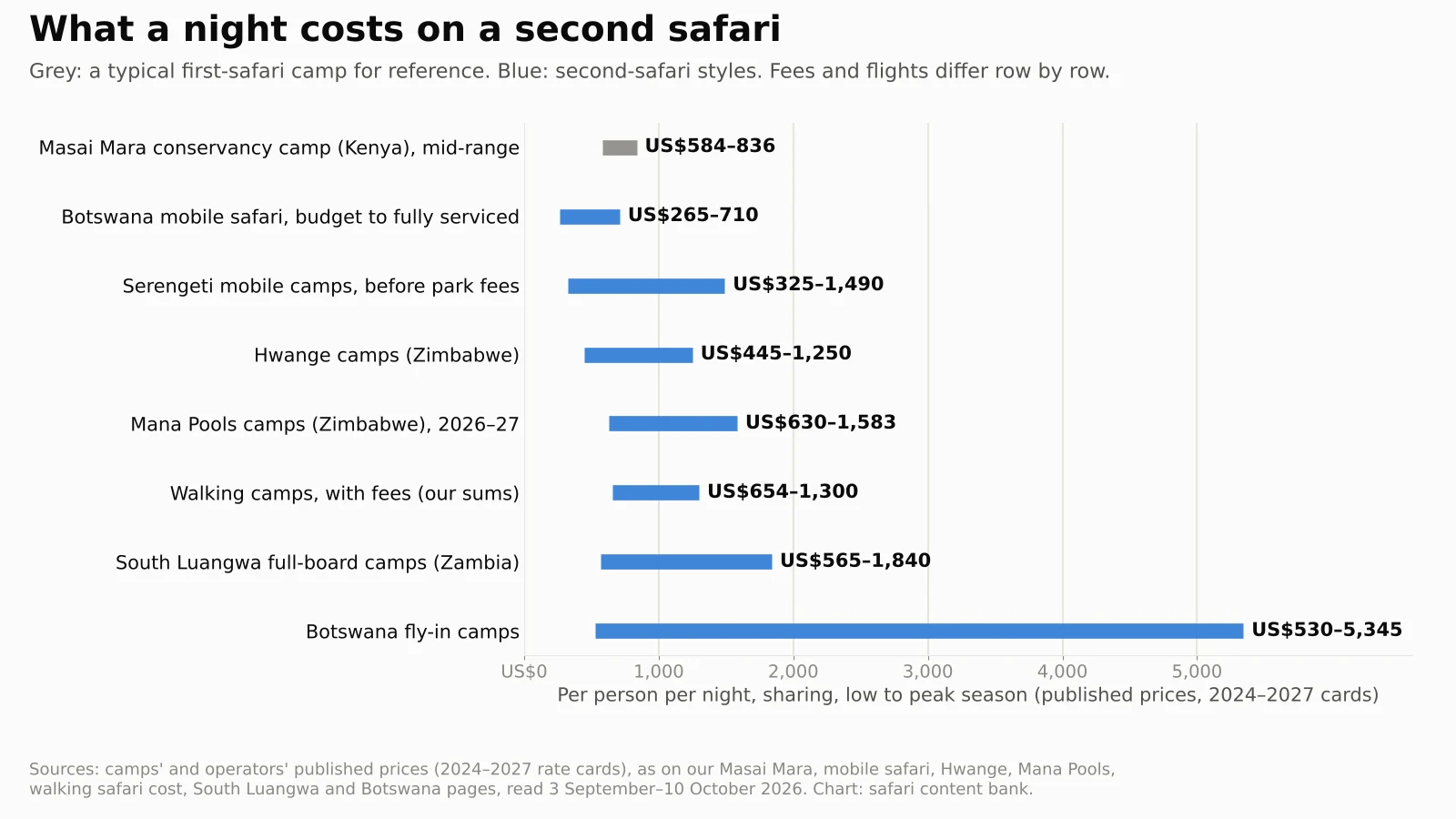 Camps’ and operators’ published prices, 2024–2027 rate cards, as on our Masai Mara, mobile safari, Hwange, Mana Pools, walking safari cost, South Luangwa and Botswana pages, read 3 September–10 October 2026. Fees and flights differ row by row. Chart: safari content bank.
- One repeat traveller’s budget, for scale: on the TripAdvisor Zimbabwe forum in 2026, a repeat safari-goer asked whether US$2,600 per person for five nights in Hwange, with meals, activities and transfers from Victoria Falls, was realistic; that is about US$520 a night (our sum), inside Hwange’s published camp range (traveller report; Hwange).
- Luxury buys the room, not the animals. Several Botswana groups run a cheaper camp on the same land as a dearer one (safari camp groups); see budget vs luxury before you trade up.
Leopard or wild dog: where the published odds are best
If your first trip missed leopard or wild dog, Zambia’s valleys lead for leopard and Moremi for wild dog in the one dataset we hold. These are the share of one safari operator’s traveller groups who saw the animal at least once on the whole trip: best cases, not counts.
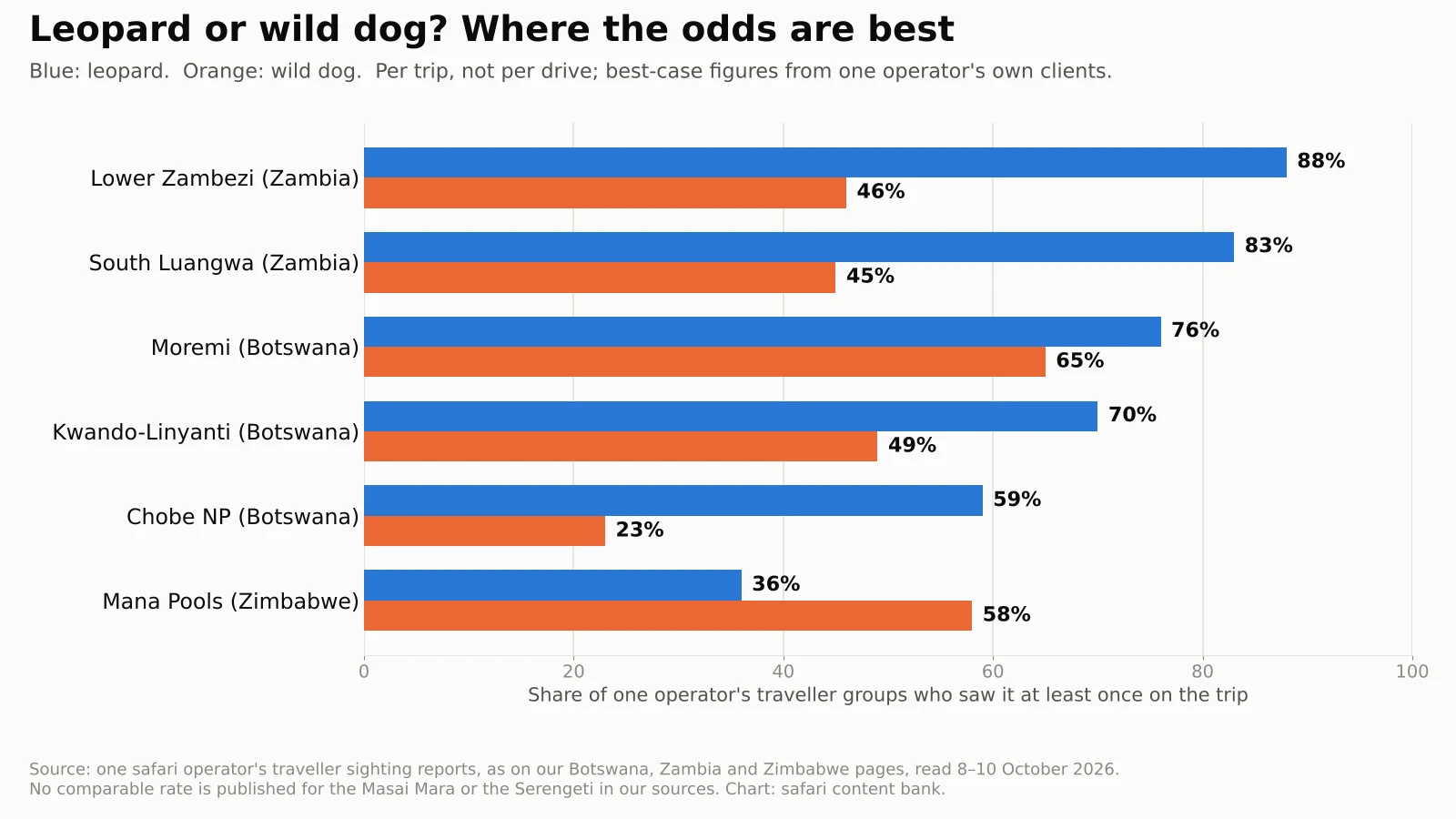 One safari operator’s traveller sighting reports, as on our Botswana safari questions, Botswana vs Zambia and Botswana vs Zimbabwe pages, read 8–10 October 2026. No comparable rate is published for the Masai Mara or the Serengeti in our sources. Chart: safari content bank.
- The same operator covers all three countries, so the odds compare like for like, but longer trips score higher, and its clients skew to longer dry-season stays in good areas.
- Chobe is the weak spot for wild dog (23%) in this dataset; Mana Pools (58%) is close to Moremi (65%). More on where to see wild dogs and where to see leopards.
Park fees on second-safari routes
East Africa charges most at the gate; Zambia and Zimbabwe charge least, and their cost is in the bed. One foreign adult, one day.
| Park | Fee per adult per day | Note | Fee page |
|---|---|---|---|
| Volcanoes, Rwanda | US$1,500 gorilla permit, per trek | 30% off November to May with two nights in Akagera or Nyungwe (RDB) | Gorilla permit prices |
| Bwindi, Uganda | US$800 gorilla permit (US$600 in April, May and November) | Includes that day’s park entry; low-season permits cannot be rescheduled | Gorilla permit prices |
| Masai Mara reserve, Kenya | US$100 (1 Jan–30 Jun); US$200 (1 Jul–31 Dec) | 12-hour ticket; Narok County FY2025/26 schedule, the last published | Kenya park fees |
| Serengeti, Tanzania | US$82.60 entry; US$70.80 15 Mar–15 May | Sleeping inside adds US$59–70.80 concession fee a night (last published tariff, 2023/24) | Tanzania park fees |
| Kruger, South Africa | R692 (R602 until 31 Oct 2026) | Same all year | Kruger park fees |
| Chobe and Moremi, Botswana | P270 | Last published schedule, 1 April 2022; in February 2026 BOPA called the existing fee P380; confirm with DWNP | Botswana park fees |
| South Luangwa, Zambia | US$25 | DNPW 2025 schedule, the last published; lodges bill US$90–110 a night in fees and levies | Zambia safari cost |
| Mana Pools, Zimbabwe | US$24 | Same whether or not you sleep in the park | Mana Pools |
| Hwange, Zimbabwe | US$24 day visitor; US$12 sleeping inside | ZimParks Tariff 2026 | Zimbabwe safari cost |
International or non-resident adult. Fees copied from our cost, fee and hub pages, checked 8–10 October 2026. Rand and pula are not converted: our sources hold no dated exchange rate.
The official fee lines, with the date each took effect and the authority’s own source:
| Fee | Amount | In force from | Source |
|---|---|---|---|
| Maasai Mara National Reserve, non-resident adult, per day (12-hour ticket, 06:00–18:00), 1 Jan–30 Jun | USD 100 | Since 1 Jan 2024; Narok County FY2025/26 schedule, the last published | Narok County fee schedule FY2025/26 |
| Maasai Mara National Reserve, non-resident adult, per day (12-hour ticket, 06:00–18:00), 1 Jul–31 Dec | USD 200 | Since 1 Jul 2024; Narok County FY2025/26 schedule, the last published, expired 30 Jun 2026 (no 2026/27 schedule as of 9 Oct 2026); The Kenya Times (6 Aug 2026, secondary) reports US$200 still applies for Jul–Dec 2026 | Narok County fee schedule FY2025/26 |
| Serengeti and Nyerere National Parks, non-East African adult, entry per day, 16 May–14 Mar | USD 70 + 18% VAT = USD 82.60 | 1 Jul 2023 (2023/24 tariff, last published) | TANAPA Tariffs 2023/24 |
| Kruger National Park daily conservation fee, international adult (12+), per day | ZAR 602 | 1 Nov 2025 to 31 Oct 2026 (SANParks 2025/26 schedule) | SANParks daily conservation fees 2025/26 |
| Kruger National Park daily conservation fee, international adult (12+), per day | ZAR 692 | 1 Nov 2026 to 31 Oct 2027 (SANParks 2026/27 schedule, already published) | SANParks daily conservation fees 2026/27 |
| Chobe National Park and Moremi Game Reserve (DWNP), non-resident adult, per person per day | BWP 270 (SADC residents BWP 205; Botswana citizens and residents BWP 30) | Last published DWNP schedule, 1 April 2022 (via Tourism Update). In Feb 2026 the government news agency BOPA called the existing non-resident fee P380; a P500 rise was announced, then reported postponed. No official current tariff: confirm with DWNP or your operator | Tourism Update, 23 Feb 2022 (DWNP fee schedule) |
| South Luangwa and Lower Zambezi National Parks (DNPW Category A), international adult, entry per day (06:00–18:00) | USD 25 (SADC and resident USD 20; Zambian citizen ZMW 55.60); child 5–13 half price, under 5 free | DNPW 2025 schedule ("official 2025 rates"), the last published; page last modified 8 May 2025, still shown 9 Oct 2026 | DNPW 2025 fee schedule, as shown on a Zambia travel portal |
| Mana Pools National Park, Sapi and Chewore, international adult, conservation fee per day | USD 24, day visitor or staying overnight (SADC USD 18; local USD 8) | ZimParks Tariff 2026 (tariff year 2026, published February 2026); the conservation-fee table does not say whether VAT is included | ZimParks De-Gazetted Tariff 2026 |
| Hwange National Park, Main Camp (row as labelled in the ZimParks 2026 tariff), international adult, conservation fee per day | USD 24 day visitor; USD 12 if staying overnight in the park (SADC USD 18 / 10; local USD 5 / 3) | ZimParks Tariff 2026 (tariff year 2026, published February 2026); the conservation-fee table does not say whether VAT is included; Robins, Sinamatella and Kazuma Pan are not listed separately in our sources | ZimParks De-Gazetted Tariff 2026 |
| Uganda: gorilla tracking permit, Bwindi Impenetrable and Mgahinga Gorilla NPs, foreign non-resident, per person per trek (guide and that day's park entry included) | USD 800 (foreign resident USD 700; rest of Africa USD 500; East African citizens UGX 300,000) | Since 1 Jul 2024 (UWA tariff 2024–26); confirmed unchanged from 1 Jan 2027 by UWA letter TDO 93/04 of 26 Feb 2026 | UWA letter TDO 93/04, 26 Feb 2026 |
| Uganda: gorilla tracking permit in April, May and November (low season), foreign non-resident, per person per trek; cannot be rescheduled | USD 600 (foreign resident USD 500) | Immediate effect from the UWA letter of 26 Feb 2026 | UWA letter TDO 93/04, 26 Feb 2026 |
| Rwanda: mountain gorilla tracking permit, Volcanoes NP, international visitor, per person per day | USD 1,500 | Current RDB price, checked 9 Oct 2026 | Visit Rwanda (Rwanda Development Board) |
Which second safari should you choose?
Name the one thing your first trip did not give you; that picks the destination.
| If you want… | Go to | Why | Compare |
|---|---|---|---|
| To walk | South Luangwa or Mana Pools | Walking is the main activity; Mana Pools also allows unguided walks with a permit | Mana Pools vs Lower Zambezi |
| Water: mokoro, canoe, boats | Okavango Delta; Mana Pools or Lower Zambezi for canoes | Mokoro in the Delta; multi-day canoe trips on the Zambezi | mokoro safari |
| Wild dog | Moremi or Mana Pools | 65% and 58% of one operator’s traveller groups | where to see wild dogs |
| Leopard and night drives in a national park | South Luangwa | 83% leopard in that dataset; night drives allowed in the park | South Luangwa |
| Fewer vehicles | A Botswana concession, Laikipia or a Mara conservancy | Only camp guests drive the land | private concession vs national park |
| Gorillas | Uganda (US$800) or Rwanda (US$1,500) | One hour with a habituated family; age 15+ | Uganda vs Rwanda for gorillas |
| The herds, after Kruger | Masai Mara or Serengeti | The herds are usually in the Mara July–October | Great Migration month by month |
| Value, after Botswana | Zimbabwe (Hwange, Mana Pools) or Zambia | Gate fees US$12–25 a day; camps from about US$445 a night | Botswana vs Zimbabwe |
| A horse instead of a vehicle | Okavango or Mara conservancies (experienced riders) | Big-game rides need riders confident at all paces | horseback safari |
From the sections above. Country-level choice: best country for a safari and East vs Southern Africa.
Common mistakes on a second safari
| What you’ll often read | What is correct |
|---|---|
| “Botswana has more wildlife than the Serengeti” | Usually fewer animals, fewer vehicles. Travellers report seeing more in the Serengeti and Mara; Botswana sells quiet, water and wild dog. |
| “A walking safari is possible anywhere in the Delta” | Not inside Moremi: walking is allowed on Botswana’s concessions, not in its parks and reserves. |
| “Zambia’s park fee is US$25, so it is cheap” | The bed is not: camps publish US$565–1,840 a night in South Luangwa, plus US$90–110 in fees and levies. |
| “A mobile safari is the budget way to see Botswana” | Not necessarily: fully serviced trips run about US$710 a night; buy one for continuity and access. |
| “Any month works, as on my first safari” | Many bush and walking camps close in the rains: South Luangwa’s open from late May to mid-November. |
| “My teenager can do everything” | Walks usually start at 12 and gorilla treks at 15. |
| “A Kruger repeat will show me something new” | A Greater Kruger lodge changes the room, not the land; water, walking or the herds need another region. |
| “Rhino will be easy in Botswana or Zambia” | Rhino are far fewer there than in South Africa; see national counts on where to see rhino. |
Frequently asked questions
Where should I go for my second safari? Somewhere that gives you what the first did not. After Kenya or Tanzania: Botswana’s Okavango, walking in Zambia or Zimbabwe, or gorillas in Uganda or Rwanda. After Kruger: the Delta, Mana Pools or the Masai Mara herds. After a self-drive: a guided mobile or walking trip.
Is Botswana a good second safari after Kenya or Tanzania? Yes, if you want water, wild dogs and fewer vehicles rather than more animals. Travellers report seeing more wildlife in the Serengeti and Mara. Botswana’s fly-in camps charge US$530–5,345 a night; Botswana-only camping trips start at about US$189–270 a day, park fees included.
What is the best second safari after Kruger? For something new, the Okavango Delta for water and fly-in camps, Mana Pools for walking and canoeing, or the Masai Mara or Serengeti for the herds, usually July to October in the Mara. A second Greater Kruger lodge changes the room more than the wildlife.
Is a walking safari a good second safari? Yes, if you want to leave the vehicle. South Luangwa and Mana Pools are the classic parks; walking camps cost about US$654–1,300 per person a night with fees (2026, our sums), and the minimum age is usually 12. Not in Moremi or the Masai Mara reserve.
Should my second Botswana trip be a mobile safari? It is a good choice if you want one guide and crew for the whole route and nights inside Moremi and Savuti. It is not the cheap option: about US$265 a night budget to about US$710 fully serviced. Inside the parks it drives by day only.
Is gorilla trekking worth adding on a second trip? For most people who can pay and hike steep slopes, yes. A permit buys one hour: US$800 in Uganda (US$600 in April, May and November) and US$1,500 in Rwanda, minimum age 15. It pairs with the Mara on the US$100 East Africa Tourist Visa. See is gorilla trekking worth it.
Is a second safari cheaper or dearer than the first? Usually dearer per night. Gate fees fall in Zambia and Zimbabwe (US$12–25 a day) against the Mara’s US$200 from July to December, but camps cost more: US$565–1,840 a night in South Luangwa and up to US$5,345 in Botswana. Self-drivers moving to a guided trip pay most.
Is there data on where repeat safari-goers go? Not in our sources. The only repeat-visitor figures we hold are from Namibia’s 2012/13 tourist exit survey (all visitors, business included), which found repeat visitors stayed 8.6 nights against 16.1 for first-timers; it says nothing about safari choices.
Sources
- Park fees and permits: Narok County, Maasai Mara fee schedule FY2025/26 (PDF), the last published; TANAPA, Tariffs 2023/24 (PDF), the last published tariff; SANParks daily conservation fees 2025/26 (PDF) and 2026/27 (PDF); DWNP schedule of 1 April 2022 via Tourism Update; a safari agent’s guide to DNPW fees, read 9 October 2026; ZimParks Tariff 2026 (PDF); UWA letter TDO 93/04, 26 Feb 2026 (PDF); Visit Rwanda (RDB); all as on our fee and cost pages, checked 8–10 October 2026
- Camp and trip prices: camps’ 2024–2027 rate cards and operators’ published prices, as on our Botswana safari cost, Zambia safari cost, Zimbabwe safari cost, South Luangwa, Mana Pools, Hwange, Ruaha, Laikipia, mobile safari, walking safari cost and best country for a safari pages, read 3 September–10 October 2026
- Rules: SANParks; Botswana Tourism; Narok County memo of 3 June 2024 (via Kenyans.co.ke); Zimbabwe Field Guide, Mana Pools; as on our walking safaris, self-drive vs guided and Kruger vs Masai Mara pages, read 8–10 October 2026
- Sighting rates: one safari operator’s traveller sighting reports for Botswana, Zambia and Zimbabwe (name and links in our editor notes), read 8–10 October 2026
- Traveller reports (forum posts and reviews, not fact): TripAdvisor Botswana forum, Botswana after Namibia, what to expect and second trip, mobile camping; TripAdvisor Zimbabwe forum, Hwange: suitable safari and costs? (2026); reviews of Botswana on a safari booking site; read September–October 2026
- Background: Ministry of Environment and Tourism, Namibia Tourist Exit Survey 2012–2013 (PDF), published April 2013, read 3 September 2026
More planning: first safari, best country for a safari, East vs Southern Africa, multi-country safari and how to choose a safari camp.
Fees, rates and rules checked 8–10 October 2026. We will update this page if a source on where repeat safari-goers travel appears, and when Narok County, TANAPA or DWNP publish a new fee schedule.