 Experience

Last verified · Next check due
On this page
- East Africa vs Southern Africa at a glance (2026)
- Wildlife: herds and gorillas, or water, predators and self-drive Big Five
- Travel style: road circuits, or self-drive and fly-in camps
- Best months: the two regions’ calendars
- Cost per day by tier
- Park fees: East Africa charges at the gate
- Entry costs: visas, eTA and Tanzania’s insurance
- Malaria and health
- Can you combine East and Southern Africa?
- Which region should you choose?
- Common mistakes when choosing between East and Southern Africa
- Frequently asked questions
- Sources
Short answer: Choose East Africa (Kenya, Tanzania, Uganda, Rwanda) for the wildebeest migration, mountain gorillas and guided road trips across open plains. Choose Southern Africa (South Africa, Botswana, Namibia, Zambia, Zimbabwe) for self-drive, Okavango fly-in camps, walking safaris, Victoria Falls and malaria-free Big Five reserves. East Africa charges more at the gate: the Masai Mara US$200 a day from July to December, against US$12–25 at Hwange and South Luangwa. Checked 9–11 October 2026.
Key facts
- Only East Africa has the wildebeest migration and mountain gorillas. The herds were counted at 1,366,109 (TAWIRI, 2023) and are in Kenya’s Masai Mara about July to October; gorillas live only in Uganda (permit US$800) and Rwanda (US$1,500) among our nine countries.
- Only Southern Africa is built for self-drive. Kruger takes an ordinary hire car, and Namibia’s usual safari is a rooftop-tent 4x4; in East Africa most trips are sold with a driver-guide.
- The two regions’ seasons are opposite in places. January–February is calving at Ndutu and a drier gorilla month in the east, but the rains in the south; April–May is the east’s wettest stretch and the start of Kruger’s and Namibia’s dry season. July–October is peak in both.
- East Africa costs more to enter. A British adult pays a US$30 eTA plus a health policy of up to US$44 (eCitizen) in Kenya, and a US$50 visa plus US$44 insurance in Tanzania; South Africa, Botswana and Zambia charge British passports nothing.
- Southern Africa has the cheapest mid-range and the dearest top end. Namibia’s self-drive with lodges costs US$336–409 a night; Mombo in Botswana reaches US$5,345.
- Malaria is listed all year in Kenya, Rwanda and Tanzania below 1,800 m (WHO); in the south it is regional and seasonal, and South Africa has Big Five reserves outside the malaria area.
East Africa vs Southern Africa at a glance (2026)
East Africa is a guided, road-based safari built around the migration plains and the gorilla forests; Southern Africa mixes self-drive, fly-in camps, walking and Victoria Falls across five countries. This page compares the two regions; the country-by-country choice is on best country for a safari.
| East Africa | Southern Africa | Read more | |
|---|---|---|---|
| Countries | Kenya, Tanzania, Uganda, Rwanda | South Africa, Botswana, Namibia, Zambia, Zimbabwe | Country hubs |
| Signature wildlife | Wildebeest herds of the Serengeti and Masai Mara; mountain gorillas; chimpanzees | Big Five with self-drive; Okavango water wildlife; wild dog; zebra migration of more than 20,000 between Chobe and Nxai Pan | Where to see the Big Five |
| How most people travel | Operator’s 4x4 with a driver-guide on a road circuit; light aircraft to the Mara and Serengeti | Self-drive (South Africa, Namibia, Botswana’s parks); light aircraft between Delta camps; road trips from Victoria Falls | Self-drive safari cost |
| Best months for game | July–October (Mara herds); June–October dry season; January–March for calving | About June–October; April–September in Kruger; May–October in Namibia | Best time for a safari |
| Rains | Two: long rains about March–May, short rains about November–December | One: about November to March or April | Green-season safari |
| Cheapest published trip, per person per day | US$57–60 (Kenya, before the Mara fee) to US$220–300 (Tanzania, park fees included) | US$138–153 (Namibia) to US$234–331 (Zambia) | Safari cost per day by country |
| Headline park fee, per adult per day | Masai Mara US$100 Jan–Jun, US$200 Jul–Dec; gorilla permits US$800 and US$1,500 | Hwange US$12–24; South Luangwa US$25; Kruger R692 (R602 until 31 Oct 2026) | Park fees, below |
| Entry, UK passport | eTA, visas and, in Kenya and Tanzania, compulsory insurance | No visa for South Africa, Botswana or Zambia; Namibia N$1,600; Zimbabwe visa needed | Entry costs, below |
| Malaria | All year in Kenya, Rwanda and Tanzania below 1,800 m (WHO) | Seasonal and regional; malaria-free Big Five reserves in South Africa | Safari malaria risk |
| Walking and night drives | On private land: Mara conservancies; walks for a fee in Tanzania’s parks | South Luangwa allows both inside the park; Kruger walks with SANParks; Botswana concessions | Walking safari |
Prices and fees as on our nine country cost pages and safari cost per day by country, read 3 September–10 October 2026. Non-resident or international adult. Rand, pula and Namibian dollars are not converted: our sources hold no dated exchange rate.
Wildlife: herds and gorillas, or water, predators and self-drive Big Five
East Africa has the one great wildebeest migration and the only mountain gorillas; Southern Africa holds most of Africa’s rhino, the Okavango’s water-based safaris and the best published wild dog odds.
| East Africa | Southern Africa | Source | |
|---|---|---|---|
| Big herd movement | Wildebeest, counted at 1,366,109 at the end of March 2023; in the Masai Mara about July–October, in Tanzania the rest of the year | Zebra: more than 20,000 between the Chobe floodplains and Nxai Pan (Botswana) | TAWIRI 2023 census (PDF); Africa Geographic; Great Migration month by month |
| Primates | Mountain gorillas in Uganda and Rwanda only; chimpanzees in Uganda’s Kibale and Rwanda’s Nyungwe | No mountain gorillas; no chimpanzee site in our sources | Gorilla permit prices; where to see chimpanzees |
| Rhino (national counts, end of 2024) | Kenya 2,102; Tanzania 268; Uganda has no rhino on a game drive | South Africa 14,389, the most in Africa; Namibia 3,598; Zimbabwe 1,320; Botswana 345; Zambia 114 | IUCN SSC African Rhino Specialist Group report to CITES, 2025; where to see rhino |
| Big Five | All five in Kenya, Tanzania and Rwanda | All five in South Africa; rhino rare or scarce in Botswana, Zambia and Zimbabwe; no buffalo in Etosha | Where to see the Big Five |
| Wild dog | No sighting rate published in our sources | 65% of one operator’s Moremi groups saw wild dog; 50% across Botswana | Where to see wild dogs |
| Water-based safari | Not in our Kenya safari sources | Mokoro and boats in the Okavango; canoeing on the Lower Zambezi; boat cruises on the Chobe | Boat safari; canoe safari |
We give national rhino counts only and never publish where in a park rhino are found. One operator’s Botswana rates are traveller-reported, per trip, not per drive.
- The rhino gap is wide: the five southern countries hold 19,766 rhino against 2,370 in Kenya and Tanzania (our sums of the IUCN national counts, end of 2024). Where the animals live is not published here.
- The herds cross a border. The wildebeest move between Tanzania’s Serengeti and Kenya’s Masai Mara, and there is no road straight between the two: the Sand River–Bologonja crossing has been closed since 1977 (Kenya–Tanzania border crossings).
- Gorillas plus big game fits one East African trip: safari and gorilla trekking and Uganda or Rwanda for gorillas.
Travel style: road circuits, or self-drive and fly-in camps
In East Africa you are usually driven: a road circuit from Nairobi or Arusha with a driver-guide. In Southern Africa you can drive yourself in Kruger and Namibia, fly between camps in Botswana, or base yourself at Victoria Falls.
| East Africa | Southern Africa | Source | |
|---|---|---|---|
| Classic route | Nairobi → Masai Mara, 5.5–6 h on tarmac; Arusha → Tarangire → Ngorongoro → Serengeti | Johannesburg → Kruger (gates 411–600 km by road); Etosha–Sossusvlei self-drive; Maun → Delta camps by air; Victoria Falls → Chobe (80 km) or Hwange (200 km) | Masai Mara getting there; Kruger self-drive; Victoria Falls and safari |
| Self-drive | Legal in Kenya and possible in Tanzania, but forum regulars advise first-timers against; private vehicles banned from game drives in the Mara reserve since 3 June 2024; Uganda rooftop-tent 4x4 rentals | Kruger in an ordinary hire car; rooftop-tent 4x4 is the usual way in Namibia; Botswana’s parks in a 4x4 at US$170–300 a day from Maun | Kenya safari questions; Botswana self-drive; Namibia self-drive distances |
| Vehicle and guide | Private Land Cruiser with driver-guide US$200–300 a day in Tanzania | The private reserves on Kruger’s western boundary sell guided drives off-road and at night | Safari vehicles; Kruger or the private reserves |
| Light aircraft | Nairobi Wilson → Masai Mara US$200 + US$20 fuel surcharge one way | Botswana light-aircraft seat US$220–594 per person per sector | Botswana bush flights |
| Walking | None sold in the Mara reserve; included at some Mara conservancy camps; Tanzania’s parks add US$23.60–29.50 per walk plus US$23.60 per group for the armed ranger (last published tariff, 2023/24) | Guided walks in South Luangwa and Mana Pools; Kruger morning walk R726 (2024/25 tariff); Botswana’s concessions walk, Moremi does not | Walking safari cost |
| Night drives | Not in the Mara reserve; sold in the Mara conservancies and selected KWS parks | Allowed inside South Luangwa; prohibited in Botswana’s national parks and reserves, allowed on its concessions | Night drive safari; Botswana concession rules |
Read 8–10 October 2026. Forum lines are traveller reports, not official guidance.
- Fly-in costs more in the south too. In Zimbabwe, published road trips cost US$418–572 a day for two people travelling privately; fly-in trips adding Mana Pools cost US$1,081–1,456 (safari cost per day by country).
- Victoria Falls is the hinge of the south. The KAZA Univisa (US$50, 30 days) covers Zimbabwe and Zambia with day trips into Botswana, and a night in Botswana voids it (multi-country safari).
- Botswana’s top camps can sit inside a reserve. Mombo (US$3,062–5,345 a night) is in Moremi Game Reserve, where Botswana Tourism says night driving is prohibited, so check a camp’s activity list before paying for night drives.
Best months: the two regions’ calendars
July to October is the best game viewing in both regions. Outside it the calendars split: January–February favours East Africa, April–May favours Kruger and Namibia, and November is the weakest month for game in both.
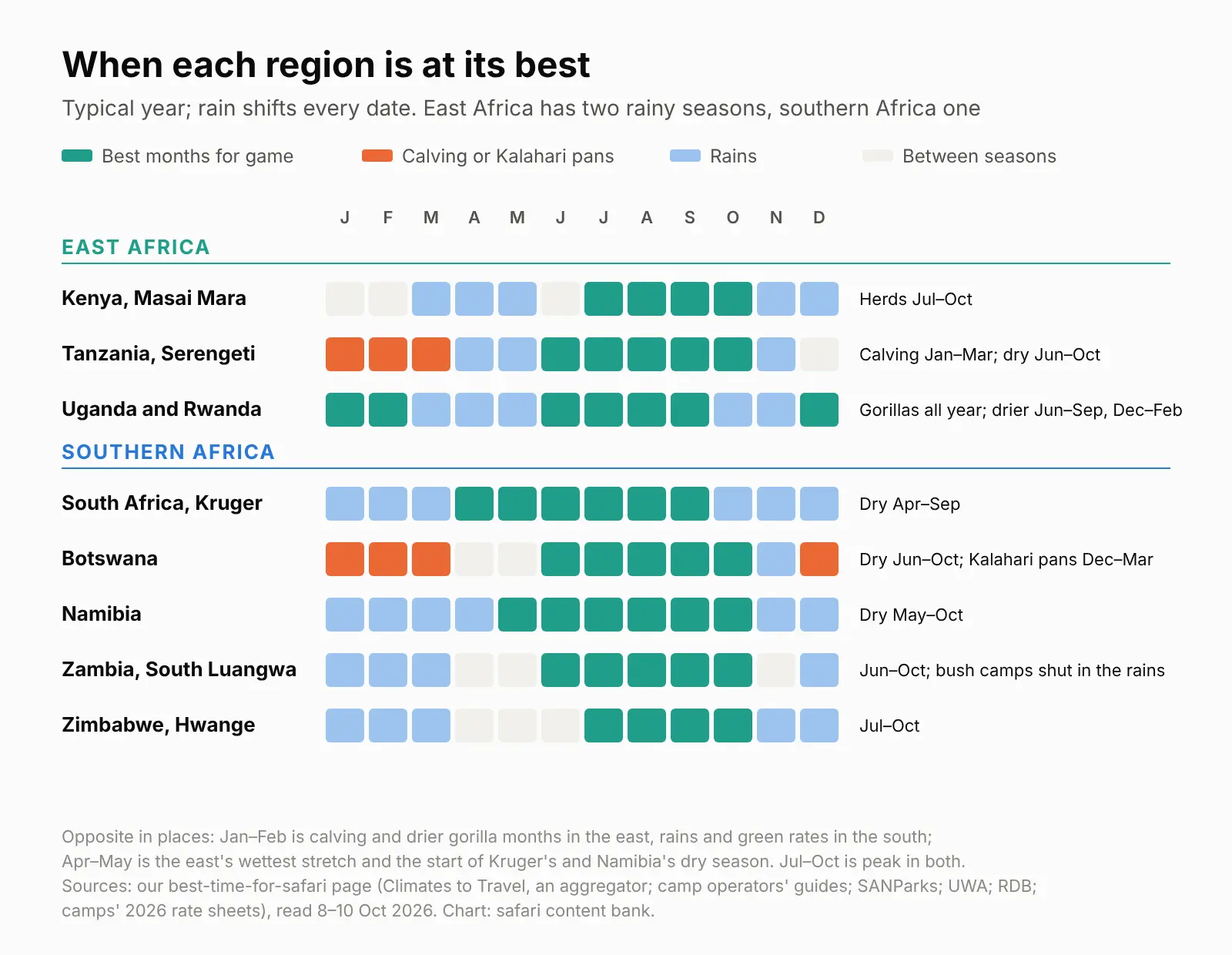 Typical year. Sources: our best-time-for-safari page (Climates to Travel, an aggregator; camp operators’ guides; SANParks; UWA; RDB; camps’ 2026 rate sheets), read 8–10 October 2026. Chart: safari content bank.
| Months | East Africa | Southern Africa | Better for game |
|---|---|---|---|
| January–February | Calving on the southern Serengeti plains, peaking at Ndutu in February; Bwindi rated “Excellent”; Mara fee US$100 | Rains; Kruger wet; South Luangwa bush camps closed; zebra on Botswana’s pans; lowest camp rates (Mombo US$3,062) | East |
| March | Last calves; long rains start | Botswana’s pans; Kruger’s last wet month | East (calving), barely |
| April–May | Wettest months (Masai Mara 210 mm in April); many Mara conservancy camps closed; Uganda permit US$600 | Kruger’s dry season starts in April, Namibia’s and Etosha’s in May; Victoria Falls at peak flow, about 3,000 m³/s in April | South |
| June | Grumeti River crossings, about the first half of June; gorilla parks drier | Dry season in Botswana, Zambia and Zimbabwe; Delta water at its highest | Both |
| July–October | Herds in the Masai Mara; Mara fee US$200 from 1 July | Game at the remaining water; top camp rates (Mombo US$5,345); October above 40°C at times in Botswana | Both: peak prices |
| November | Short rains; Uganda permit US$600; Rwanda permit discount starts | Rains start; South Luangwa bush camps close 15 November; Victoria Falls lowest, about 300 m³/s | Neither |
| December | Herds spread south toward Ndutu; gorilla parks drier; holiday rates from 20–21 December | Botswana’s pans; SANParks high season from 13 December | East, or Botswana’s pans |
Typical year, not a forecast, as on our best time for a safari page (sources read 8–10 October 2026). Herd months shift by weeks each year: Great Migration month by month. Fees: Narok County FY2025/26 schedule, the last published; UWA letter TDO 93/04.
- Peak months coincide in July–October, so a trip then pays the Mara’s US$200 fee in the east or the top camp rates in the south.
- Green season is cheaper in both. Governors’ Camp in the Mara falls from US$998 to US$453 a night in April–May; Mombo from US$5,345 to US$3,062 in January–March (green-season safari).
- Month guides: safari in January, February, April, May, November.
Cost per day by tier
At the budget end the regions overlap; at mid-range Southern Africa is cheaper (Namibia from US$336 a night); at the top Botswana is dearest, and Rwanda has the highest entry to luxury. All prices per person, sharing, land only, without international flights.
| Tier | East Africa | Southern Africa | Cheapest in each region |
|---|---|---|---|
| Cheapest published trip, per day | US$57–300: Kenya US$57–60 (park fees not included), Uganda about US$148, Rwanda about US$194, Tanzania US$220–300 (park fees included) | US$138–331: Namibia US$138–153, Zimbabwe about US$151, South Africa about US$214, Botswana about US$265, Zambia US$234–331 | East: Kenya, before fees; South: Namibia |
| Typical mid-range | US$406–1,090: Tanzania US$406–656, Uganda US$481–708, Kenya US$584–836 a night, Rwanda US$603–1,090 with gorillas | US$336–850: Namibia US$336–409, South Africa US$371–652, Zambia US$397–751 a night, Zimbabwe US$403–572, Botswana US$500–850 a night | East: Tanzania; South: Namibia |
| Luxury | US$578–3,085: Tanzania US$578–873, Kenya US$810–1,305 a night, Uganda US$1,081–2,023, Rwanda US$2,750–3,085 | US$731–5,345: Zambia US$731–1,840 a night, Zimbabwe US$733–1,788, South Africa US$1,250–1,980, Namibia US$1,407–1,590 a night, Botswana US$995–5,345 a night | East: Tanzania; South: Zambia |
Region ranges are our summary of the country ranges on safari cost per day by country (operators’ and lodges’ published prices, read 3 September–9 October 2026). “A night” marks a camp or lodge rate; per day is the trip price divided by its days. Prices do not compare like for like: Tanzania’s cheapest includes park fees, Kenya’s excludes them, and most operators don’t say. What each tier buys: budget vs mid-range vs luxury.
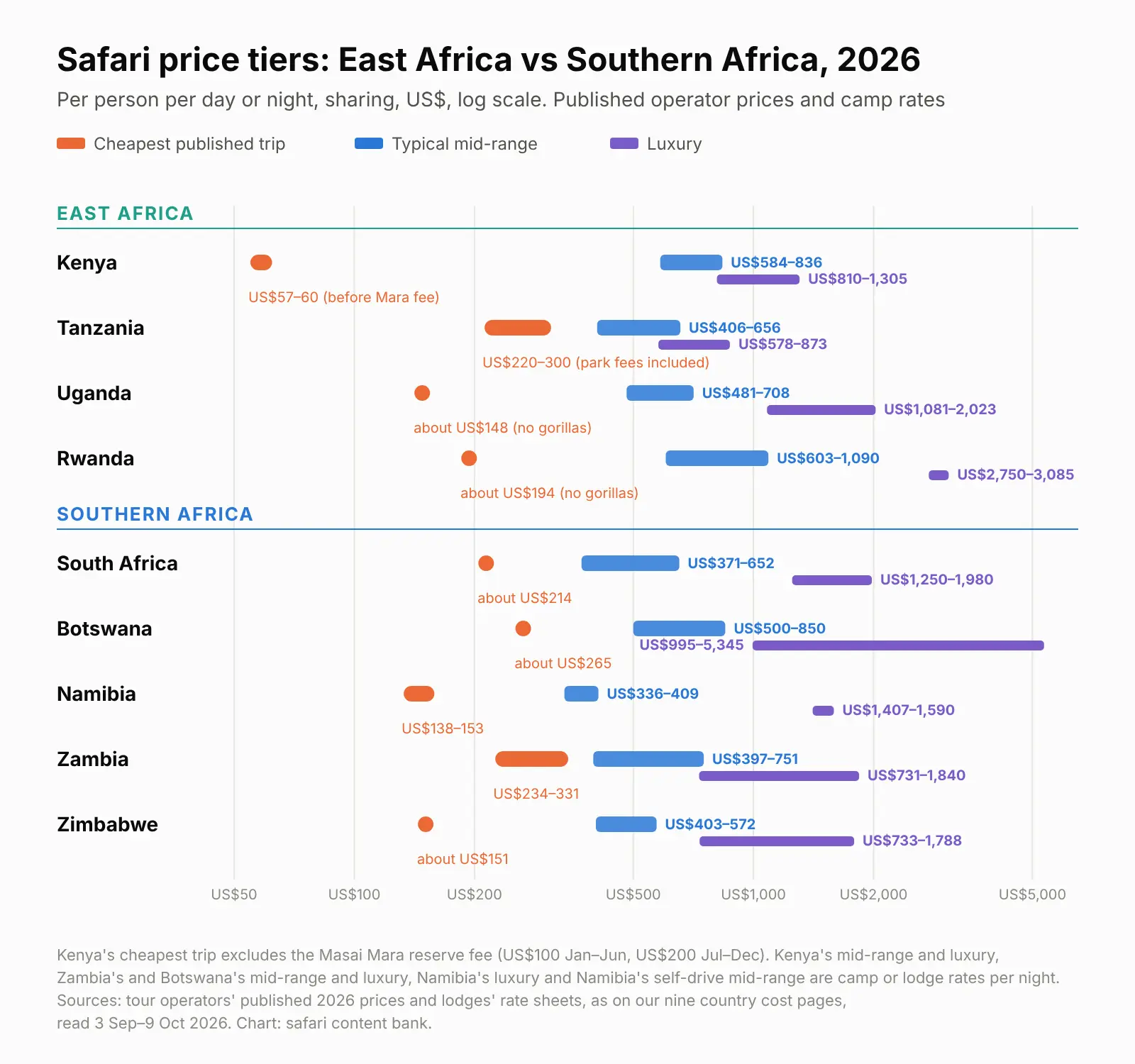 Operators’ published 2026 prices and lodges’ rate sheets, as on our nine country cost pages, read 3 September–9 October 2026. Chart: safari content bank.
- East Africa’s budget price hides the fee. With the July–December Mara fee added, Kenya’s US$57–60 a day becomes about US$257–260 (our sum: price per day + US$200). See the cheapest safari in Africa.
- Gorillas set East Africa’s mid-range. A Rwanda permit is US$1,500 per trek; on a 3-day trip that is US$500 a day (our sum). See gorilla trekking trip cost.
- Southern Africa’s top end is in the bed, not the gate. Botswana’s camps charge US$530–5,345 a night while the last published park fee is P270 a day. See luxury safari and fly-in safari cost.
Park fees: East Africa charges at the gate
Three days in the Masai Mara cost one foreign adult US$600 from July to December, against US$72 in Hwange and US$75 in South Luangwa (our sums), and East Africa’s gorilla permits are the dearest single fees of all. Kruger, Chobe and Etosha are priced in rand, pula and Namibian dollars, which we compare in their own currency.
| Region | Country, headline park | Fee per adult per day | 3 days, one foreign adult (our sums) | Fee page |
|---|---|---|---|---|
| East | Rwanda, Volcanoes | US$1,500 gorilla permit, per trek | US$1,500 (one trek) | Gorilla permit prices |
| East | Uganda, Bwindi | US$800 gorilla permit (US$600 in April, May and November); entry US$40 | US$880; US$680 in April, May, November | Uganda safari cost |
| East | Kenya, Masai Mara reserve | US$100 (1 Jan–30 Jun); US$200 (1 Jul–31 Dec) | US$600 Jul–Dec; US$300 Jan–Jun | Masai Mara park fees |
| East | Tanzania, Serengeti | US$82.60 entry; US$129.80–153.40 a night with the concession fee (last published tariff, 2023/24) | US$460.20 Jul–Sep; US$389.40 15 Mar–15 May (3 nights inside) | Serengeti park fees |
| South | South Africa, Kruger | R692 (R602 until 31 Oct 2026) | R2,076 from 1 Nov 2026; R1,806 until 31 Oct 2026 | Kruger park fees |
| South | Botswana, Chobe and Moremi | P270 (last published schedule, 1 April 2022; no official current tariff) | P810 at the last published fee | Botswana park fees |
| South | Namibia, Etosha | N$280 per foreign adult + N$60 per car | N$840, plus N$60 per car per entry | Etosha park fees |
| South | Zambia, South Luangwa | US$25 (DNPW 2025 schedule, last published); lodges bill US$90–110 a night | US$75 gate fee; lodges bill US$270–330 instead | Zambia safari cost |
| South | Zimbabwe, Hwange | US$24 day visitor, US$12 sleeping inside | US$72 day visitor; US$36 sleeping inside | Zimbabwe safari cost |
International or non-resident adult. Fees and 3-day sums copied from our cost and fee pages and safari cost per day by country, checked 8–10 October 2026. Etosha: we count one fee per park day, as MEFT’s 2021 schedule did. Rand, pula and Namibian dollars are not converted.
The official fee lines, with the date each took effect and the authority’s own source:
| Fee | Amount | In force from | Source |
|---|---|---|---|
| Serengeti and Nyerere National Parks, non-East African adult, entry per day, 16 May–14 Mar | USD 70 + 18% VAT = USD 82.60 | 1 Jul 2023 (2023/24 tariff, last published) | TANAPA Tariffs 2023/24 |
| Serengeti and Nyerere National Parks, non-East African adult, entry per day, 15 Mar–15 May | USD 60 + 18% VAT = USD 70.80 | 1 Jul 2023 (2023/24 tariff, last published) | TANAPA Tariffs 2023/24 |
| Serengeti and Nyerere, concession fee per person per night inside the park | Jul–Sep USD 60 + VAT = USD 70.80; Oct–Jun USD 50 + VAT = USD 59 | 1 Jul 2023 (2023/24 tariff, last published) | TANAPA Tariffs 2023/24 |
| Maasai Mara National Reserve, non-resident adult, per day (12-hour ticket, 06:00–18:00), 1 Jan–30 Jun | USD 100 | Since 1 Jan 2024; Narok County FY2025/26 schedule, the last published | Narok County fee schedule FY2025/26 |
| Maasai Mara National Reserve, non-resident adult, per day (12-hour ticket, 06:00–18:00), 1 Jul–31 Dec | USD 200 | Since 1 Jul 2024; Narok County FY2025/26 schedule, the last published, expired 30 Jun 2026 (no 2026/27 schedule as of 9 Oct 2026); The Kenya Times (6 Aug 2026, secondary) reports US$200 still applies for Jul–Dec 2026 | Narok County fee schedule FY2025/26 |
| Kruger National Park daily conservation fee, international adult (12+), per day | ZAR 602 | 1 Nov 2025 to 31 Oct 2026 (SANParks 2025/26 schedule) | SANParks daily conservation fees 2025/26 |
| Kruger National Park daily conservation fee, international adult (12+), per day | ZAR 692 | 1 Nov 2026 to 31 Oct 2027 (SANParks 2026/27 schedule, already published) | SANParks daily conservation fees 2026/27 |
| Chobe National Park and Moremi Game Reserve (DWNP), non-resident adult, per person per day | BWP 270 (SADC residents BWP 205; Botswana citizens and residents BWP 30) | Last published DWNP schedule, 1 April 2022 (via Tourism Update). In Feb 2026 the government news agency BOPA called the existing non-resident fee P380; a P500 rise was announced, then reported postponed. No official current tariff: confirm with DWNP or your operator | Tourism Update, 23 Feb 2022 (DWNP fee schedule) |
| Tier 1 parks (Etosha, Namib-Naukluft including Sossusvlei, Skeleton Coast, Ai-Ais/Fish River Canyon, Waterberg Plateau, Cape Cross, Dorob, Tsau //Khaeb), foreign adult 16+, per person | NAD 280 (NAD 140 park entrance + NAD 140 conservation fee) | 1 Apr 2026 (Government Notice 115 of 2026; the notice prices fees per person with no period; MEFT's 2021 schedule made fees valid for 24 hours from entry); was NAD 150 under the 2021 schedule | Government Gazette 8877 (Government Notice 115 of 2026), hosted by the Legal Assistance Centre |
| Vehicle up to 10 seats, most Namibian national parks (N$50 at Sandwich Harbour), per vehicle | NAD 60 | 1 Apr 2026 (Government Notice 115 of 2026; the notice states no period; MEFT's 2021 schedule made fees valid for 24 hours from entry); was NAD 50 | Government Gazette 8877 (Government Notice 115 of 2026), hosted by the Legal Assistance Centre |
| Uganda: gorilla tracking permit, Bwindi Impenetrable and Mgahinga Gorilla NPs, foreign non-resident, per person per trek (guide and that day's park entry included) | USD 800 (foreign resident USD 700; rest of Africa USD 500; East African citizens UGX 300,000) | Since 1 Jul 2024 (UWA tariff 2024–26); confirmed unchanged from 1 Jan 2027 by UWA letter TDO 93/04 of 26 Feb 2026 | UWA letter TDO 93/04, 26 Feb 2026 |
| Uganda: gorilla tracking permit in April, May and November (low season), foreign non-resident, per person per trek; cannot be rescheduled | USD 600 (foreign resident USD 500) | Immediate effect from the UWA letter of 26 Feb 2026 | UWA letter TDO 93/04, 26 Feb 2026 |
| Uganda: park entry, Queen Elizabeth, Bwindi, Mgahinga, Kibale, Kidepo Valley and Lake Mburo NPs, foreign non-resident adult, per 24 hours | USD 40 (child USD 20) | 1 Jul 2024 (UWA Conservation Tariff July 2024–June 2026, the last published park-entry rates; the 2026/27 letter does not cover park entry) | UWA Conservation Tariff July 2024–June 2026 |
| Rwanda: mountain gorilla tracking permit, Volcanoes NP, international visitor, per person per day | USD 1,500 | Current RDB price, checked 9 Oct 2026 | Visit Rwanda (Rwanda Development Board) |
| Akagera National Park, international adult, park entry per person | USD 100 for one night or day; USD 150 for two nights; USD 200 for three (child 6–12: USD 50 / 75 / 100; under 6 free) | 2024 price list, the latest we found (checked 8 Oct 2026) | African Parks, Akagera NP price list 2024 |
| Hwange National Park, Main Camp (row as labelled in the ZimParks 2026 tariff), international adult, conservation fee per day | USD 24 day visitor; USD 12 if staying overnight in the park (SADC USD 18 / 10; local USD 5 / 3) | ZimParks Tariff 2026 (tariff year 2026, published February 2026); the conservation-fee table does not say whether VAT is included; Robins, Sinamatella and Kazuma Pan are not listed separately in our sources | ZimParks De-Gazetted Tariff 2026 |
| South Luangwa and Lower Zambezi National Parks (DNPW Category A), international adult, entry per day (06:00–18:00) | USD 25 (SADC and resident USD 20; Zambian citizen ZMW 55.60); child 5–13 half price, under 5 free | DNPW 2025 schedule ("official 2025 rates"), the last published; page last modified 8 May 2025, still shown 9 Oct 2026 | DNPW 2025 fee schedule, as shown on a Zambia travel portal |
- Private land adds levies in both regions. Mara conservancies charge US$130 per adult (per night on Kicheche’s rate sheet, per day on Porini’s); Botswana camp levies run US$20–100 a night; Timbavati’s levy in Greater Kruger is R660 per adult per night (Mara reserve or conservancy; Kruger or the private reserves).
- Botswana’s fee is unsettled. In February 2026 the government news agency BOPA called the existing non-resident fee P380; a P500 rise was announced, then reported postponed. Confirm with DWNP or your operator.
- Fee detail by country: Kenya park fees, Tanzania park fees, Ngorongoro park fees, Namibia park fees, Chobe park fees, and how we source them: how we source fees.
Entry costs: visas, eTA and Tanzania’s insurance
A British adult pays nothing to enter South Africa, Botswana or Zambia, but up to US$74 for Kenya and US$94 for Tanzania (our sums), because both now add a compulsory government insurance or health policy to the visa or eTA.
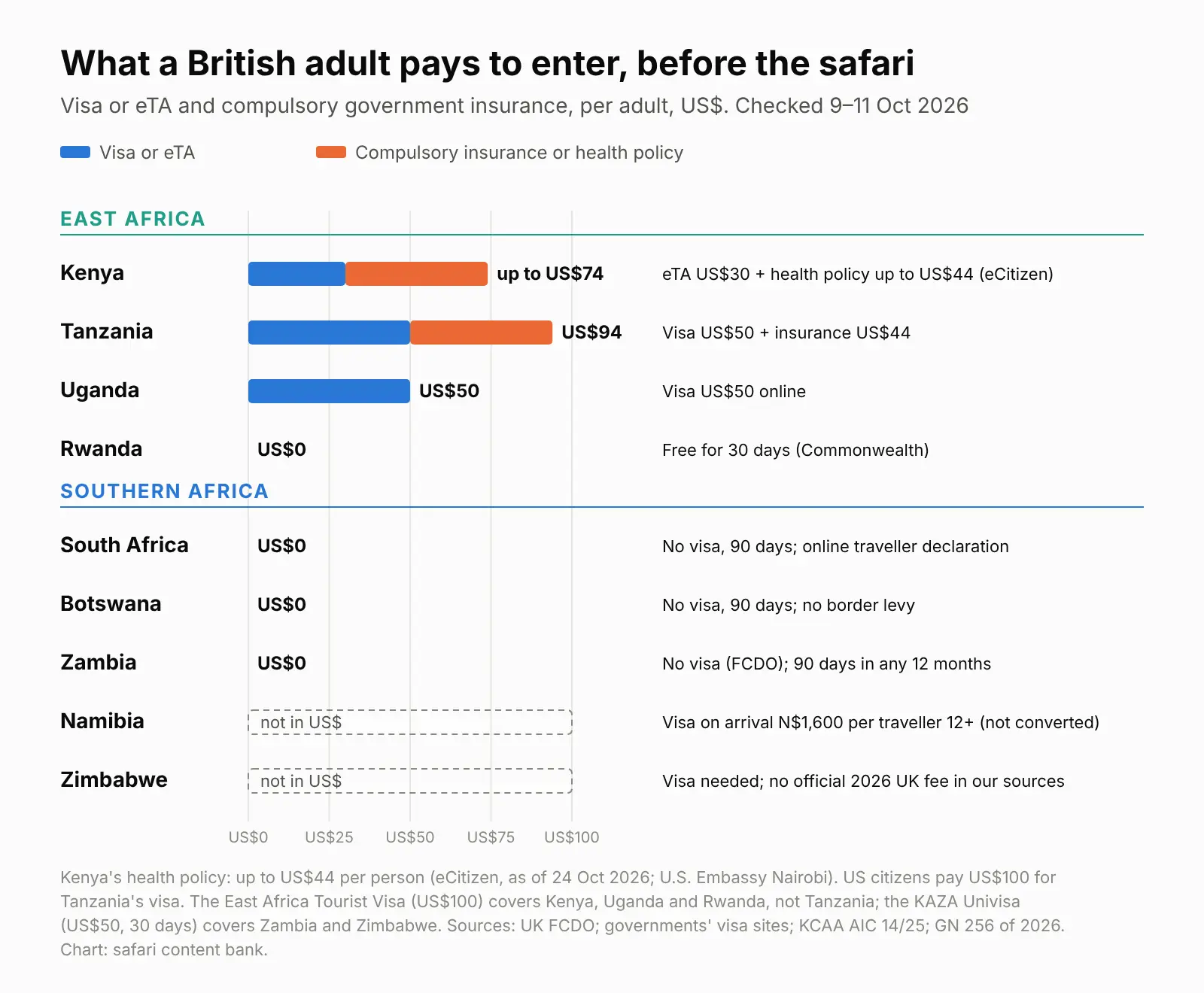 UK passport, adult, checked 9–11 October 2026. Sources: UK FCDO; KCAA AIC 14/25; eCitizen (Kenya health policy, as of 24 Oct 2026); Tanzania e-visa guidelines; GN 256 of 2026 via Clyde & Co; governments’ visa sites, as on our nine visa pages. Our sums. Chart: safari content bank.
| Country | Visa or entry document, UK passport | Compulsory insurance | Visa page |
|---|---|---|---|
| Kenya | eTA US$30 plus card charges, 3 working days; no visa on arrival | Government health policy, up to US$44 (eCitizen), required for arrivals since 5 October 2026 (U.S. Embassy Nairobi) | Kenya visa; Kenya visitor insurance |
| Tanzania | Visa US$50; US citizens US$100; one visa covers Zanzibar | US$44 per adult, 92 days (GN 256 of 2026); EAC and SADC residents exempt on the mainland; needed “even if” you have your own policy (UK FCDO, 20 Oct 2026) | Tanzania visa; Tanzania visitor insurance |
| Uganda | Visa US$50, online before travel | None in our sources | Uganda visa |
| Rwanda | Free for 30 days for Commonwealth citizens, British included; others up to US$50 | None set by the rules we checked | Rwanda visa |
| South Africa | None, 90 days; online traveller declaration since 1 July 2026 | None | South Africa visa |
| Botswana | None for British citizens, 90 days; US citizens not covered by name | None; no US$30 border levy | Botswana visa |
| Namibia | Visa on arrival N$1,600 per traveller aged 12+, since 1 April 2025 | None in our sources | Namibia visa |
| Zambia | None for UK or US passports (FCDO); British tourists 90 days in any 12 months | None in our sources | Zambia visa |
| Zimbabwe | Visa needed, on arrival or online; KAZA Univisa US$50 adds Zambia | None in our sources | Zimbabwe visa |
Checked 9–11 October 2026 on the governments’ visa sites and UK FCDO, as on our nine visa pages. Trade press (VisasNews) also lists Canadian, German, French, Italian, Spanish, Dutch and Belgian passports as visa-free for Zambia.
- Joint visas exist in both regions, and neither covers everything. The East Africa Tourist Visa (US$100, 90 days) covers Kenya, Uganda and Rwanda, not Tanzania; the KAZA Univisa (US$50, 30 days) covers Zambia and Zimbabwe.
- A Kenya and Tanzania trip costs a British adult up to US$168 to enter (our sum: US$30 + US$44 + US$50 + US$44); South Africa, Botswana and Zambia together cost nothing.
Malaria and health
WHO lists malaria risk all year in the whole of Kenya and Rwanda and in Tanzania below 1,800 m; in Southern Africa the risk is regional and seasonal, and South Africa has Big Five reserves outside the malaria area.
| Region | Country | Malaria (official sources) |
|---|---|---|
| East | Kenya | All year, whole country; low only in Nairobi and above 2,500 m (WHO) |
| East | Tanzania | All year below 1,800 m, Zanzibar included (WHO); the Ngorongoro crater rim is above it |
| East | Rwanda | All year, whole country (WHO) |
| East | Uganda | No official areas or months in our sources |
| South | South Africa | Kruger and Mapungubwe only, highest November–April (SANParks); malaria-free Big Five reserves in North West, the Waterberg and the Eastern Cape |
| South | Botswana | North high risk October–May, low June–September; south very low all year (TravelHealthPro) |
| South | Namibia | Six northern regions November–June, river areas all year (WHO); not the coast, Sossusvlei or the south |
| South | Zambia, Zimbabwe | No official areas or months in our sources; the US State Department recommends prophylaxis |
Sources: WHO country list 2022 (rev. 3 January 2023), UK TravelHealthPro, SANParks, as on safari malaria risk, read 8–10 October 2026. Which tablets to take is a decision for a travel clinic.
- Malaria-free is a South African option only: Madikwe, Pilanesberg, the Waterberg and Eastern Cape reserves such as Addo. It is not cheaper at the gate: Pilanesberg charges R748 per foreign adult a day (malaria-free safaris; Madikwe or Pilanesberg).
- Yellow fever links the two regions. Kenya is a yellow fever risk country, so going on from Kenya to Botswana or South Africa needs the certificate (yellow fever and safaris).
Can you combine East and Southern Africa?
Yes, but the regions are best paired within themselves. The usual combinations are Kenya + Tanzania, savanna + gorillas, and Victoria Falls with Botswana, Zambia or Zimbabwe (multi-country safari).
- Flights between the regions are not in our sources: we hold no Nairobi–Johannesburg timetable or fare and no direct flight between Kenya and Botswana, so check the live timetable.
- Carry a yellow fever certificate if you go on from Kenya or Uganda to the south.
- Entry costs stack: the Kenyan eTA and health policy or the Tanzanian visa and insurance on the East African leg; Namibia’s N$1,600 or a Zimbabwe visa or Univisa on the southern leg.
- Head-to-head guides across the two regions: Kenya vs Botswana, Kenya vs South Africa, Kenya vs Namibia, Kenya vs Zambia, Tanzania vs Botswana, Tanzania vs South Africa, Tanzania vs Namibia, Tanzania vs Zambia; by park: Serengeti vs Kruger, Kruger vs Masai Mara, Okavango Delta vs Serengeti.
Which region should you choose?
Start from the one thing you most want, then check the month. If the answer is a single country, best country for a safari narrows it down.
| If you want… | Choose | Why | Compare |
|---|---|---|---|
| The wildebeest migration or a river crossing | East Africa | Herds in the Masai Mara about July–October, in Tanzania the rest of the year | Kenya vs Tanzania |
| Calving season, January–March | East Africa | Calving peaks at Ndutu in February; it is the south’s rainy season | Serengeti calving season |
| Mountain gorillas | East Africa | Only Uganda (US$800) and Rwanda (US$1,500) | Uganda vs Rwanda for gorillas |
| A self-drive safari | Southern Africa | Kruger in an ordinary hire car; rooftop-tent 4x4s in Namibia | Namibia vs South Africa |
| No malaria tablets | Southern Africa | Malaria-free Big Five reserves in South Africa; East Africa’s parks have risk all year | Malaria-free safaris |
| Walking safaris and night drives inside a national park | Southern Africa | South Luangwa allows both; the Mara reserve sells neither | Walking safari |
| Water, mokoro and fly-in camps | Southern Africa | The Okavango Delta’s water is highest about May–August | Okavango Delta vs Serengeti |
| Victoria Falls with a safari | Southern Africa | Chobe 80 km and Hwange 200 km by road; KAZA Univisa US$50 | Victoria Falls and safari |
| The most rhino | Southern Africa | South Africa has 14,389, the most in Africa (end of 2024) | Where to see rhino |
| A safari in April or May | Southern Africa | Kruger’s and Namibia’s dry seasons start; East Africa’s long rains | Safari in April |
| The lowest entry costs | Southern Africa | South Africa, Botswana and Zambia charge British passports nothing | Entry costs, above |
| The cheapest mid-range trip | Southern Africa | Namibia’s self-drive with lodges, US$336–409 a night | Self-drive safari cost |
| A short first safari with little planning | Either | Nairobi → Mara 5.5–6 h on tarmac; Kruger by hire car | Kenya vs South Africa |
| A beach after the safari | East Africa | Zanzibar on the same Tanzanian visa; Kenya’s coast | Tanzania safari and Zanzibar; Kenya safari and beach |
| Cape Town and the winelands with a safari | Southern Africa | Pair the city with Kruger or a malaria-free reserve | Cape Town and safari |
New to safaris? See our first safari guide, and how to check a safari operator is licensed in either region.
Common mistakes when choosing between East and Southern Africa
| What you’ll often read | What is correct |
|---|---|
| “East Africa is the cheap option” | Kenya’s cheapest trip (US$57–60 a day) excludes park fees, and the Mara adds US$100–200 a day. Southern Africa has the cheapest mid-range: Namibia’s self-drive with lodges, US$336–409 a night. |
| “Southern Africa has no migration” | It has no wildebeest migration, but more than 20,000 zebra move between the Chobe floodplains and Nxai Pan. |
| “The safari season is the same everywhere” | Not outside July–October: January–February suits the east (calving), April–May the south (Kruger and Namibia’s dry season). |
| “Southern Africa is malaria-free” | Kruger is in a malaria risk area and northern Botswana is high risk October–May; only some South African reserves are malaria-free. |
| “One visa covers East Africa” | The East Africa Tourist Visa (US$100) covers Kenya, Uganda and Rwanda, not Tanzania, which also requires US$44 insurance. |
| “You can see gorillas anywhere in East Africa” | Only in Uganda and Rwanda among our nine countries. |
| “The KAZA Univisa covers Botswana” | It covers Zambia and Zimbabwe, with day trips into Botswana; a night in Botswana voids it. |
| “Kruger costs R602 a day” | That was the 2025/26 rate, which ended on 31 October 2026. Since 1 November 2026: R692 per international adult per day. |
| “Botswana is expensive because of park fees” | The last published fee is P270 a day in Chobe and Moremi; the price is in the bed: camps charge US$530–5,345 a night. |
Frequently asked questions
Is East Africa or Southern Africa better for a safari? It depends on what you want to see. East Africa (Kenya, Tanzania, Uganda, Rwanda) has the wildebeest migration and the only mountain gorillas. Southern Africa (South Africa, Botswana, Namibia, Zambia, Zimbabwe) has self-drive, the Okavango Delta’s fly-in camps, walking safaris in South Luangwa, Victoria Falls, malaria-free Big Five reserves and most of Africa’s rhino.
Which is cheaper, East or Southern Africa? At the budget end they overlap: Kenya’s cheapest trip is US$57–60 a day before the Mara fee of US$100–200, and Namibia’s US$138–153. At mid-range Southern Africa is cheaper, from US$336 a night on a Namibian self-drive with lodges against US$406 a day on a private Tanzanian safari. At the top Botswana is dearest (Mombo up to US$5,345 a night). East Africa also charges more at the gate and to enter. Full ranking: safari cost per day by country.
When is the best time for a safari in East and Southern Africa? July to October in both, which is also peak price. January–February favours East Africa, with calving at Ndutu and drier gorilla months, while the south is in its rains. April–May favours the south, when Kruger’s and Namibia’s dry seasons start and East Africa has its long rains. Month by month: best time for a safari.
Can I see the Great Migration in Southern Africa? No. The wildebeest migration moves between Tanzania’s Serengeti and Kenya’s Masai Mara, where the herds usually are from July to October. Southern Africa’s migration is zebra: more than 20,000 move between the Chobe floodplains and Nxai Pan in Botswana (Africa Geographic).
Is there a malaria-free safari in East Africa? Not in our sources. WHO lists risk all year in the whole of Kenya and Rwanda and in Tanzania below 1,800 m. South Africa is the region with malaria-free Big Five reserves, such as Madikwe, Pilanesberg and Eastern Cape reserves like Addo. See safari malaria risk.
Can I self-drive a safari in East Africa? It is legal in Kenya and possible in Tanzania and Uganda, but forum regulars advise first-timers against it, private vehicles have been banned from game drives in the Masai Mara reserve since 3 June 2024, and a licensed guide is required in Ngorongoro Crater. Southern Africa is the self-drive region: Kruger in an ordinary hire car, Namibia in a rooftop-tent 4x4.
Do I need a visa for East or Southern Africa? For a British passport: an eTA (US$30) for Kenya, a visa (US$50) for Tanzania and Uganda, and none for Rwanda for 30 days. Kenya also requires a health policy of up to US$44 (eCitizen) and Tanzania US$44 insurance. South Africa, Botswana and Zambia need no visa; Namibia charges N$1,600 on arrival and Zimbabwe needs a visa.
Can I do gorillas and Victoria Falls on one trip? Yes, but they are in different regions: gorillas in Uganda or Rwanda, the Falls between Zimbabwe and Zambia. Our sources hold no direct flight between the two regions’ safari hubs, so check the live timetable and carry a yellow fever certificate if you go on from Uganda or Kenya. See multi-country safari.
Sources
- Our nine country hubs and cost pages, where every price and fee above is itemised with its link and read date: Kenya, Tanzania, Uganda, Rwanda, South Africa, Botswana, Namibia, Zambia, Zimbabwe; safari cost per day by country
- Narok County, Maasai Mara fee schedule FY2025/26 (PDF), the last published; TANAPA, Tariffs 2023/24 (PDF), the last published tariff
- SANParks, daily conservation fees 2025/26 (PDF) and 2026/27 (PDF); SANParks, Kruger malaria
- DWNP schedule effective 1 April 2022, via Tourism Update, 23 Feb 2022; Botswana Daily News (BOPA), 24 Feb 2026
- Namibia, Government Gazette 8877 (Government Notice 115 of 2026), hosted by the Legal Assistance Centre
- Uganda Wildlife Authority, tariff 2026/27, letter TDO 93/04 (PDF) and Conservation Tariff July 2024–June 2026 (PDF); Rwanda Development Board, Visit Rwanda: gorilla tracking; African Parks, Akagera price list 2024 (PDF)
- ZimParks, De-Gazetted Tariff 2026 (PDF); a safari agent’s guide to park entry fees, read 11 October 2026 (DNPW 2025 schedule, the last published)
- Entry, checked 9–11 October 2026: Kenya Civil Aviation Authority, AIC 14/25 (PDF); Tanzania Immigration, e-visa guidelines; Clyde & Co, 16 Sep 2026 (GN 256 of 2026); UK FCDO entry requirements for Tanzania, Botswana, Zambia and Zimbabwe; U.S. Embassy Nairobi and eCitizen (Kenya health policy); VisasNews (Zambia, trade press); Uganda e-visa and Uganda Immigration, EATV; Rwanda Directorate General of Immigration and Emigration; Namibia MHAISS visa on arrival; South Africa Home Affairs; a safari agent’s guide, 7 Jan 2026 (KAZA Univisa); all as on our nine visa pages
- Health: WHO, country list 2022, rev. 3 Jan 2023 (PDF); UK TravelHealthPro, Botswana; yellow fever rules as on our yellow fever page
- Wildlife: TAWIRI 2023 wildebeest census (PDF); Africa Geographic, zebra migrations; IUCN SSC African and Asian Rhino Specialist Groups and TRAFFIC, report to CITES CoP20 (2025), national rhino counts at the end of 2024, as on where to see rhino; one operator’s Botswana wildlife statistics
- Seasons: our best time for a safari page (camp operators’ migration and seasonal guides; Climates to Travel, an aggregator; camps’ 2026 rate sheets; Time + Tide)
- Travel: Botswana Tourism, game viewing; Mombasa Air Safari 2026; Wilderness, Mombo; Governors’ 2026; Kicheche 2026 (PDF); SANParks walks (2024/25 tariff), as on walking safari cost
- Tour operators’ published 2026 package prices (names and links kept in our editor notes), read 3 September–9 October 2026
- Traveller reports (opinion and experience, not official findings): TripAdvisor forums, via our Kenya and Tanzania questions pages
Prices and fees checked 9–10 October 2026 against our country cost pages; visas checked 9–11 October 2026; SANParks fees checked 1 November 2026. We will update this page when Narok County publishes a 2026/27 Mara schedule, when TANAPA or DWNP publishes a new tariff, when Kenya publishes an official health-policy price, and when a country cost page changes a headline price or fee. More: Kenya, Tanzania, Uganda, Rwanda, South Africa, Botswana, Namibia, Zambia, Zimbabwe.